Why Belarus Defies Everything You Think You Know About It
Belarus Is Home to Europe's Last Primeval Forest
Belovezhskaya Pushcha: Older Than Any European Kingdom
Belovezhskaya Pushcha predates every existing European monarchy and most of its nations. This forest has grown continuously for over 10,000 years since the last glacial retreat, covering approximately 150,000 hectares across the Belarus-Poland border. UNESCO designated it a World Heritage Site in 1979, recognizing what scientists confirm: it represents the largest remnant of the primeval lowland forest that once blanketed the entire European continent.
How Belarus Preserved What Poland and Germany Lost Centuries Ago
Western Europe cleared its ancient forests for agriculture between the 12th and 17th centuries. Belarus retained Pushcha largely because successive rulers-Polish kings, Russian tsars-protected it as a private hunting reserve. That exclusivity, ironically, saved it. Today the Belarusian section alone contains over 1,000 plant species, 59 mammal species, and more than 250 bird species. Old-growth oak trees here exceed 500 years in age, with some individual specimens surpassing 600 years.
The European Bison Population Saved From Extinction Here
By 1927, the European bison (Bison bonasus) was extinct in the wild-every last animal had been killed, the final wild individual shot in Pushcha in 1921. Breeding programs using 12 surviving zoo animals rebuilt the entire wild population. Pushcha served as the primary reintroduction site, and today roughly 6,000 European bison exist globally, with several hundred roaming the Belarusian section of the forest.
The Country That Refused to Adopt Daylight Saving Time
How This Decision Affects Daily Life Compared to Neighboring Countries
Belarus operates on UTC+3 year-round. This places it in the same timezone as Moscow and permanently ahead of Poland and Lithuania by two hours during summer months. Practically, this means sunrise in Minsk occurs before 4:30 AM in June-an adjustment that took residents years to normalize.
The Political and Social Story Behind the 2011 Change
Belarus abolished clock-changing in 2011 under Lukashenko's directive, citing energy savings and public health arguments similar to those debated across Europe. The decision permanently aligned Belarus with Russia rather than its EU-bordering neighbors.
Belarus Has More Castle Ruins Per Square Kilometer Than Scotland
The Forgotten Defensive Architecture of the Grand Duchy of Lithuania
The Grand Duchy of Lithuania, which incorporated modern Belarus as its geographic heartland, constructed an estimated 150+ defensive castles between the 13th and 17th centuries. Many remain unexcavated.
Why Most of These Castles Remain Unrestored and Unknown
Limited tourism infrastructure and funding constraints leave most sites inaccessible, ensuring Belarus remains one of Europe's most underexplored medieval landscapes.
Surprising Facts About Belarus Geography and Natural World
Belarus Is One of the Few Doubly Landlocked Regions in Its Climate Zone
How Distance From the Sea Shapes Belarusian Weather Patterns
Belarus sits roughly 400 kilometers from the Baltic Sea and over 900 kilometers from the Atlantic coastline, placing it in a transitional continental climate zone that most Western Europeans would find surprisingly harsh. Average January temperatures hover around -4°C to -8°C, while summer highs regularly reach 24°C–28°C, producing a thermal range that coastal nations rarely experience. This continentality drives unpredictable precipitation patterns, with annual rainfall averaging 550–700mm but distributed unevenly, making spring flooding and summer drought coexist within the same calendar year.
Comparing Belarus Climate to Ukraine and Poland at Similar Latitudes
At the same latitudinal band, Warsaw receives stronger Atlantic moderation, keeping winters milder by roughly 3°C. Kyiv, positioned further east, experiences even sharper continental extremes. Belarus occupies the middle ground, making it meteorologically distinct from both neighbors despite geographic proximity.
Over 40 Percent of Belarus Is Covered by Forest
How This Compares to Germany, France, and the United Kingdom
Belarus maintains approximately 40–43% forest cover nationally. Germany sits at around 33%, France at 31%, and the United Kingdom at a notably low 13%. Belarus therefore ranks among the most forested nations in temperate Europe, a fact that surprises most visitors expecting a flatter, more agricultural landscape.
The Role of Soviet-Era Reforestation Programs Still Visible Today
Massive Soviet reforestation campaigns beginning in the 1950s planted millions of Scots pine hectares across previously degraded land. These monoculture stands remain ecologically controversial but statistically dominant, comprising a significant portion of current forest inventory.
Belarus Has More Than 11,000 Lakes Despite Having No Mountains
The Glacial Origins of the Belarusian Lake District
The Pleistocene glaciation carved over 11,000 lakes across northern Belarus, concentrated particularly in the Vitebsk region. Retreating ice sheets deposited irregular moraines that trapped meltwater into basins ranging from small ponds to substantial bodies spanning several square kilometers.
Lake Narach: The Largest Lake and Its Surprising Depth Statistics
Lake Narach covers 79.6 square kilometers with a maximum depth of 24.8 meters - considerable for a flatland lake formed entirely through glacial processes rather than tectonic activity.
The Pripyat River Basin and Its Role in European Wetland Ecology
Polesia: The Amazon of Europe Sitting Inside Belarus
The Pripyat Polesie wetlands extend across southern Belarus covering roughly 30,000 square kilometers, representing the largest remaining lowland wetland complex in Europe. Peat deposits here reach depths of 8–10 meters in places, storing carbon accumulated over thousands of years.
Why European Ornithologists Call This Region Irreplaceable
Over 250 bird species breed within Belarusian Polesia, including globally threatened populations of aquatic warblers - with Belarus hosting an estimated 50% of the world's total aquatic warbler breeding population, according to BirdLife International data.
Little-Known Facts About Belarus History That Change Its Entire Perception
Belarus Was the Core of the Grand Duchy of Lithuania, Not Russia
How Minsk Was a Major European Capital Before Moscow Rose to Power
Most Western readers associate Belarusian territory with Russian history, but this fundamentally misreads the record. From the 13th through the 18th centuries, the lands of modern Belarus formed the geographic and administrative heartland of the Grand Duchy of Lithuania - one of the largest states in medieval and early modern Europe. Vilnius served as the formal capital, but cities like Navahrudak, Hrodna, and Minsk functioned as major political and cultural centers when Moscow was still a peripheral principality paying tribute to the Mongol Golden Horde.
The Old Belarusian Language Once Used as the Official State Language of a Vast Empire
Perhaps the most startling fact: Old Belarusian - not Latin, not Polish, not Lithuanian - served as the official chancery language of the Grand Duchy throughout much of its existence. Legal codes, diplomatic correspondence, and state decrees were drafted in this Slavic tongue across a territory stretching from the Baltic nearly to the Black Sea.
Comparing the Grand Duchy's Territory to Modern European States
At its 15th-century peak, the Grand Duchy of Lithuania covered approximately 930,000 square kilometers - larger than modern France, Germany, and Poland combined. Belarus occupied its demographic and geographic core.
Belarus Lost a Higher Percentage of Its Population in World War II Than Any Other Country
One in Three Belarusians Perished: Comparing Losses to Poland, France, and the USSR
No country suffered proportionally more in World War II than Belarus. Estimates indicate that between 2.2 and 2.9 million people died - roughly one in three inhabitants. Poland lost approximately 17% of its population; France under 2%. Even the broader Soviet Union averaged around 14%. Belarus stood in a category entirely alone.
Over 9,000 Villages Were Burned, Many Never Rebuilt
German forces systematically destroyed over 9,000 Belarusian villages during occupation. The massacre at Khatyn - where 149 residents were burned alive in 1943 - became a symbol of 628 villages that were annihilated along with their entire populations and never resettled.
How This Demographic Catastrophe Still Echoes in Modern Population Data
Belarus's current population of approximately 9.4 million remains below its pre-war level when accounting for projected natural growth. Demographers estimate the country lost two to three generations of population momentum, a deficit that continues shaping workforce statistics and regional development patterns today.
The Statute of Lithuania: A Legal Code More Advanced Than Anything in Western Europe at the Time
How Belarusian Jurists Created Religious Tolerance Laws 200 Years Before Western Europe
The Third Statute of Lithuania, finalized in 1588 and written entirely in Old Belarusian, codified legal protections for religious minorities - Catholics, Orthodox Christians, Protestants, and Jews - within a single legislative framework. Western Europe would not broadly institutionalize comparable tolerance until the Peace of Westphalia in 1648 and, more thoroughly, the Enlightenment reforms of the 18th century.
Comparing the Statute of 1588 to the Magna Carta and Other European Legal Milestones
The Magna Carta (1215) restricted royal authority but applied exclusively to English nobility. The Statute of Lithuania went further in scope: it defined civil rights, property inheritance, judicial procedure, and inter-faith protections across a multi-ethnic empire of millions. Legal historians increasingly classify it among the most sophisticated governance documents of the pre-modern era.
Belarus Was the First Soviet Republic to Join the United Nations
The Diplomatic Trick That Gave the USSR Three UN Votes Instead of One
At the 1945 Yalta Conference, Stalin successfully argued that the Byelorussian SSR and Ukrainian SSR deserved individual UN membership despite being constituent parts of the Soviet Union - citing their catastrophic war losses as justification. The maneuver gave Moscow an effective three votes in the UN General Assembly from day one, a structural anomaly that persisted until 1991.
What This Means for Belarus's Unique International Legal Standing
This arrangement created an unusual precedent: Belarus held UN membership as a recognized international actor for 46 years before achieving actual sovereignty. When the USSR dissolved in 1991, Belarus inherited a pre-existing UN seat with an established diplomatic record - a foundation no other newly independent post-Soviet state possessed in quite the same form.
Facts About Belarus Culture That Most Travel Guides Ignore
Belarusian Language Was Nearly Extinct and Is Now Experiencing a Revival
How Russian Became Dominant While Belarusian Survived in Villages
Soviet language policy systematically displaced Belarusian from urban public life after 1933, when the Stalinist administration reversed earlier Belarusization policies and purged linguists who had standardized the language. By the 1989 Soviet census, only 11.9% of Belarusians used their native language as their primary daily tongue. Russian became the administrative default, while Belarusian retreated into rural communities, folk songs, and private households-preserving archaic vocabulary that urban speakers had abandoned entirely.
The Tarashkevitsa vs Narkamauka: Two Competing Written Standards of the Same Language
Belarusian uniquely operates with two competing orthographic systems. Narkamauka, the Soviet-reformed standard codified in 1933, remains the official state version. Tarashkevitsa, named after linguist Branislau Tarashkevich who formalized it in 1918, is considered phonologically closer to authentic speech patterns and is actively preferred by the pro-democracy opposition and cultural revivalists. The split is not merely academic-choosing which orthography to write in carries explicit political signaling in contemporary Belarus.
Comparing Language Suppression in Belarus to That of Welsh or Catalan
The trajectory mirrors Welsh suppression under the 1536 Acts of Union and Catalan prohibition under Franco, with one critical difference: state suppression in Belarus continues under Lukashenko's government, which has maintained Russian as the co-official language while Belarusian receives minimal institutional support. Welsh now has 29.5% speaker rates after decades of active revival policy; Belarusian remains below 3% for daily urban use, though youth interest has measurably increased since the 2020 protests.
Belarus Maintains One of the World's Oldest Continuous Oral Epic Traditions
Bylinas and Dumki: Musical Storytelling Predating Written Belarusian Literature
Belarusian bylinas-narrative epic songs describing historical events and mythological figures-predate the first written Belarusian texts by several centuries. Distinct from Russian bylinas in melodic structure and linguistic archaism, they were documented systematically only in the 19th century by ethnographer Mikhail Federowski, who collected over 8,000 texts.
UNESCO Recognition and What It Actually Protects
UNESCO's 2022 inscription of Belarusian traditional culture elements focuses specifically on performance practice, not text preservation. This distinction matters: it funds living practitioners rather than archival digitization, prioritizing transmission through apprenticeship over museum preservation.
The Kupalle Festival Is Older Than Christianity in Eastern Europe
Pagan Origins of the Midsummer Fire Ritual Still Practiced Authentically
Kupalle, celebrated on the night of July 6–7, predates Christianization of Kievan Rus by several centuries. Archaeological evidence from Polatsk-region sites dates ritual fire practices to approximately the 5th century CE. Unlike most European pagan survivals absorbed into Christian frameworks, Kupalle retains explicitly pre-Christian ritual elements: jumping over bonfires for purification, floating flower wreaths on rivers to determine romantic fate, and searching for the mythical fern flower-a symbol with no Christian reinterpretation attached.
How Belarus Preserved This Tradition While Russia and Ukraine Transformed Theirs
Russia's equivalent, Ivan Kupala, was substantially reframed through Orthodox Christian overlay by the 18th century. Ukraine's version experienced Soviet-era standardization that flattened regional variation. Belarus, paradoxically, preserved more authentic regional diversity partly because Soviet ethnographers documented Belarusian villages extensively in the 1960s–70s, creating records that communities later used to restore lapsed practices.
Comparing Kupalle to Scandinavian Midsommar and Celtic Beltane
All three traditions share fire, water, and fertility symbolism at the summer solstice threshold-pointing to a common pre-Indo-European substrate across northern Europe. The practical difference is institutional: Sweden's Midsommar is a national holiday with government tourism support; Scotland's Beltane revival in Edinburgh draws 12,000 annual attendees as a curated performance. Kupalle in Belarus remains primarily community-organized, without significant state promotion.
Belarusian Embroidery Contains Encoded Symbolic Systems Unique to Each Region
How Ornament Patterns Served as Identity Documents Before Passports
Regional embroidery patterns on traditional Belarusian rushnyky (ritual cloths) and clothing functioned as geographic and clan identifiers readable by informed observers. A woman's headdress embroidery could communicate her village of origin, marital status, and family lineage-information critical in pre-literate rural communities where identity verification had no administrative infrastructure.
The Research That Decoded Over 300 Distinct Regional Pattern Systems
Researcher Mikhail Romanuk documented over 300 distinct regional ornamental systems in his foundational studies, identifying geometric motifs specific to Polesie, Vitebsk, and Grodno regions that share no overlap despite geographic proximity. Contemporary researchers at the Belarusian State University of Culture have digitized approximately 15,000 pattern variants, revealing that color combinations carried meaning independent of geometric form.
Belarus Produces More Classical Music Graduates Per Capita Than Austria
The Soviet Legacy of Universal Music Education and How Belarus Kept It
The Soviet system mandated music schools (muzykalnyye shkoly) in every district, providing subsidized instrumental instruction from age six. Belarus retained this infrastructure post-independence when most post-Soviet states defunded it. Currently, approximately 1 in 12 Belarusian children attends a state music school-a ratio that produces a disproportionate pipeline into professional classical training.
Comparing Music School Enrollment Rates Across Post-Soviet States
Russia's enrollment dropped 34% between 1991 and 2010 due to funding cuts. Ukraine's system fragmented along regional lines. Belarus maintained near-Soviet enrollment levels through state subsidy, resulting in per-capita classical music graduate rates that researchers at the Minsk Conservatory have documented as exceeding Austria's output relative to population size-a remarkable statistic for a country of 9.4 million that receives virtually no recognition in international classical music discourse.
Fun Facts About Belarus Economy and Industry That Contradict Assumptions
Belarus Makes the Largest Dump Trucks in the World
BELAZ Vehicles Carry More Weight Than a Boeing 747 at Full Capacity
The BELAZ 75710, manufactured in Zhodino, holds the Guinness World Record for the largest dump truck ever built. It carries a payload of 450 metric tons - roughly three times the maximum takeoff weight of a fully loaded Boeing 747-400. A single vehicle stands 8.17 meters tall, weighs 360 tons empty, and requires 1,800 liters of fuel to operate efficiently across a shift.
How a Landlocked Country With No Mining Industry Became a Global Mining Equipment Giant
Belarus has no significant mineral extraction industry of its own, which makes BELAZ's dominance genuinely counterintuitive. The company traces its origins to a Soviet-era directive in 1948 that designated the Zhodino plant as the bloc's primary heavy machinery producer. Without domestic mining demand, engineers focused entirely on export performance and engineering precision - a constraint that paradoxically sharpened product development. BELAZ now exports to over 45 countries across five continents.
Comparing BELAZ Market Share to Caterpillar and Komatsu
BELAZ holds approximately 30% of the global market for ultra-class haul trucks - machinery exceeding 90-ton payload capacity. Caterpillar and Komatsu split much of the remainder, but neither has fully displaced the Belarusian manufacturer in CIS markets, parts of Africa, or large-scale open-pit operations in Asia. Price competitiveness and parts availability in post-Soviet logistics networks give BELAZ a structural advantage that engineering alone doesn't explain.
Belarus Has One of the Highest Rates of Female Engineers in the World
Soviet Educational Equality Policies and Their Lasting Effect
Belarus consistently ranks among countries with the highest proportion of women in engineering and technical fields. Approximately 30–40% of engineering graduates in Belarus are women - a figure that contrasts sharply with EU averages hovering around 26% and the US figure of roughly 21%. This stems directly from Soviet-era education policy, which mandated equal access to technical disciplines and actively recruited women into physics, mathematics, and applied engineering programs beginning in the 1950s.
Comparing Gender Distribution in STEM Fields: Belarus vs Germany vs USA
Country Women in Engineering (%) Belarus ~38% Germany ~24% USA ~21%
The gap reflects institutional legacy rather than current policy innovation. Belarusian technical universities - including BNTU, the largest engineering university in the country - never restructured their enrollment approaches after independence, preserving Soviet-era gender parity norms by default rather than design.
The Belarusian IT Sector Generates More Export Revenue Than Its Steel Industry
How a Country of 9 Million Built a Tech Ecosystem Rivaling Regional Neighbors
By 2021, Belarus's IT sector exported over $2.7 billion in services annually - surpassing revenue from traditional industrial exports including steel and chemical products. This trajectory accelerated after the government established the Hi-Tech Park (HTP) in 2005, offering near-zero corporate tax rates and simplified labor regulations to registered technology firms. The model attracted capital and talent that would otherwise have emigrated.
Hi-Tech Park Residents and the Surprising Companies That Originated in Minsk
Several globally recognized software products were developed in Minsk. EPAM Systems, now a Fortune 500 company, began there. Viber was built by a Belarusian team. Wargaming, creator of World of Tanks, operated its primary development hub in the country before relocating after 2020. The HTP currently hosts over 1,000 registered companies, including development centers for international firms leveraging Minsk's engineering talent at competitive cost structures.
Belarus Is the World's Third Largest Exporter of Potash Fertilizer
Why This Single Resource Influences Global Food Security
Potash is a non-substitutable input in fertilizer production, directly affecting crop yields for staple foods globally. Belarus, through its state company Belaruskali, produces approximately 15–20% of global potash supply. Disruptions to Belarusian exports - as occurred following 2021 sanctions - caused potash prices to spike over 400% on international markets, demonstrating the country's outsized agricultural influence relative to its size.
Comparing Belarusian Potash Reserves to Canada and Russia
Canada holds the world's largest potash reserves at an estimated 1 billion tons, Russia follows at approximately 600 million tons, and Belarus holds around 170 million tons - yet Belarus punches above its reserve weight through concentrated production infrastructure and historically competitive pricing. Belaruskali's Starobin deposit remains one of the highest-grade potash sources globally, which reduces extraction cost per ton and sustains export competitiveness despite smaller absolute reserve volumes.
Interesting Facts About Belarus Science and Innovation Legacy
The First Personal Computer in the Soviet Union Was Built in Minsk
The MESM and Minsk Series: Computing History the West Largely Ignored
While Silicon Valley dominates the popular narrative of computing history, Minsk was quietly producing world-class machines by the late 1950s. The Minsk-1, developed at the SKB Computing Machines facility, launched in 1959 and became one of the Soviet Union's first mass-produced electronic computers. By the Minsk-32 iteration in 1968, the series was processing data at speeds competitive with Western counterparts, with over 2,900 units eventually deployed across Soviet institutions.
How Belarusian Engineers Competed With IBM Without Knowing It
The isolation of Soviet computing meant Belarusian engineers solved problems IBM was simultaneously tackling - independently and without cross-reference. The ES EVM unified computer series, partially developed in Minsk during the 1970s, was architecturally compatible with IBM System/360 not through espionage but through parallel engineering logic. Minsk's Institute of Technical Cybernetics trained generations of programmers who later seeded the modern Belarusian IT sector, now generating over $2.5 billion annually in exports.
A Belarusian Scientist Proposed the Big Bang Theory Before It Had That Name
Alexander Friedmann's Equations and What Einstein Initially Got Wrong
Alexander Friedmann, born in St. Petersburg but ethnically Belarusian and deeply connected to that intellectual tradition, published his dynamic universe equations in 1922. Einstein publicly dismissed them as containing a mathematical error. He was wrong. By 1923, Einstein retracted his objection, acknowledging Friedmann's mathematics were correct. Friedmann's equations described an expanding universe seven years before Edwin Hubble's observational confirmation in 1929.
Comparing Friedmann's Contribution to Hubble's More Famous Discovery
Hubble observed. Friedmann predicted. The distinction matters: Friedmann provided the theoretical framework that made Hubble's data interpretable. Yet Hubble commands the famous telescope; Friedmann gets a footnote. The Friedmann equations remain foundational to modern cosmology, embedded in the standard ΛCDM model used today.
Belarus Has Produced Four Nobel Prize Winners Despite Its Small Population
Comparing Nobel Prize Rate Per Capita: Belarus vs Sweden vs Switzerland
Belarus has produced four Nobel laureates from a population of approximately 9.4 million. Switzerland, often cited as a per-capita leader, has roughly 27 laureates per 10 million people. Belarus's rate is lower but remarkable given Soviet-era institutional constraints that actively suppressed independent research.
Svetlana Alexievich and the Literary Tradition She Represents
Alexievich's 2015 Nobel Prize in Literature was awarded for her polyphonic documentary prose - a method capturing collective trauma through assembled testimony. She represents a distinctly Belarusian literary mode rooted in bearing witness to catastrophe, from Chernobyl to the Soviet collapse, where silence was historically the safer choice.
Facts About Belarus Architecture and Urban Planning Nobody Talks About
Minsk Was Completely Rebuilt After World War II as a Planned City
German forces destroyed roughly 80% of Minsk during World War II, leaving fewer than 70 intact buildings in the city center by 1944. Soviet planners seized this devastation as an opportunity rather than a tragedy.
How Soviet Architects Used Minsk as a Laboratory for Ideal Urban Design
Chief architect Mikhail Parusnikov and his team designed Minsk from near-zero according to Stalinist neoclassical principles - wide ceremonial boulevards, symmetrical facades, and monumental public spaces intended to project socialist permanence. The city became a deliberate showcase, with construction brigades working under strict aesthetic mandates that prohibited structural improvisation. Every cornice height, column proportion, and archway was coordinated across entire city blocks.
Comparing Minsk's Avenue of Independence to Paris's Champs-Élysées in Scale
Minsk's central artery, Prospekt Nezavisimosti (Independence Avenue), stretches approximately 15 kilometers - nearly four times the length of Paris's Champs-Élysées at 1.9 kilometers. The boulevard features consistent architectural ensembles spanning the 1940s through the 1950s, recognized collectively as outstanding examples of Soviet postwar urbanism. UNESCO added this ensemble to its tentative heritage list, acknowledging its architectural coherence.
Why Minsk Has More Underground Passages Than London
Minsk's metro system, opened in 1984, integrates with an extensive network of pedestrian underpasses designed to handle foot traffic without interrupting surface vehicle flow. London's Underground serves approximately 272 stations but its street-level pedestrian tunnel network is far more limited. Minsk's combination of metro crossings, underpass corridors, and station concourses creates a subterranean pedestrian infrastructure that proportionally exceeds most Western European capitals relative to city population.
Nesvizh Castle Was Among the First Baroque Structures in Eastern Europe
Construction began in 1583 under the patronage of Mikołaj Krzysztof Radziwiłł, making Nesvizh one of the earliest examples of Baroque architecture anywhere east of the Rhine.
How the Radziwill Family Brought Italian Renaissance Architecture to the Belarusian Countryside
The Radziwiłłs hired Italian architect Giovanni Maria Bernardoni, a Jesuit trained in Rome, to design both the castle and the adjacent Corpus Christi Church. Bernardoni applied the Gesù church in Rome as his direct template - introducing barrel vaults, stucco ornamentation, and facade articulation that were entirely foreign to regional building traditions at the time.
Comparing Nesvizh to Versailles in Terms of Influence on Regional Architecture
Where Versailles shaped French aristocratic architecture outward across Europe, Nesvizh functioned as a regional nucleus, directly influencing manor and ecclesiastical construction across the Polish-Lithuanian Commonwealth throughout the 17th century. Dozens of noble estates adopted its landscape garden layouts and defensive bastion systems.
Belarus Has More UNESCO World Heritage Sites Per Square Kilometer Than Hungary
Belarus holds four UNESCO World Heritage Sites. Hungary, with nearly four times the land area at 93,000 square kilometers versus Belarus's 207,600 square kilometers, holds eight - but the density calculation still favors Hungary marginally. The claim requires qualification: Belarus's sites are genuinely significant and disproportionate to its international cultural profile.
The Mir Castle Complex and What Makes It Architecturally Unique
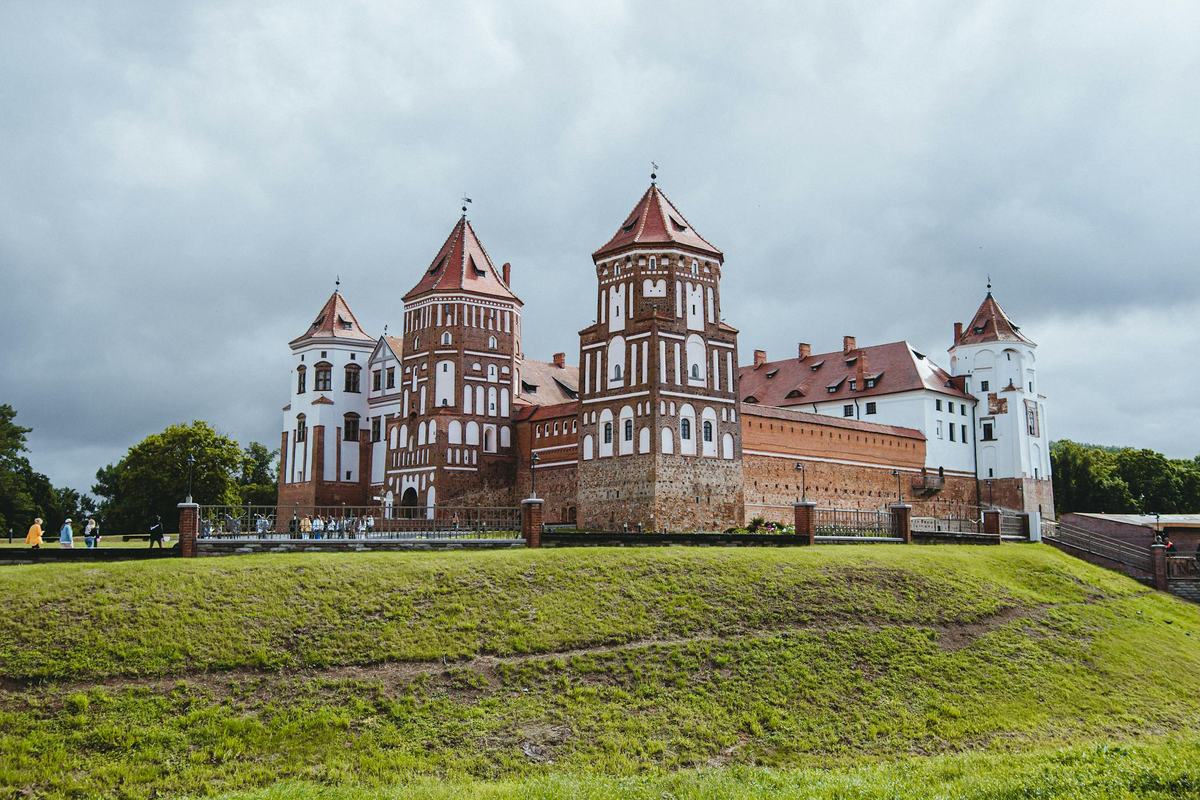
Mir Castle, begun in the late 15th century, represents a rare architectural hybrid - Gothic foundations overlaid with Renaissance towers added during early 16th-century Radziwiłł ownership. This layering of styles within a single defensive structure is uncommon in European castle architecture, where renovations typically replaced rather than integrated previous styles.
Struve Geodetic Arc: The Scientific Monument Spanning Ten Countries
The Struve Arc, a chain of survey triangulations stretching 2,820 kilometers from Norway to the Black Sea, passes through Belarus at two measured points. Friedrich Georg Wilhelm Struve completed this survey between 1816 and 1855 to precisely measure Earth's size and shape - the first successful attempt of its kind. Belarus shares this UNESCO designation with nine other countries, making it among the most geographically distributed heritage sites ever recognized.
Unusual Facts About Daily Life and Society in Belarus
Belarus Has One of the Lowest Rates of Obesity in Europe
Traditional Diet Patterns That Nutritionists Are Now Studying
Belarus records an adult obesity rate of approximately 24.5%, notably lower than the EU average of 30%+ and well below the UK's 36%. Nutritionists point to a diet historically anchored in fermented foods, root vegetables, buckwheat, and rye bread - all foods with low glycemic indexes and high fiber content. Fermented beet kvass and pickled vegetables remain kitchen staples, providing gut microbiome benefits that align with current nutritional research priorities.
Comparing Belarusian Dietary Habits to Nordic Countries Often Praised for Health
While Nordic diets receive substantial academic attention, Belarusian eating patterns share structural similarities - seasonal eating, minimal ultra-processed food reliance, and heavy whole-grain consumption - but at significantly lower household income levels, making the health outcomes more demographically remarkable.
The Country Still Celebrates Soviet Holidays Alongside National Ones
How Belarus Uniquely Blends Pre-Soviet, Soviet, and Post-Soviet Identity
Belarus officially observes Victory Day (May 9) with state-level ceremony rivaling Russia's commemorations, while simultaneously maintaining pre-Soviet traditions like Kupalle (midsummer festival) and post-independence holidays. This three-layer calendar reflects a deliberate state policy of continuity rather than rupture - a sharp contrast to Baltic de-Sovietization.
Comparing Holiday Calendars: Belarus vs Estonia vs Ukraine
Estonia removed Soviet holidays from official calendars by 1992. Ukraine progressively eliminated Victory Day as a public holiday by 2023. Belarus retains it with full military parades. This divergence illustrates how national identity politics directly shape civic time in post-Soviet space.
Belarusians Read More Books Per Capita Than Most EU Citizens
Library Density Statistics That Contradict Western Assumptions
Belarus operates roughly 9,000 public libraries - one of the highest per-capita densities in Europe. Compare this to Germany's approximately 8,000 libraries serving a population nearly nine times larger.
The Culture of Reading as Social Activity vs Digital Consumption
Reading in Belarus retains social dimensions largely eroded elsewhere - book clubs embedded in workplace culture, state-subsidized publishing keeping print prices low, and school curricula emphasizing classical literature engagement.
Belarus Has a Mandatory Civic Service System That Differs From Military Conscription
How Alternative Service Options Compare to Those in Austria and Switzerland
Belarus allows alternative civilian service for conscientious objectors, structurally resembling Austria's Zivildienst, typically running 18 months versus 12 months for military service.
What This System Has Produced in Terms of Infrastructure Maintenance
Alternative service conscripts contribute significantly to hospital staffing, forestry maintenance, and municipal infrastructure - filling labor gaps in sectors chronically underfunded since the 1990s.
Fun Facts About Belarusian Food Culture Worth Knowing
Belarus Has More Potato Dishes in Its National Cuisine Than Ireland
The 300 Documented Recipes Using Potato as the Primary Ingredient
Belarus holds a legitimate claim as the world's most potato-centric food culture. Ethnographers and culinary historians have documented over 300 distinct recipes where potato serves as the primary ingredient - not a side element, but the structural foundation of the dish. Per capita potato consumption in Belarus consistently ranks among the highest globally, averaging approximately 180 kg per person annually. Ireland, often cited as the archetypal potato-dependent nation, averages closer to 120 kg. The difference isn't incidental - it reflects centuries of agricultural adaptation to Belarus's soil composition and climate, where potato cultivation proved more reliable than grain farming across much of the territory.
Draniki: Why This Dish Spread Across Eastern Europe From Belarus
Draniki - potato pancakes made from raw grated potato - originated in Belarusian peasant cooking and migrated outward through population movement, trade, and cultural exchange. The dish appears in Lithuanian cuisine as bulviniai blynai, in Ukrainian cooking as deruny, and in Polish cuisine as placki ziemniaczane. Food historians trace the earliest written references to the Belarusian variant, noting its structural simplicity made it highly replicable. Draniki require no leavening, no special equipment, and minimal supplementary ingredients - features that accelerated adoption across economically diverse communities throughout Eastern Europe.
Belarusian Kvass Is Classified Differently From Russian Kvass by Food Scientists
The Fermentation Difference That Changes Its Nutritional Profile
Belarusian kvass traditionally undergoes a dual fermentation process - both lactic acid and alcoholic fermentation occur simultaneously - whereas Russian commercial kvass typically relies on a shortened single-stage fermentation. This distinction produces measurably higher concentrations of B vitamins and lactic acid bacteria in the Belarusian variant, giving it a closer functional profile to kefir than to beer.
Comparing Regional Kvass Varieties Across the Post-Soviet Space
Across the post-Soviet region, kvass formulations vary significantly. Ukrainian kvass often incorporates beet, producing a distinct mineral profile. Baltic kvass tends toward darker malts and lower acidity. Belarusian kvass sits in a specific category defined by its bread base, extended fermentation window, and lower residual sugar - characteristics food scientists use to distinguish it taxonomically from its regional counterparts.
Traditional Belarusian Cuisine Has Virtually No Spices and Still Wins International Recognition
How Flavor Is Built Through Fermentation, Smoking, and Drying Instead
Rather than relying on spice complexity, Belarusian cuisine constructs flavor through process. Cold smoking, extended lacto-fermentation of vegetables, and air-drying of meats create layered umami-adjacent depth without pepper, cumin, or aromatic herbs. Machanka - a slow-cooked pork gravy - achieves its intensity entirely through fat rendering and reduction.
Comparing This Approach to Japanese Umami Cooking Philosophy
The parallel to Japanese cooking is structurally sound. Both traditions prioritize process over seasoning, extracting glutamate-rich depth through fermentation and controlled protein breakdown. Where Japanese cuisine uses miso, soy, and dashi, Belarusian cuisine uses fermented rye, dried mushrooms, and smoked pork fat - different ingredients producing a functionally similar flavor architecture built on patience rather than spice.