Why Bosnia and Herzegovina Surprises Even Seasoned Travelers
A Country With Two Names, Three Peoples, and Four Governments
Bosnia and Herzegovina isn't just a mouthful to pronounce - it reflects a country whose very identity is layered with historical tension and political compromise.
The Dayton Agreement and the World's Most Complex Political Structure
The 1995 Dayton Peace Agreement ended a brutal three-year war but created a governmental architecture that political scientists still study with a mixture of admiration and disbelief. The country operates under two entities - the Federation of Bosnia and Herzegovina and Republika Srpska - plus the self-governing Brčko District. Each entity has its own president, parliament, and government. Above them sits a state-level government with a three-member rotating presidency representing Bosniaks, Serbs, and Croats.
The result: Bosnia and Herzegovina effectively runs four governments simultaneously, with over 150 ministers across all levels for a population of roughly 3.5 million people. By comparison, Germany governs 84 million citizens with considerably less institutional overhead.
How Bosnia Compares to Belgium in Constitutional Complexity
Belgium is frequently cited as Europe's most complex federal state, and the comparison with Bosnia is instructive. Belgium has six governments for 11.5 million people, structured along linguistic rather than ethnic-war fault lines. Bosnia has fewer governmental layers but a more rigid ethnic power-sharing mechanism - certain political positions are legally restricted to specific ethnic groups, a system the European Court of Human Rights ruled discriminatory in the landmark Sejdić and Finci v. Bosnia and Herzegovina case in 2009. Despite the ruling, the constitution remains unchanged. Belgium's complexity frustrates administrators; Bosnia's risks structural paralysis.
The Geographic Oddity: A Country With Only 20 Kilometers of Coastline
Landlocked countries are common. Countries with almost no coastline are far rarer - and Bosnia and Herzegovina belongs firmly in the second category.
Neum: The Tiny Coastal Town That Splits Croatia in Two
Bosnia's entire Adriatic presence consists of 24.5 kilometers of coastline (figures vary slightly by source, with 20–26 km commonly cited), all concentrated around a single town: Neum, with a population of approximately 4,500. This narrow coastal strip creates a genuinely unusual geopolitical situation - it physically bisects Croatia, separating the Dubrovnik region from the rest of the Croatian mainland.
For decades, crossing into and out of Dubrovnik overland required passing through Bosnia. Croatia partially resolved this with the Pelješac Bridge, completed in July 2022 at a cost of roughly €550 million, which now allows Croatian nationals and EU citizens to travel between Dubrovnik and Split without entering Bosnian territory. Neum, meanwhile, functions primarily as a summer resort town popular with Bosnians who have no other domestic sea access.
Comparison With Other Countries With Minimal Sea Access
Bosnia's coastal situation is extreme but not entirely unique. Jordan has approximately 26 kilometers of Red Sea coastline at Aqaba, and Iraq has roughly 58 kilometers of Persian Gulf access. However, both countries have functioning port infrastructure of regional significance. Neum has a modest marina. Bosnia has no commercial seaport of note - making its coastline more symbolic than strategic.
Obscure Historical Facts About Bosnia and Herzegovina
The Shot That Changed the World: Sarajevo 1914
Why Gavrilo Princip's Second Attempt Succeeded by Pure Accident
On June 28, 1914, Gavrilo Princip's assassination of Archduke Franz Ferdinand was less a masterpiece of conspiracy than a comedy of near-misses that accidentally ignited World War One. The first attempt that morning failed entirely - Nedeljko Čabrinović threw a bomb that bounced off the Archduke's car and exploded under the following vehicle, wounding several bystanders. The royal motorcade sped away. Princip, believing the mission had failed, stopped at Schiller's Delicatessen on Franz Josef Street to collect himself. What happened next defies planning: the Archduke's driver, unaware that the route had been changed for security reasons, turned onto that same street by mistake. When ordered to reverse, the engine stalled - directly in front of Princip - presenting a stationary target from roughly five feet away. Two shots ended the Austro-Hungarian succession and triggered a war that killed approximately 20 million people.
The Latin Bridge: One of the Most Historically Significant Corners in Europe
The corner near the Latin Bridge in Sarajevo where Princip fired those shots is arguably the most consequential few square meters in modern history. The bridge itself, an Ottoman stone structure spanning the Miljacka River, dates to the 16th century. A small museum - the Museum of Sarajevo 1878–1918 - now occupies the building beside the assassination site. During Yugoslav times, bronze footprints were embedded in the pavement marking where Princip stood, later removed after the 1990s war reframed his legacy from "freedom fighter" to "terrorist," depending sharply on which national narrative one follows.
Bosnia Was Once the Heart of a Mysterious Medieval Kingdom
The Bogomils and the Bosnian Church: A Faith Found Nowhere Else in Europe
Between roughly the 12th and 15th centuries, Bosnia hosted a Christian institution called the Bosnian Church - a schismatic organization rejected by both Rome and Constantinople, leaving its followers ecclesiastically stateless. For decades, historians debated whether its members were Bogomils, a dualist heretical movement originating in Bulgaria. Current scholarly consensus is more cautious, suggesting the Bosnian Church was an autonomous monastic community rather than a doctrinally heretical sect. Regardless, it disappeared entirely after the Ottoman conquest in 1463, leaving almost no written theological record - an extraordinary historical void.
Stećci: Over 70,000 Medieval Tombstones That Still Puzzle Historians
Scattered across Bosnia, Herzegovina, Montenegro, and parts of Croatia and Serbia are approximately 70,000 medieval monolithic tombstones called stećci, with the densest concentrations inside modern Bosnia. Dating primarily from the 12th to 16th centuries, these stone monuments - some weighing several tons - feature carved motifs including hunting scenes, spirals, dancing figures, and celestial symbols whose precise meaning remains unresolved. UNESCO inscribed the stećci necropoles as a World Heritage Site in 2016. What makes them particularly enigmatic is their association with the Bosnian Church: many stand in areas where that institution operated, yet definitive links between the two remain archaeologically unconfirmed.
Ottoman Legacy That Shaped Modern Bosnia
Sarajevo: The First City in the Balkans to Have a Tram System
Sarajevo launched its first tram line in 1885 - horse-drawn initially, electrified by 1895 - making it the first city in the Balkans and one of the earliest in Europe to operate an electric street railway. For context, London's first electric tram began running in 1901. The Austro-Hungarian administration, which had formally occupied Bosnia in 1878, drove this modernization as part of a deliberate infrastructure campaign. The same tram network, substantially rebuilt, still operates today.
How Bosnia Under the Ottomans Had More Libraries Than Most of Western Europe
During the 16th and 17th centuries, Sarajevo under Ottoman governance contained numerous maktabs (primary schools), medresas (Islamic colleges), and tekkes (Sufi lodges), each maintaining its own library. The city had over 100 such institutions at its Ottoman peak. By comparison, most Western European cities outside major university towns held minimal organized public collections during the same period. The Gazi Husrev-beg Library, founded in 1537, survives to this day, housing thousands of manuscripts in Arabic, Persian, Ottoman Turkish, and Bosnian - one of the most significant Islamic manuscript collections in Southeast Europe.
The Austro-Hungarian Transformation of Bosnia (1878–1918)
Why Vienna Turned Bosnia Into an Architectural Experiment
When Austria-Hungary occupied Bosnia following the Congress of Berlin in 1878, the imperial administration under Governor Benjamin Kállay pursued a calculated strategy: transform Sarajevo into a showcase of enlightened imperial governance. The result was a unique architectural hybrid - Moorish Revival, Pseudo-Moorish, and Historicist styles were deliberately layered onto an existing Ottoman urban fabric. The City Hall (Vijećnica), completed in 1896, is the most dramatic example: a Pseudo-Moorish structure originally housing the national library, later destroyed in 1992 when Bosnian Serb forces burned approximately 2 million books and documents, and painstakingly restored by 2014.
Mostar Bridge: Built by Ottomans, Destroyed in War, Rebuilt With Ancient Techniques
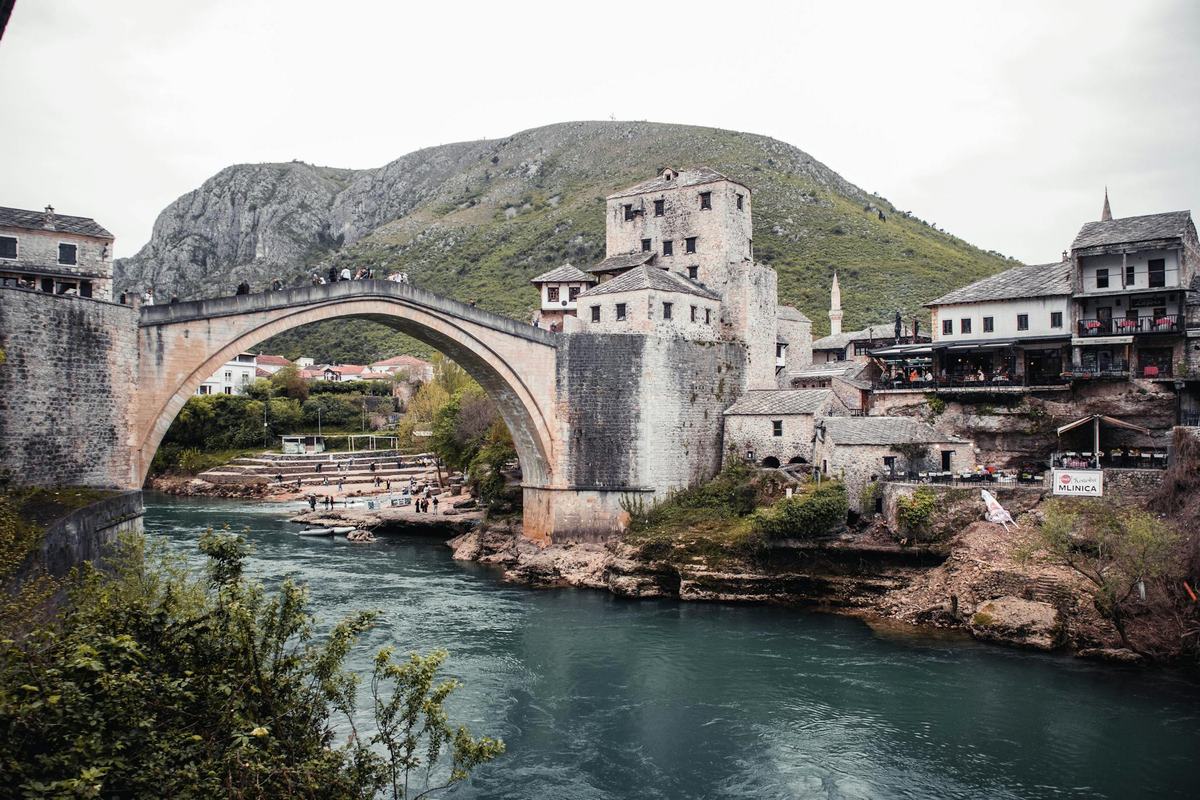
The Stari Most (Old Bridge) in Mostar was commissioned by Suleiman the Magnificent and completed in 1566 by the architect Mimar Hayruddin. For 427 years it stood as the widest man-made arch in the world at the time of its construction - a single elegant span of 29 meters across the Neretva River. Croatian forces destroyed it with tank and artillery fire on November 9, 1993. Its reconstruction, completed in 2004, used stone quarried from the same source as the original - a local limestone called tenelija - and employed Ottoman construction methods including traditional hand tools. UNESCO inscribed the rebuilt bridge and old city as a World Heritage Site that same year.
Unique Geographic and Natural Facts About Bosnia and Herzegovina
Bosnia Has One of the Last Wild Rivers in Europe
The Una and Neretva Rivers: Why Europe's Conservationists Are Watching Bosnia
While Western Europe has spent billions attempting to restore rivers damaged by 20th-century engineering, Bosnia still holds stretches of waterway that were never altered in the first place. The Una River, running along Bosnia's northwestern border with Croatia, remains largely free-flowing, undammed in its upper reaches, and ecologically intact to a degree that makes it exceptional on the continent. The Neretva, cutting through Herzegovina toward the Adriatic, supports one of the last viable softmouth trout (Salmo obtusirostris) populations in existence. Both rivers fall within the "Blue Heart of Europe" designation-a conservation campaign identifying the Balkans as the final stronghold for wild rivers in Europe, where an estimated 27 hydropower plants have been proposed on protected waterways in Bosnia alone, making activist opposition both urgent and consequential.
Comparison With Rewilded Rivers in Western Europe
The Rhine restoration project has cost over €3 billion since the 1980s with partial results. The Isar in Munich, rewilded at considerable expense in the 2000s, now approximates what sections of the Una look like naturally. This isn't a romanticization of underdevelopment-it's a measurable ecological baseline that rewilding scientists actively reference. Bosnia's rivers are, in the language of conservation biology, reference ecosystems.
The Dinaric Alps and Bosnia's Extreme Vertical Landscape
Bjelašnica: The Mountain That Hosted the 1984 Winter Olympics
Bjelašnica rises to 2,067 meters above sea level and sits roughly 30 kilometers southwest of Sarajevo-meaning the Bosnian capital sits within day-trip distance of genuine alpine terrain. The 1984 Winter Olympics used Bjelašnica for alpine skiing events, and the infrastructure, though war-damaged, has been partially restored. The mountain receives reliable snowfall from November through April, and its proximity to an urban center of 275,000 people makes it an anomaly in European geography.
How Bosnia's Elevation Range Rivals That of Much Larger Countries
Bosnia covers approximately 51,197 square kilometers-smaller than Nova Scotia-yet its elevation ranges from near sea level in the Neretva valley to 2,386 meters at Maglić, its highest peak. That vertical range within a compact territory creates pronounced microclimates, distinct vegetation zones, and biodiversity gradients comparable to countries several times its size.
Underground Bosnia: Caves, Canyons, and Karst Wonders
The Vjetrenica Cave System: One of the Richest Biosystems in Any European Cave
Located in the Popovo Polje karst field in Herzegovina, Vjetrenica contains over 200 documented animal species, including 20 endemic to the cave itself. It ranks among the biologically richest cave systems in Europe by species density. The cave extends at least 6.7 kilometers, though hydrological connections suggest a far larger system remains unmapped.
Rakitnica Canyon: Deeper Than Most People Realize and Almost Entirely Unexplored
Rakitnica cuts up to 1,000 meters deep through the Visočica and Bjelašnica plateaus. Road access is effectively nonexistent along most of its length. Its inaccessibility has preserved both its ecology and its near-total absence from tourist infrastructure-making it arguably the most dramatic unknown landscape in Central Europe.
The Mystery of the Bosnian Pyramids
What Mainstream Archaeology Actually Says About Visočica Hill
The "Bosnian Pyramid of the Sun" near Visoko is, according to every peer-reviewed geological and archaeological assessment, a naturally formed hill shaped by fluviodenudation. The European Association of Archaeologists issued a formal statement in 2006 calling the pyramid claims a "cruel hoax." The triangular geometry results from the alignment of natural stratified sandstone and conglomerate layers, not human construction.
Why the Debate Itself Reflects Bosnia's Complex Relationship With Its Own Past
What makes the pyramid phenomenon culturally interesting isn't the geology-it's the reception. In a country where wartime destruction erased or contested historical identity, the promise of a 12,000-year-old civilization predating Egypt offered something nationalism and archaeology both struggled to provide: unambiguous, pre-ethnic pride. The site draws hundreds of thousands of visitors annually regardless of scientific consensus, which says as much about post-conflict identity needs as it does about pseudoarchaeology's persistent appeal.
Facts About Bosnia and Herzegovina Culture That Most Outsiders Miss
Coffee Culture in Bosnia: It Is Not Just a Drink, It Is a Ceremony
Bosnian Coffee vs Turkish Coffee: The Differences That Matter
Bosnian coffee (bosanska kafa) is frequently mislabeled as Turkish coffee, but the preparation method differs in a technically meaningful way. Turkish coffee is boiled with the grounds; Bosnian coffee is brewed by pouring hot water directly over grounds placed in a džezva (a small copper or brass pot), then left to settle. The result is a clearer, less bitter cup. It is served in a fildžan - a small handleless cup - alongside a sugar cube and often a piece of rahat lokum (Turkish delight). Skipping these accompaniments is considered socially incomplete, not optional.
The Social Rules of Serving and Drinking Kahva
Drinking kahva follows unspoken but firmly observed protocols. The host pours first, guests do not rush the process, and leaving before finishing the cup signals disrespect. A single coffee ritual can last 45 minutes to over an hour. In Sarajevo's old bazaar, Baščaršija, kafanas open before 7 a.m. specifically to serve this morning ritual. It functions as the primary mechanism for social bonding, business negotiation, and conflict resolution.
Sevdalinka: The Blues Music of the Balkans
Why Ethnomusicologists Compare Sevdalinka to Fado and Flamenco
Sevdalinka is a genre of urban folk music that emerged in Bosnian cities during Ottoman rule, roughly the 16th century onward. The word derives from the Arabic-Turkish sevda, meaning melancholic longing rooted in love. Ethnomusicologists at institutions including the University of Sarajevo and international folklore researchers have drawn structural parallels with Portuguese fado and Andalusian flamenco: all three carry maqam-influenced scales, improvisational phrasing, and a preoccupation with unrequited emotion. The vocal ornamentation in sevdalinka directly reflects Ottoman maqam tradition.
How This Genre Survived Communism, War, and Globalization
During Yugoslav communism, sevdalinka was institutionalized rather than suppressed - broadcast on state radio and taught in music schools - which paradoxically preserved it. The 1990s war threatened its continuity as cultural institutions collapsed, but the diaspora carried it to Vienna, Chicago, and Stockholm. Artists like Amira Medunjanin brought sevdalinka to international concert halls in the 2000s, performing at venues including the Barbican in London. Streaming data now shows consistent listenership outside the Western Balkans.
The Concept of Insan: Bosnia's Deeply Rooted Philosophy of Humanity
How Islamic Humanism Shaped Bosnian Social Ethics
Insan - the Arabic-Quranic term for the human being in their highest moral capacity - became a cornerstone of Bosnian Islamic thought through centuries of Sufi influence, particularly the Naqshbandi and Qadiri orders active in Bosnia since the 17th century. Bosnian Islamic scholars interpreted insan not merely theologically but as a social ethic: the obligation to recognize full human dignity regardless of faith. This shaped how Bosnian Muslims historically interacted with Catholic, Orthodox, and Jewish neighbors.
Comparison With Similar Philosophies in Other Post-Ottoman Cultures
The Bosnian application of insan closely parallels kemal (moral perfection) in Turkish Sufi thought and the Egyptian concept of muru'a (virtue and dignity). What distinguishes the Bosnian version is its sustained expression across a multiconfessional society, unlike regions where Ottoman withdrawal produced religious homogenization. Scholars including Rusmir Mahmutćehajić have documented this distinction in works such as Bosnia the Good, published by Oxford University Press in 2000.
Religious Coexistence That Predates Modern Interfaith Movements
Sarajevo's Square Mile: Mosque, Church, Cathedral, and Synagogue Within Walking Distance
Within approximately 500 meters in central Sarajevo, four major religious sites coexist: the Gazi Husrev-beg Mosque (1531), the Serbian Orthodox Cathedral of the Nativity of the Theotokos (1872), the Catholic Sacred Heart Cathedral (1889), and the Ashkenazi Synagogue (1902, now the Jewish Museum). No comparable concentration exists in any other European capital. This proximity was not accidental - Ottoman urban planning in Sarajevo deliberately allocated adjacent quarters (mahallas) to different communities.
The Tradition of Komšiluk: Neighborliness Across Religious Lines
Komšiluk - derived from the Turkish komşu (neighbor) - describes a Bosnian social institution requiring active reciprocal care between neighbors regardless of religious identity. In practical terms, this meant attending neighbors' religious holidays, sharing food during Ramadan, Christmas, and Passover, and providing mutual assistance during hardship. Anthropological fieldwork documented by researchers including Tone Bringa in her 1995 study Being Muslim the Bosnian Way shows that komšiluk operated as a functional social contract, not mere sentiment, in rural Bosnian villages well into the late 20th century.
Bosnian Language: A Linguistic Identity With Political Dimensions
How Bosnian, Serbian, and Croatian Are Simultaneously the Same and Different
Bosnian, Serbian, and Croatian share a common South Slavic base - formerly grouped under the umbrella term Serbo-Croatian - and are mutually intelligible at approximately 90 percent of everyday vocabulary. The 1991 dissolution of Yugoslavia politicized their separation. Bosnian received official status in the 1995 Dayton Agreement, which formally recognized Bosnia and Herzegovina's linguistic distinctiveness. Linguists classify the three as a pluricentric language, similar to how Spanish varies across Latin American nations, rather than as entirely separate systems.
Words That Exist in Bosnian but Have No Direct Equivalent Elsewhere
Bosnian retains a higher density of Ottoman Turkish and Arabic loanwords than Serbian or Croatian. Sevap (a morally meritorious act), merhamet (compassion with active responsibility), and emanet (something held in sacred trust) carry nuanced ethical meanings that lack single-word equivalents in neighboring languages or in English. These lexical retentions are not archaic holdovers - they remain in active daily use and reflect the philosophical concepts, including insan and komšiluk, that define Bosnian cultural identity.
Fun and Surprising Facts About Bosnia and Herzegovina
Bosnia Produces World-Class Athletes Relative to Its Population Size
How a Country of 3.5 Million Consistently Punches Above Its Weight in Sports
With a population of approximately 3.5 million, Bosnia and Herzegovina produces elite athletes at a rate that consistently surprises analysts. The country has sent competitors to every Summer Olympics since its independent debut in 1992 in Barcelona, earning medals in sports ranging from taekwondo to athletics. Amel Tuka claimed a bronze medal in the 800 meters at the 2019 World Athletics Championships, while the national football team qualified for the 2014 FIFA World Cup - the country's first and only qualification to date - competing against Algeria, Nigeria, and Argentina.
Basketball has long been a cultural pillar, with numerous Bosnian players reaching the NBA and EuroLeague. Mirza Teletović and Jusuf Nurkić represent a pipeline of talent that operates independently of any structured national sports budget that would rival larger European nations.
Comparison With Similar Small Nations in European Athletics
When benchmarked against comparable small nations - Slovenia (2.1 million), Latvia (1.8 million), Estonia (1.3 million) - Bosnia holds its own despite significantly lower per-capita sports investment. Slovenia benefits from alpine skiing infrastructure; the Baltic states leverage Soviet-era athletic training systems. Bosnia, by contrast, developed its athletic culture largely through community clubs and diaspora networks, many of which were rebuilt after the 1992–1995 war from almost nothing.
The Town of Jajce: Where History Literally Flows Through a Waterfall
A Waterfall in the Middle of a Town and What It Says About Bosnian Urban History
Jajce contains one of Europe's most unusual urban features: the Pliva Waterfall, a 21-meter cascade that drops directly within the town boundary, where the Pliva River meets the Vrbas. Medieval fortifications, Ottoman-era architecture, and the waterfall coexist within a few hundred meters of each other - a physical record of layered civilizations using the same geography across centuries.
Why Jajce Was the Capital of Yugoslavia for One Brief Moment
On November 29, 1943, the Anti-Fascist Council for the National Liberation of Yugoslavia (AVNOJ) convened its second session in Jajce, effectively establishing the framework for postwar Yugoslavia. For that brief period, Jajce functioned as the political capital of a government-in-formation. November 29 subsequently became Yugoslavia's national day, celebrated until the country's dissolution.
Bosnia Has a Town That Was Never Bombed During World War II by Either Side
The Story of Travnik and Its Strategic Obscurity
Travnik, the former Ottoman capital of the Bosnian pashalik, escaped World War II aerial bombardment largely due to its limited industrial or military significance. Without rail junctions or armaments manufacturing, it offered no strategic target. This preservation left its Ottoman-era architecture largely intact.
Ivo Andrić: The Nobel Prize Winner Who Immortalized This Region
Travnik's most consequential contribution to world culture may be Ivo Andrić, born there in 1892. His novel Bosnian Chronicle is set entirely in Travnik during the Napoleonic era. Andrić received the Nobel Prize in Literature in 1961 - the only Nobel laureate from the former Yugoslav space - cementing Travnik's literary significance far beyond its modest size.
The World's Only Heart-Shaped Country? Not Quite, but Bosnia Comes Close
The Unusual Shape of Bosnia's Territory and What Caused It
Bosnia and Herzegovina's outline, when viewed on a map, bears a rough triangular resemblance occasionally described as heart-shaped in travel writing. The shape is actually the result of centuries of contested frontier zones between Ottoman, Habsburg, and Serbian Orthodox spheres of influence, each claiming or ceding territory through successive wars and treaties.
How Ottoman Land Surveys Created the Current Border Configuration
The Congress of Berlin (1878) formalized much of modern Bosnia's border after the Ottomans ceded administrative control to Austria-Hungary. Ottoman cadastral surveys - detailed land registries tied to tax obligations - had defined village and regional boundaries that negotiators in Berlin largely accepted as practical delimitations. Those administrative records, originally designed for tax collection, inadvertently became the blueprints for a modern national border.
Economic and Social Facts About Bosnia and Herzegovina
The Brain Drain Crisis: One of the Highest Emigration Rates in Europe
How Bosnia Loses Educated Youth Faster Than Almost Any EU Candidate State
Bosnia and Herzegovina faces one of the most severe demographic collapses in the Western Balkans. Estimates suggest the country has lost between 150,000 and 200,000 residents since 2013, with emigration accelerating sharply after EU freedom of movement agreements made Germany, Austria, and Slovenia accessible destinations. The population, currently estimated at under 3.3 million permanent residents, is declining at a pace that alarms demographers and policymakers alike.
What distinguishes Bosnia's emigration from simple poverty-driven migration is its concentration among educated young professionals. Physicians, engineers, and IT workers leave at disproportionately high rates. The BiH Medical Chamber has repeatedly warned that hospitals in Republika Srpska and the Federation entity face staffing crises directly tied to emigration. Some estimates suggest Bosnia loses over 10,000 working-age residents annually - a staggering figure for a country this size.
Comparison With Kosovo and Moldova on Demographic Decline
Kosovo and Moldova share similarly acute emigration pressures, but Bosnia's situation carries a distinct structural weight. Kosovo's emigration is partially offset by a younger demographic base and higher birth rates. Moldova has benefited from EU accession momentum and targeted diaspora remittance programs. Bosnia, by contrast, combines low birth rates, political paralysis, and limited institutional reform - conditions that give young people few rational incentives to stay. Remittances currently account for roughly 10–12% of Bosnia's GDP, which reflects the scale of the diaspora but does nothing to address the underlying talent exodus.
Bosnia's Informal Economy and Its Surprising Scale
Why a Significant Portion of Economic Activity Never Appears in Official Statistics
The World Bank and IMF have consistently flagged Bosnia's shadow economy as a structural concern. Estimates place the informal economy at approximately 25–30% of GDP, meaning roughly one in four economic transactions occurs entirely outside formal accounting. Cash-in-hand labor, unregistered agricultural production, and informal service arrangements are widespread - particularly in rural cantons and smaller municipalities where enforcement capacity is thin.
How This Compares to Shadow Economies in Southern Europe
For context, Greece's shadow economy sits at around 20–22% of GDP, and Italy's at approximately 19–21%. Bosnia's informal sector is therefore not an outlier by regional standards, but its persistence reflects weaker institutional enforcement rather than cultural norm alone. The complexity of Bosnia's dual-entity governance structure - with different tax authorities in Republika Srpska and the Federation - creates regulatory gaps that informal operators reliably exploit.
Renewable Energy Potential That Remains Largely Untapped
Bosnia's Hydropower Resources vs Its Actual Energy Output
Bosnia sits atop one of Europe's most significant untapped hydropower reserves. The country's rivers - particularly the Neretva, Vrbas, and Drina - theoretically support generation capacity that could make Bosnia a net energy exporter at scale. Currently, hydropower contributes roughly 40–45% of domestic electricity generation, but dozens of planned projects remain stalled in permitting or financing.
Why Environmental Groups and Energy Investors Are Simultaneously Watching Bosnia
The same rivers attracting energy investors are classified among Europe's last wild rivers by conservation organizations. Groups like EuroNatur and RiverWatch have mounted significant campaigns against dam construction in ecologically sensitive zones, particularly in the upper Neretva basin. This tension - between legitimate energy development and irreplaceable Balkan freshwater ecosystems - has made Bosnia a flashpoint in the broader European debate over green energy trade-offs.
Facts About Bosnia and Herzegovina in Comparison With the Rest of the World
How Bosnia's Wartime Siege of Sarajevo Compares to Other Urban Sieges in Modern History
The Longest Siege of a Capital City in the History of Modern Warfare
The Siege of Sarajevo lasted 1,425 days - from April 5, 1992 to February 29, 1996 - making it the longest siege of a capital city in modern warfare history. For context, the Siege of Leningrad during World War II lasted 872 days, and the Siege of Madrid during the Spanish Civil War lasted roughly 1,000 days. Sarajevo surpassed both. An estimated 13,952 people were killed during the siege, including 5,434 civilians. At its peak, the city endured an average of 329 shell impacts per day, with a recorded single-day high of 3,777 shells on July 22, 1993.
What Remained Functioning in Sarajevo During 1,425 Days of Siege
Despite near-total encirclement by Bosnian Serb forces, parts of Sarajevo's civic life persisted. The Sarajevo War Theatre opened in 1992 and staged over 300 performances during the siege. The city's tram system, one of the oldest in the Balkans (operational since 1885), resumed limited service in 1994. A tunnel constructed beneath the airport - just 1.6 meters high and 800 meters long - became the city's lifeline, facilitating the movement of food, weapons, and civilians. The Sarajevo Marathon was held during the siege years. These facts underscore a documented pattern of cultural resistance that historians have studied as a model of civilian resilience under sustained military pressure.
Bosnia's UNESCO Heritage Sites vs Its Global Recognition
Stećci, Old Bridge, and the Mehmed Paša Sokolović Bridge: Three UNESCO Sites Few People Know
Bosnia and Herzegovina holds three UNESCO World Heritage Sites. The Old Bridge of Mostar (Stari Most), inscribed in 2005, was originally built in 1566 under Ottoman architect Mimar Hayruddin and destroyed in 1993 before being reconstructed in 2004. The Mehmed Paša Sokolović Bridge in Višegrad, inscribed in 2007, dates to 1571 and spans 179 meters across the Drina River. The Stećci Medieval Tombstones, inscribed in 2016 as a transnational site shared with Croatia, Serbia, and Montenegro, represent over 70,000 medieval monumental tombstones unique to the western Balkans.
Why Bosnia Has More UNESCO Sites Per Capita Than Several Western European Countries
With a population of approximately 3.2 million, Bosnia holds 3 UNESCO sites - roughly 0.94 sites per million people. Portugal, with 10 million people and 17 UNESCO sites, sits at 1.7 per million, while the Netherlands (18 million, 12 sites) comes in at 0.67 per million. Bosnia's ratio exceeds that of Belgium, Austria, and Sweden. This density reflects the country's position at the crossroads of Byzantine, Ottoman, and medieval Catholic cultural spheres - a concentration of distinct civilizations in a small geographic area of just 51,209 square kilometers.
Bosnian Cuisine: Influences From Four Empires on One Plate
Ćevapi, Burek, and Klepe: What Each Dish Reveals About Bosnia's Layered History
Bosnian cuisine is a direct archaeological record of imperial occupation. Ćevapi - grilled minced meat served in somun flatbread - entered Bosnian culture through the Ottoman Empire and today represents a protected regional product, with Sarajevo and Banja Luka maintaining distinct preparation styles recognized at the national level. Burek, phyllo pastry filled with meat, arrived via Ottoman culinary traditions but diverged from Turkish börek specifically in Bosnia, where purists insist only meat-filled pastry qualifies as burek (cheese, spinach, or potato versions carry separate names). Klepe, Bosnian meat-filled dumplings, draw direct parallels to Central Asian manti, reflecting the broader Turkic culinary corridor that extended into the Balkans during the 14th and 15th centuries.
How Bosnian Food Differs From Serbian and Croatian Cuisine Despite Surface Similarities
Shared dishes mask meaningful distinctions. Croatian cuisine integrates heavy Austro-Hungarian and Mediterranean (particularly Dalmatian) influences - evident in its use of olive oil, seafood, and risotto-style preparations largely absent in traditional Bosnian cooking. Serbian cuisine features more pork-centric dishes due to the dominance of Eastern Orthodox traditions, whereas Bosnian cuisine historically avoided pork under Ottoman-period Islamic dietary norms, shaping a beef and lamb-dominant culinary tradition. Bosnian coffee (bosanska kafa) - served unfiltered in a džezva with a sugar cube and Turkish delight - differs procedurally and culturally from both Croatian and Serbian coffee culture, functioning more as a social ritual than a beverage, with a formalized serving sequence that has no direct equivalent in neighboring cuisines.