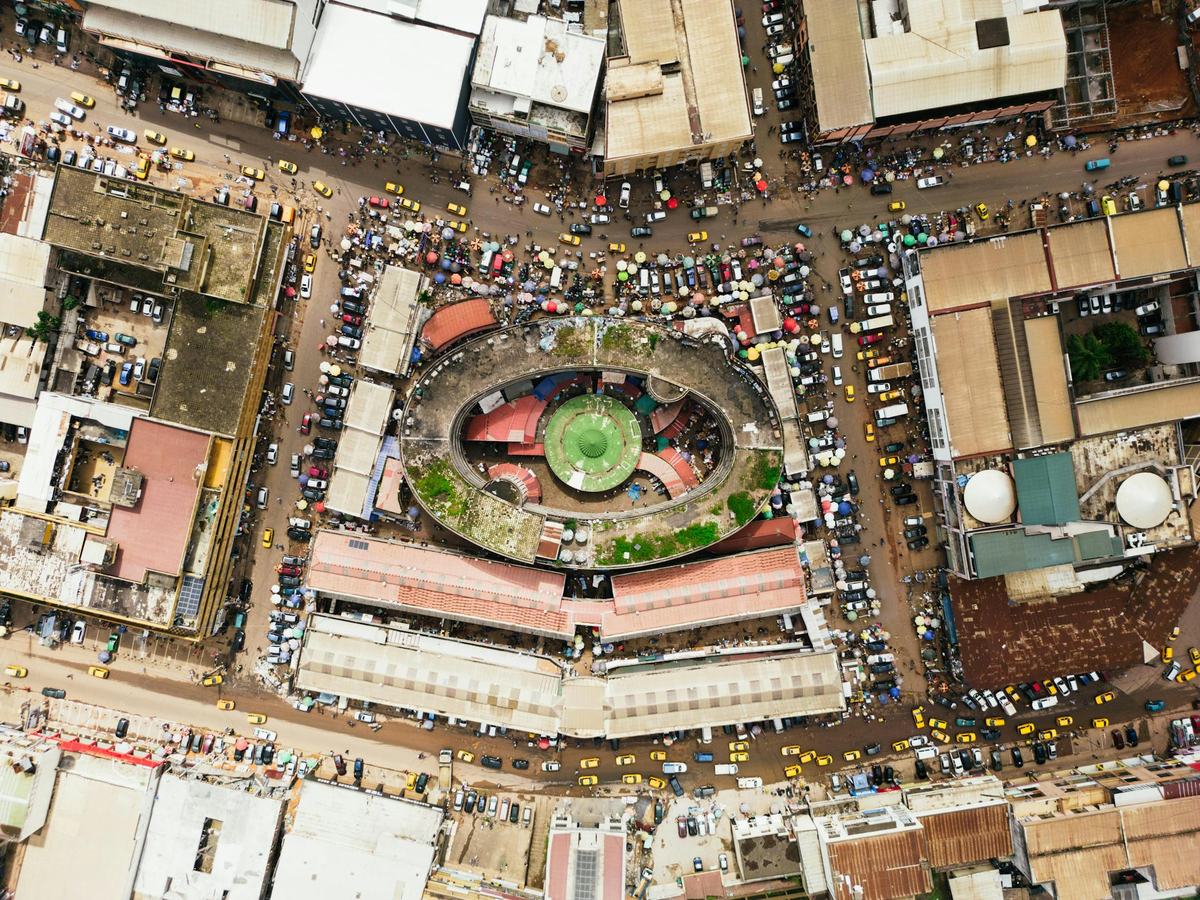
Why Cameroon Is Called 'Africa in Miniature': The Geographic Marvel Behind the Name
The Five Climate Zones Packed Into One Country
How Cameroon Compresses What Most Continents Spread Across Thousands of Miles
Cameroon's nickname isn't marketing hyperbole. Within its 475,440 square kilometers, the country transitions from dense equatorial rainforest in the south, through tropical savanna in the center, to semi-arid Sahel conditions in the far north near Lake Chad. Add the montane ecosystems of the western highlands and the coastal mangrove belt along the Atlantic, and you have five distinct climate zones stacked within a single national border.
Most continents require 3,000 to 5,000 kilometers of latitude to achieve similar climatic variation. Cameroon delivers it in roughly 1,200 kilometers from north to south.
Comparing Cameroon's Biodiversity Density to the Amazon Basin
The numbers are striking. Cameroon hosts approximately 9,000 plant species, 900 bird species, and over 320 mammal species. The Congo Basin rainforest, which extends into southern Cameroon, is the second-largest tropical forest on Earth after the Amazon. Per unit area, Cameroon's species density rivals regions three to four times its size, making it one of the top biodiversity hotspots globally according to Conservation International.
Mount Cameroon: Africa's Most Active Volcano You've Never Heard Of
The 4,040-Meter Giant That Has Erupted More Recently Than Mount Vesuvius
Standing at 4,040 meters, Mount Cameroon is the highest peak in West and Central Africa and one of the continent's most persistently active volcanoes. It has erupted over 20 times since records began, with significant eruptions in 1999 and 2000. Mount Vesuvius last erupted in 1944. By that measure alone, Mount Cameroon is considerably more geologically restless.
How Mount Cameroon Compares to Kilimanjaro in Ecological Significance
Kilimanjaro is taller at 5,895 meters, but it is essentially dormant. Mount Cameroon's ongoing volcanic activity continuously regenerates soil fertility across its slopes, supporting extraordinarily dense endemic flora. The mountain hosts over 40 plant species found nowhere else on Earth, a figure that reflects active geological dynamism rather than passive altitude.
Lake Nyos: The Killer Lake That Asphyxiated 1,800 People Overnight in 1986
The Limnic Eruption Phenomenon Found in Only Three Lakes on Earth
On August 21, 1986, Lake Nyos in northwestern Cameroon released an estimated 1.6 million tons of carbon dioxide in a single limnic eruption - a sudden, violent degassing of a CO₂-saturated lake. The dense gas cloud traveled at low altitude for 25 kilometers, killing approximately 1,800 people and 3,500 livestock within hours. Only three known lakes on Earth - Nyos, Monoun, and Kivu - contain sufficient dissolved CO₂ to produce this phenomenon.
What Scientists Installed to Prevent Another Catastrophe
Beginning in 2001, engineers installed degassing pipes that draw CO₂-saturated water from depth and release it safely at the surface in controlled streams. By 2011, five such pipes were operational at Lake Nyos, continuously bleeding pressure and significantly reducing catastrophic eruption risk.
Stunning Facts About Cameroon's Linguistic Landscape: The Country With 280+ Languages
Cameroon's linguistic reality is arguably its most underappreciated feature. With 284 documented living languages across a population of roughly 28 million, the country averages one language per 100,000 speakers - a density that reshapes how you understand communication, governance, and identity on the continent.
Cameroon Pidgin English: A Lingua Franca That Predates the Colonial Era
Contrary to popular assumption, Cameroon Pidgin English (CPE) did not emerge from British colonization. Linguistic evidence traces its roots to 17th-century coastal trade contacts, predating formal British administration by over two centuries. Today, CPE functions as a market language, a cross-ethnic bridge, and a vehicle for music and oral tradition, spoken by an estimated 5–10 million people as a second language.
How Camfranglais Blends French, English, and Indigenous Languages Into a Street Dialect
Emerging in Yaoundé and Douala during the 1970s and 1980s, Camfranglais is a youth-driven creole that draws from French grammatical structures, English lexicon, and indigenous vocabulary - primarily Ewondo and Bamiléké. A single sentence might contain "Je go au march pour buy some mbom" (I'm going to the market to buy some things). Linguists classify it as a mixed code, not a pidgin, because its speakers are often educated multilinguals deliberately choosing hybridity rather than linguistic simplification.
Comparing Cameroon's Language Density to Papua New Guinea, the World Leader
Papua New Guinea holds the global record with approximately 840 languages for 10 million people - roughly one language per 12,000 speakers. Cameroon's ratio is less extreme, but its combination of Afroasiatic, Nilo-Saharan, Niger-Congo, and Ubangian families within one national border makes it a UNESCO-recognized hotspot for linguistic diversity.
Why Cameroon Has Two Official Languages While Most African Nations Have One
Only four African countries maintain two European languages as co-official: Cameroon, Rwanda, Burundi, and Equatorial Guinea. Cameroon's bilingualism is not merely administrative - it reflects a structural colonial fracture.
The 1961 Plebiscite That Split British Southern Cameroons From Northern Cameroons
On February 11, 1961, UN-supervised votes in British-administered territories produced a binary result: Northern Cameroons voted to join Nigeria; Southern Cameroons voted to federate with French Cameroun. This created the Federal Republic of Cameroon, which became officially bilingual - a status entrenched in the 1996 constitution.
The Anglophone Crisis: How a Language Policy Escalated Into Armed Conflict
What began in 2016 as lawyers and teachers protesting the imposition of French-speaking judges and teachers in Anglophone regions evolved into the Ambazonian separatist conflict. By 2023, estimates placed the death toll above 6,000, with over 700,000 internally displaced - demonstrating that language policy carries real geopolitical consequences.
The Secret Language of the Bafut Kingdom: Royal Speech Forbidden to Commoners
The Bafut Fondom in Northwest Cameroon maintains a stratified linguistic system in which the Fon (king) and his inner court use ceremonial registers inaccessible to ordinary subjects. This is not metaphorical exclusivity - specific vocabulary, tonal patterns, and speech acts are institutionally restricted.
How the Bafut Fon Uses Ceremonial Language to Maintain Political Authority
Language restriction functions as a sovereignty tool. When the Fon speaks publicly, interpreters - known as "nchinda" - mediate between royal utterance and public understanding. This creates a deliberate communicative barrier that reinforces hierarchical distance and sacralizes political power.
Comparison With the Sacred Languages of the Zulu Royal Court
The Zulu concept of hlonipha (avoidance language) bears structural similarities: women, in particular, were historically prohibited from uttering syllables contained in a husband's or in-law's name, generating entirely new vocabulary. Both systems use linguistic restriction as social control, though Bafut's system is more explicitly tied to royal political authority rather than kinship obligation.
Remarkable Facts About Cameroon Culture That Defy Common Assumptions
The Fulani Cattle Corridor: A Pastoral Migration Route Older Than Most Nations
How Mbororo Fulani Herdsmen Navigate 1,500 Kilometers Without Modern Navigation
The Mbororo Fulani execute seasonal transhumance across roughly 1,500 kilometers of West and Central African terrain using an inherited spatial knowledge system called pulaaku - a code of conduct embedding ecological literacy, star navigation, and generational memory of water sources. Herders identify dry-season pastures in the Adamawa Plateau and wet-season ranges in the Sahel fringe through oral cartography passed from father to son. No GPS. No written maps. Cattle egret behavior and specific grass species signal adequate water within 20 kilometers.
The Conflict Between Nomadic Herders and Settled Farmers: A Crisis Misunderstood by the World
International media frames Fulani-farmer violence as ethnic or religious conflict. The actual driver is shrinking pastureland - Cameroon lost approximately 30% of its northern savanna to desertification between 1970 and 2010. As corridors compress, cattle inevitably cross crop boundaries. The crisis is fundamentally a land-tenure failure: Cameroonian law recognizes neither customary pastoral corridors nor seasonal grazing rights, leaving herders legally invisible on land their families used for generations.
The Kirdi Peoples of the Far North: Communities That Resisted Islam for Centuries
Why the Mandara Mountains Became a Refuge for Non-Islamized Populations
"Kirdi" - a Kanuri term meaning roughly "pagan" - was applied collectively to over 30 distinct ethnic groups who retreated into the Mandara Mountains between the 14th and 19th centuries specifically to escape Bornu and Fulani jihad pressure. The terrain did the work: peaks exceeding 1,400 meters created defensible microclimates where groups like the Mofu, Podoko, and Kapsiki maintained pre-Islamic religious systems, including elaborate beer-sacrifice rituals and iron-smelting cosmologies.
Comparing Kirdi Cultural Preservation to the Dogon of Mali
The parallel with Mali's Dogon is structurally accurate. Both groups used mountain geography as cultural armor. Both maintained cosmological systems of extraordinary complexity - Dogon astronomy is well-documented, while Kapsiki divination using crabs remains understudied outside specialist anthropology. The key difference: Dogon became a global heritage brand; Kirdi communities receive minimal international preservation attention despite equivalent cultural depth.
Bamileke Secret Societies and the Skull Cult: Ancestor Veneration Misunderstood by Outsiders
What the Kwifon Society Actually Does and Why Colonial Authorities Feared It
The Kwifon is a regulatory institution, not a criminal fraternity. Functioning as legislature, judiciary, and executive simultaneously within Bamileke chiefdoms, it enforces customary law, manages land disputes, and controls succession. German colonial administrators in the early 1900s outlawed it specifically because it represented an autonomous governance structure that undermined colonial authority - not because of ceremonial practices involving ancestral skulls, which were mischaracterized as barbaric ritual.
How Bamileke Fons Accumulate Political Power Through Ceremonial Wives
A Bamileke Fon's political network scales directly with the number of ceremonial wives (takam), some chiefdoms recording over 200. These women are not primarily domestic partners but diplomatic assets - each represents a family alliance, a lineage obligation, and an intelligence network. The Fon redistributes resources through these women to constituent families, creating loyalty structures that survived colonialism, independence, and multiparty democratization largely intact.
The Grassfields Palace Architecture: A UNESCO-Recognized Building Tradition
Why Bamileke and Bamoun Palaces Use Giant Spider Webs as Decorative Elements
The nda ksi (spider house) motif appearing on palace raffia-weave panels and carved doorframes references the nggam divination spider - a species whose leg movements over arranged objects reveal messages from ancestors. Incorporating the web pattern into architecture literally inscribes spiritual surveillance into the built environment. It signals that the palace operates under ancestral oversight, not merely human authority.
Comparing Foumban Royal Palace to the Palaces of Benin Kingdom in Nigeria
Foumban's Royal Palace, built by Sultan Njoya around 1917 and influenced by German colonial architecture he observed firsthand, covers approximately 3 hectares and houses the Bamoun Museum - one of Central Africa's most significant ethnographic collections. Where Benin's palace tradition emphasized bronze casting as its primary prestige medium, Bamoun palatial culture prioritized textile production, writing systems (Njoya invented the Shümom script around 1896), and architectural synthesis. Both traditions share the core principle that palace space encodes cosmological and political order simultaneously.
Hidden Facts About Cameroon's Economic Paradoxes and Natural Resources
Cameroon's Oil Curse: How Petroleum Wealth Failed to Industrialize the Country
Cameroon discovered commercially viable oil in the Rio del Rey basin in the 1970s, peaking at roughly 185,000 barrels per day in 1985. By 2023, production had declined to approximately 65,000–70,000 barrels per day - yet the structural dysfunction petroleum created persists long after the boom faded.
Why Cameroon Exports Crude Oil but Imports Refined Petroleum Products
The Sonara refinery in Limbe, Cameroon's sole refining facility, operates at a fraction of its 2.1 million tonne annual capacity due to chronic underinvestment, aging infrastructure, and a 2019 fire that severely damaged operations. As a result, Cameroon exports raw crude while spending hundreds of millions of dollars annually importing diesel, gasoline, and jet fuel - a textbook resource trap. Fuel subsidies, which consumed over CFA 400 billion ($650 million) in 2022 alone, further distort incentives for refinery rehabilitation or private-sector entry.
Comparing Cameroon's Oil Revenue Management to Botswana's Diamond Strategy
Botswana established the Pula Fund in 1994, channeling diamond revenues into a sovereign wealth mechanism that financed education, infrastructure, and economic diversification. Cameroon created the National Hydrocarbons Corporation (SNH) but routed revenues largely through opaque off-budget transfers, limiting public accountability. Transparency International consistently ranks Cameroon 40–50 points lower than Botswana on its Corruption Perceptions Index, illustrating how institutional design - not resource endowment - determines development outcomes.
The Cocoa and Coffee Contradiction: World-Class Beans, Domestic Market Ignorance
Cameroon ranks among the top five global producers of Robusta coffee and produces prized fine-flavor cocoa in its southwestern highlands. Yet virtually no internationally recognized Cameroonian consumer brand exists.
How Cameroonian Robusta Coffee Ends Up in European Blends Without Attribution
European roasters - particularly in Italy, France, and Germany - routinely incorporate Cameroonian Robusta as a body-building filler in espresso blends. Origin labeling regulations permit this without disclosure, meaning consumers drinking branded Italian espresso may unknowingly be tasting Cameroon's harvest. The country exports roughly 35,000–40,000 metric tonnes of coffee annually, almost entirely as unprocessed green beans.
Why Farmers in Mbam Region Earn Less Than 3% of the Final Consumer Price
A kilogram of processed specialty coffee retailing in Paris for €30–€40 yields the Mbam-region farmer approximately $0.60–$0.80. Middlemen, export traders, shipping costs, roasting margins, and retail markups absorb the remainder. Cooperatives remain underfunded, and government extension services have contracted sharply since structural adjustment programs of the 1990s dismantled state marketing boards.
The Ngoyla-Mintom Forest: One of the Last Intact Congo Basin Rainforests Under Threat
Spanning approximately 600,000 hectares in southern Cameroon, Ngoyla-Mintom represents one of the largest unfragmented lowland rainforest blocks outside the Democratic Republic of Congo.
How China-Backed Infrastructure Projects Are Reshaping the Cameroon-Congo Ecosystem
The planned Cameroon-Congo road corridor, partially financed through Chinese infrastructure agreements, cuts directly through critical wildlife corridors linking Ngoyla-Mintom to Odzala-Kokoua National Park in Congo. Logging concessions already encircle roughly 40% of the forest's perimeter, and road construction historically accelerates encroachment by a documented factor of 3–5x in Central African forest contexts.
Comparing Deforestation Rates in Cameroon to Indonesia at Peak Palm Oil Expansion
Global Forest Watch data indicates Cameroon lost approximately 290,000 hectares of tree cover annually between 2015 and 2022. While this remains below Indonesia's peak deforestation rate of roughly 840,000 hectares per year during its 2000s palm oil surge, Cameroon's loss is concentrated in high-biodiversity primary forest rather than degraded secondary growth - making the ecological cost per hectare significantly higher.
Surprising Facts About Cameroon's Political and Historical Complexity
Cameroon Was Never Colonized by a Single European Power: The Triple Colonial Legacy
How Germany, France, and Britain Each Left Distinct Architectural and Legal Imprints
Germany established Kamerun as a protectorate in 1884 following the Duala Treaty, leaving behind plantation infrastructure in the southwest and colonial-era buildings still visible in Buea. After Germany's WWI defeat, the territory was partitioned: France received roughly 80% while Britain administered the remaining 20% as two non-contiguous strips along the Nigerian border.
This division created a legal schism that persists today. Francophone Cameroon operates under Napoleonic civil law; anglophone regions retain English common law traditions. The two educational systems, two court structures, and two administrative cultures within one nation remain a primary driver of the ongoing Anglophone Crisis, which has claimed over 6,000 lives since 2016.
The Kamerun Mandate: Why the League of Nations Split a Country Into Two Trusteeships
Under the 1922 League of Nations mandate system, French Cameroun and British Cameroons became separate trusteeships rather than annexed territories. When independence arrived in 1960 for French Cameroun, British Southern Cameroons voted in a 1961 UN plebiscite to join the new republic rather than Nigeria - a decision that remains politically contested. British Northern Cameroons voted to join Nigeria, permanently severing that territory from the Cameroonian state.
Ahmadou Ahidjo's Secret: How the First President Converted to Salafism Before His Exile
The 1984 Republican Guard Coup That Nearly Dismantled Paul Biya's Government
Ahidjo resigned in 1982, but his influence lingered dangerously. In April 1984, northern soldiers - loyalists to Ahidjo, who had by then embraced a strict Salafist orientation in Saudi exile - launched a coup attempt against Paul Biya. Fighting around the presidential palace in Yaoundé lasted nearly two days, leaving approximately 1,000 dead. Biya survived, purged the northern military establishment, and renamed the country from the "United Republic of Cameroon" back to the "Republic of Cameroon" - a symbolic erasure of the federal compact with anglophone regions.
Comparing Cameroon's Post-Colonial Continuity to Senegal's Democratic Transitions
Senegal has transitioned power peacefully between rival political parties multiple times, including in 2000 and 2012. Cameroon has had only two presidents since independence. Biya, in power since 1982, is currently the world's oldest serving head of state at 91. That institutional rigidity, absent Senegal's competitive multiparty culture, explains much of Cameroon's structural political tension.
The Bakassi Peninsula: A Territory Cameroon Won From Nigeria at the International Court
How the 2002 ICJ Ruling Over Bakassi Became One of Africa's Smoothest Border Transfers
The International Court of Justice ruled in October 2002 that the Bakassi Peninsula belonged to Cameroon, citing the 1906 Anglo-German Agreement and the 1913 Thomson-Marchand Declaration. Nigeria completed its withdrawal by 2008 under the Greentree Agreement - a remarkably orderly transfer given the peninsula's strategic sensitivity.
The Oil Potential That Made Bakassi Worth Arguing Over for Three Decades
Bakassi sits within an offshore zone estimated to hold significant hydrocarbon reserves, with some projections suggesting deposits comparable to smaller Niger Delta fields. Nigeria had administered the territory for decades and its fishing communities held strong ties to Nigerian identity, making the legal resolution politically costly for Abuja despite ICJ compliance.
Extraordinary Wildlife and Ecological Facts About Cameroon
The Baka Pygmies' Forest Pharmacopoeia: Medicinal Knowledge That Predates Modern Science
How Baka Hunter-Gatherers Use Plant Compounds That Pharmaceuticals Are Now Studying
The Baka people of southeastern Cameroon have accumulated over 50,000 years of pharmacological knowledge encoded in oral tradition. Ethnobotanical surveys have documented more than 300 plant species the Baka use medicinally, including Prunus africana, whose bark compounds are now synthesized in treatments for benign prostatic hyperplasia sold across Europe. Researchers at the Royal Botanic Gardens, Kew, have confirmed that Baka preparations for fever, wound infection, and gastrointestinal illness consistently align with documented bioactive properties-often predating clinical validation by centuries.
The Ethical Crisis of Bio-Piracy: When Western Companies Patent Baka Traditional Knowledge
Between 1995 and 2015, at least a dozen European and North American pharmaceutical patents cited plant compounds first identified through indigenous central African knowledge systems, with zero royalty arrangements benefiting source communities. The Nagoya Protocol (2010) established frameworks for benefit-sharing, but enforcement in Cameroon remains inconsistent. The Baka receive no formal compensation from the multi-million-dollar Prunus africana extract industry, which generates an estimated €220 million annually in European markets alone.
Cross River Gorillas: The World's Most Endangered Ape Lives on the Cameroon-Nigeria Border
Why Fewer Than 300 Cross River Gorillas Remain and What Makes Their Habitat Irreplaceable
The Cross River gorilla (Gorilla gorilla diehli) population sits at approximately 250–300 individuals distributed across 11 fragmented forest patches straddling Cameroon's Takamanda National Park and Nigeria's Cross River National Park. Their habitat-montane and submontane forest between 150 and 1,600 meters elevation-supports a unique assemblage of species found nowhere else. Genetic isolation between subpopulations is accelerating inbreeding depression, and hunting pressure, despite legal protections, continues through bushmeat networks serving urban markets in Bamenda and Calabar.
Comparing Cross River Gorilla Conservation Challenges to Mountain Gorilla Success in Rwanda
Mountain gorillas in Rwanda's Volcanoes National Park recovered from approximately 620 individuals in 2010 to over 1,000 by 2018-largely through intensive ranger presence, tourism revenue reinvestment, and community benefit-sharing. Cross River gorillas lack equivalent ecotourism infrastructure, primarily because their extreme shyness makes sighting rates commercially unviable. Rwanda's model required $15–20 million annually in conservation investment; comparable funding for Cross River habitats has never materialized.
Waza National Park: Where the Sahel Meets Wildlife in a Counterintuitive Ecosystem
How Lions, Elephants, and Giraffes Coexist in a Semi-Arid Environment
Waza National Park in Cameroon's Far North Region covers 1,700 km² of Sahelian floodplain and supports one of West-Central Africa's last viable lion populations alongside elephants, Kordofan giraffes, and cheetahs. Seasonal flooding of the Logone River creates a brief ecological window of extraordinary productivity, concentrating wildlife at densities surprising for an environment receiving under 600mm of annual rainfall.
Why Waza's Hippo Population Declined 90% in Twenty Years and What That Signals
Waza's hippopotamus population collapsed from roughly 1,200 animals in the early 1980s to fewer than 100 by 2005-a 90%+ decline driven by water diversion for irrigation upstream, drought intensification, and poaching. This crash functions as a sentinel indicator: hippos regulate aquatic nutrient cycles, and their disappearance correlates with measurable declines in fish biomass affecting communities dependent on Lake Chad basin resources.
Intriguing Facts About Cameroon's Cuisine and Food Culture
Ndolé: The National Dish That Uses Bitter Leaf as a Culinary and Medicinal Ingredient
Cameroon's national dish combines Vernonia amygdalina (bitter leaf), ground peanuts, and protein-typically beef, shrimp, or crayfish-into a dense, earthy stew that doubles as a medicinal preparation. The plant contains vernodalin and vernomygdin, alkaloids with documented antiparasitic and antimalarial properties.
How Ndolé's Preparation Technique Neutralizes Toxins Present in Raw Vernonia amygdalina
Raw bitter leaf is inedible without processing. Cooks repeatedly knead and rinse the leaves-typically six to eight cycles-removing tannins and reducing bitter glycoside concentration to palatable levels while preserving bioactive compounds. Laboratory studies confirm this technique reduces total phenolic content by approximately 60–70% without eliminating the antioxidant activity responsible for the plant's medicinal reputation.
Comparing Bitter Leaf Cuisine Across Central and West Africa
Nigeria's ofe onugbu (bitter leaf soup) uses the same plant but combines it with cocoyam paste as a thickener-a structural difference that reflects distinct agricultural traditions. In the DRC, bitter leaf appears in pondu alongside cassava leaves. Cameroon's version is distinctive for its peanut base, which adds protein density and a nutty bitterness that complements rather than masks the leaf's residual bite.
The Suya Tradition: Cameroon's Contribution to the Global Street Food Vocabulary
Suya-spiced, skewered meat grilled over open flame-originated among Hausa-Fulani communities in northern Cameroon and northeastern Nigeria before spreading continent-wide and entering diaspora food culture globally.
How Hausa-Fulani Spice Rubs Traveled From Cameroon's North to Become Nigeria's Favorite Street Meat
Hausa cattle traders and butchers migrating southward during the 18th and 19th centuries carried the preparation technique into Lagos and Kano markets. By the 20th century, suya had become Nigeria's dominant street meat, with an estimated 100,000+ suya vendors operating nationally by 2010.
The Specific Spice Blend That Distinguishes Cameroonian Suya From Its Nigerian Cousin
Northern Cameroon's tsire spice blend incorporates grains of Selim (Xylopia aethiopica) alongside groundnut cake, ginger, and paprika. Nigerian suya typically omits grains of Selim, producing a sharper, less resinous flavor profile. Cameroonian versions also tend toward thicker cuts, charred more aggressively.
Palm Wine Tapping Guilds: An Ancient Economic System Still Functioning in the Grassfields
The Grassfields of the Northwest and West regions host organized tapping guilds controlling access to Raphia hookeri and oil palms across defined territories.
How Tappers Maintain Territory Rights Passed Down Through Non-Written Customary Law
Rights pass patrilineally through verbal agreements ratified by fon (traditional ruler) councils-enforceable without documentation for generations.
Comparing Cameroon's Palm Wine Culture to Kerala's Toddy Tradition in India
Kerala's toddy shops operate under state licensing frameworks; Grassfields tappers function entirely within customary law, producing an estimated 3–5 liters per tree daily during peak season-volumes comparable to Kerala's Cocos nucifera yields.
Unusual Facts About Cameroon's Sports Identity Beyond Football
The Indomitable Lions' 1990 World Cup Run: How Cameroon Rewrote African Football History
Cameroon's Italia 90 campaign stands as one of the most consequential sporting stories of the 20th century, fundamentally altering how FIFA and the global football community perceived African competition.
Why Roger Milla's Corner Flag Dance Became More Iconic Than the Goals Themselves
Roger Milla scored four goals at Italia 90 at age 38, making him the oldest World Cup scorer at the time. But the corner flag celebration absorbed the cultural imagination in ways pure statistics cannot explain. The dance was improvised, entirely unrehearsed, and rooted in Central African celebratory movement traditions. It communicated something television audiences across 100+ countries hadn't seen on a World Cup stage: African joy, expressed unapologetically on the sport's biggest platform. That image circulated through broadcast media for years, functioning as shorthand for the tournament itself.
How Cameroon's Quarter-Final Appearance Changed FIFA's African Quota Permanently
Before 1990, Africa received just two guaranteed World Cup berths. Cameroon's run to the quarter-finals - defeating Argentina, Romania, and Colombia before losing narrowly to England 3-2 after extra time - provided FIFA with undeniable evidence that African teams could compete at the deepest tournament stages. By the 1994 World Cup cycle, African representation increased to three spots. That figure expanded to five by 2010, when South Africa hosted the tournament. Cameroon's 1990 performance is the direct catalyst most football historians cite for this structural shift.
Cameroon's Dominance in Olympic Wrestling: An Overlooked Continental Tradition
Football dominates Cameroon's international sports identity, but combat sports tell a parallel story that rarely receives equivalent coverage.
The Laamb Wrestling Influence on Cameroonian Traditional Combat Sports
While Laamb is technically Senegalese in origin, its influence has shaped wrestling culture across West and Central Africa, including Cameroon's own traditional wrestling forms practiced among the Bamiléké and other ethnic groups. These traditions emphasize not just physical strength but ritual preparation, community ceremony, and psychological endurance - qualities that translate directly to competitive combat sports at elite levels.
Comparing Cameroon's Per-Capita Olympic Medal Count to Its Football Recognition
Cameroon has won multiple Olympic medals in athletics and combat sports, yet public discourse allocates approximately 90% of sports conversation to football. The country's population of roughly 28 million makes any Olympic medal achievement statistically significant on a per-capita basis. Francoise Mbango Etone's back-to-back Olympic gold medals in the triple jump (Athens 2004, Beijing 2008) represent a level of sustained excellence that arguably surpasses anything Cameroonian football has achieved at the senior international level - yet her recognition internationally remains a fraction of players who never won a World Cup match.