Cambodia's Most Astonishing Historical Secrets That Textbooks Rarely Mention
Angkor Wat Was Once the Largest Pre-Industrial City on Earth
How Angkor's Urban Footprint Dwarfed Medieval London and Paris
LiDAR surveys conducted between 2012 and 2015 by the Greater Angkor Project revealed that the Khmer capital extended across roughly 1,000 square kilometers - making it the largest low-density urban complex in the pre-industrial world. For comparison, medieval London occupied approximately 2.9 square kilometers at its 12th-century peak. Paris within its city walls covered less than 10 square kilometers during the same era. Angkor wasn't simply a temple complex surrounded by jungle; it was a sprawling metropolitan grid of residential neighborhoods, rice paddies, administrative districts, and ceremonial precincts housing an estimated 750,000 to 1 million people at its height around 1200 CE.
The Advanced Hydraulic Network That Sustained a Million People
Angkor's survival depended on one of the ancient world's most sophisticated water management systems. Engineers constructed a network of canals, reservoirs (barays), and moats spanning hundreds of kilometers. The West Baray alone measures 8 kilometers by 2.1 kilometers and still holds water today. This infrastructure captured monsoon rainfall, irrigated multiple rice harvests annually, and controlled flooding - enabling agricultural surpluses that fed the empire's labor force. Recent research suggests hydraulic failure, likely caused by climate shifts and infrastructure neglect during the 14th and 15th centuries, contributed directly to Angkor's decline.
Cambodia Had a Female King in the 1830s: The Forgotten Reign of Chan
How Queen Chan Navigated Between Vietnamese and Siamese Empires
Ang Chan II's daughter, Chan (also recorded as Ang Mey), ascended to effective power around 1835 under Vietnamese suzerainty following a period of intense Siamese-Vietnamese competition over Cambodia. She operated within an extraordinarily constrained political environment, effectively serving as a client ruler under Vietnamese Emperor Minh Mạng, who was simultaneously attempting to administratively absorb Cambodia as a province called Trấn Tây Thành.
Why Her Story Was Systematically Erased From Official Histories
Chan's reign contradicted multiple political narratives simultaneously. Vietnamese imperial records minimized her agency to reinforce their colonial legitimacy. Later Cambodian nationalist historiography, which emphasized male royal lineages and resistance to foreign domination, found little use for a female ruler associated with Vietnamese occupation. French colonial historians largely ignored her. The result was near-total erasure from mainstream Cambodian textbooks despite her representing a genuinely remarkable case of female political authority in 19th-century Southeast Asia.
The Khmer Empire Once Controlled More Territory Than Modern France
Comparing Khmer Imperial Borders to Contemporary Southeast Asian Nations
At peak expansion under Jayavarman VII (reigned approximately 1181–1218), the Khmer Empire encompassed an estimated 1 million square kilometers - exceeding France's current 643,000 square kilometers. This territory stretched from the Malay Peninsula in the south through present-day Thailand, Laos, and portions of Myanmar and Vietnam.
The Vassal States That Paid Tribute to Angkor
Subordinate polities including Lavo (central Thailand), Haripunchai (northern Thailand), and Champa (coastal Vietnam) periodically paid tribute to Angkor. Chinese diplomatic records from the Zhou Daguan mission of 1296–1297 document the empire's wealth and administrative complexity, describing a capital city that visibly stunned one of the era's most cosmopolitan observers.
Cambodia Was the First Southeast Asian Nation to Receive a UN Peacekeeping Mission
UNTAC 1992: The Largest UN Operation in History at That Time
The United Nations Transitional Authority in Cambodia (UNTAC), deployed in 1992, mobilized approximately 22,000 military and civilian personnel at a cost exceeding $1.6 billion - making it the largest and most expensive UN operation ever mounted at that point. Its mandate was unprecedented: administer a sovereign nation's transition from civil war to multiparty democracy, overseeing the repatriation of 370,000 refugees and organizing the 1993 national elections.
How It Reshaped Modern Cambodian Governance
UNTAC's legacy is genuinely mixed. The 1993 elections achieved 89.5% voter turnout under difficult conditions, a legitimate democratic achievement. However, the power-sharing arrangement that followed - placing both FUNCINPEC and CPP in government simultaneously - created structural instability that culminated in Hun Sen's 1997 violent seizure of sole power. UNTAC also introduced systemic problems including a dramatic increase in sex trafficking and HIV transmission linked to the peacekeeping presence itself, a documented pattern that prompted significant reform in subsequent UN mission conduct protocols globally.
Extraordinary Facts About Cambodian Geography and Natural Phenomena
The Tonle Sap Lake Reverses Its Flow Direction Twice Every Year
The Hydrological Mechanics Behind This Rare Natural Event
Every June, something hydrologically extraordinary happens in the heart of Cambodia. The Tonle Sap River, which normally drains Southeast Asia's largest freshwater lake into the Mekong, reverses its flow entirely. Mekong floodwaters, swollen by Himalayan snowmelt and monsoon rainfall, push back upstream with enough force to transform the Tonle Sap Lake from roughly 2,500 square kilometers to nearly 16,000 square kilometers by peak flood season in October. The lake depth shifts from approximately 1 meter to over 9 meters. Then, as the Mekong recedes between November and January, the flow reverses again, draining the lake back southward toward Phnom Penh.
Comparing Tonle Sap to Other Reversing Rivers Worldwide
Bidirectional river systems exist elsewhere - China's Fen River and certain sections of the Nile delta demonstrate seasonal flow reversal - but none match the Tonle Sap's sheer volumetric drama or the ecological consequences it produces. The scale of inundation, covering an area roughly equivalent to Connecticut, places this phenomenon in a category largely unmatched among inland freshwater systems globally.
How This Phenomenon Feeds 40 Percent of Cambodia's Protein Supply
The annual flood pulse fertilizes a vast flooded forest ecosystem, creating ideal spawning and feeding conditions for over 850 documented fish species. The receding waters effectively trap juvenile fish in productive backwater habitats, concentrating biomass that sustains one of the world's most productive inland fisheries. Annual catch estimates have historically exceeded 400,000 metric tons, providing Cambodians with approximately 40 percent of their total dietary protein intake.
Cambodia Has One of the World's Fastest Rates of Forest Recovery After Decades of Loss
Satellite Data Revealing Cambodia's Forest Regrowth Patterns
Cambodia lost roughly 25 percent of its forest cover between 2001 and 2019, ranking among the highest deforestation rates globally during that period. However, recent satellite analysis from Global Forest Watch indicates measurable secondary forest regrowth in northeastern provinces, particularly in Mondulkiri and Ratanakiri, where abandoned agricultural land is transitioning back to woody vegetation.
Community Forestry Programs That Rival Costa Rica's Conservation Model
Cambodia's Community Forestry Sub-Decree, formalized in 2003, has since designated over 500,000 hectares under community management agreements. Some researchers draw direct comparisons to Costa Rica's Payment for Ecosystem Services model, noting that locally governed forest plots in Kampong Thom province show canopy recovery rates approaching 3 percent annually - figures that challenge assumptions about post-conflict landscape restoration timelines in tropical Asia.
The Cardamom Mountains Hide Biodiversity Comparable to the Amazon Basin
Newly Discovered Species Found Nowhere Else on Earth
The Cardamom Mountains - stretching approximately 10,000 square kilometers across southwestern Cambodia - have yielded over 60 species new to science since systematic surveys began in the early 2000s. These include the Cardamom Bent-toed Gecko (Cyrtodactylus cardamomensis), multiple undescribed amphibian species, and rare large mammals including the Indochinese leopard, confirmed through camera trap surveys by Wildlife Alliance as recently as 2019.
Why This Range Remained Unexplored Until the Late 1990s
The Cardamoms served as the final stronghold of Khmer Rouge forces through the 1990s, making scientific access effectively impossible until formal surrenders concluded around 1998. This enforced isolation, while historically tragic, inadvertently preserved ecosystems that logging and agricultural conversion had already destroyed across neighboring lowland regions. The mountains now represent one of mainland Southeast Asia's last intact large-mammal refuges.
Cambodia's Mekong Section Contains the World's Largest Freshwater Fish Population
The Giant Mekong Catfish: Bigger Than a Grizzly Bear
The Mekong giant catfish (Pangasianodon gigas) holds the verified record as the world's largest freshwater fish, with documented specimens reaching 300 kilograms and nearly 3 meters in length - exceeding the average weight of a North American grizzly bear. Cambodia's stretch of the Mekong, particularly around Kratie and Stung Treng, represents critical habitat for this critically endangered species, which has declined by an estimated 80 percent over the past century due to overfishing and dam construction upstream.
Comparing Mekong Freshwater Biodiversity to the Congo River
The Lower Mekong basin harbors approximately 1,200 freshwater fish species, second globally only to the Amazon's roughly 2,400. The Congo River, often cited as Africa's biodiversity benchmark, contains around 700 documented species by comparison. Cambodia's section alone accounts for a disproportionately high share of this richness, functioning as a critical confluence zone where species from different biogeographical zones overlap, making it irreplaceable from a conservation genetics standpoint.
Little-Known Facts About Cambodian Culture and Society
Cambodia Has the Youngest Population Median Age in Southeast Asia Due to the Genocide
The Khmer Rouge's systematic murder of an estimated 1.7 to 2.5 million people between 1975 and 1979 - roughly 25% of Cambodia's entire population - created a demographic rupture with no parallel in modern Southeast Asian history. Today, Cambodia's median age sits at approximately 26 years, younger than Vietnam (31.5), Thailand (40.1), and most ASEAN neighbors.
The Demographic Pyramid That Makes Cambodia Demographically Unique
Cambodia's population pyramid is distinctly bottom-heavy, with those over 60 dramatically underrepresented. The genocide specifically targeted educated adults, Buddhist monks, ethnic minorities, and professionals - productive middle-aged cohorts. The result is a society where elderly mentors, institutional memory, and intergenerational knowledge transfer remain structurally scarce. Over 65% of Cambodians today were born after 1979.
Comparing Cambodia's Age Structure to Vietnam and Thailand
Thailand's aging population faces labor shortages and pension system stress. Vietnam, with a median age five years younger than Thailand, still has a far more balanced demographic curve than Cambodia. Cambodia's youth bulge creates both opportunity - a large working-age population entering the economy - and strain on education, healthcare, and employment infrastructure, with approximately 250,000 young Cambodians entering the labor market each year.
Cambodian Classical Dance Is One of UNESCO's Most Complex Intangible Heritage Traditions
Inscribed on UNESCO's Representative List of Intangible Cultural Heritage in 2008, Cambodian classical dance - particularly Apsara dance - is among the most technically demanding performance traditions on earth.
The 4,500 Distinct Hand Gestures Used in Apsara Dance
Apsara dance employs approximately 4,500 distinct hand gestures, called kbach, each encoding specific narrative or symbolic meaning. Dancers train from childhood, spending years simply learning to hyperextend their fingers backward at precise angles - a physical conditioning process that begins before joints fully calcify. A complete performance vocabulary requires over a decade to master.
How the Khmer Rouge Nearly Exterminated This Art Form Entirely
The Khmer Rouge systematically executed artists, viewing classical performance as feudalist contamination. Estimates suggest 90% of classical dancers and musicians were killed between 1975 and 1979. Reconstruction after 1979 depended almost entirely on the handful of surviving masters - some scholars estimate fewer than 30 trained practitioners remained. The Royal University of Fine Arts in Phnom Penh became the institutional vehicle for revival, painstakingly reconstructing lost choreographies from survivor memory and Angkor Wat bas-relief carvings.
Comparison With Indian Bharatanatyam and Thai Khon Dance
Bharatanatyam uses 28 single-hand gestures (asamyuta hastas) and 23 double-hand gestures - precise but fewer than Khmer classical repertoire. Thai Khon dance shares Angkorian stylistic roots with Apsara but emphasizes masked male performance, whereas Cambodian classical tradition centers female dancers embodying celestial apsaras depicted across Angkor's walls.
Cambodians Celebrate New Year Three Times Annually
Cambodia observes three distinct new year celebrations, each rooted in different cultural traditions that layered onto Khmer society across centuries of contact with India, China, and the Western world.
The Solar Khmer New Year in April and Its Astronomical Origins
Khmer New Year (Chaul Chnam Thmey) falls in mid-April, determined by the solar calendar and the sun's transition into Aries. Lasting three days, it aligns with the end of the harvest season and draws on ancient Brahmanical astronomical calculations introduced via Indian trade contact before the 1st century CE. Families perform ritual bathing of Buddha statues, sand stupa construction, and ancestral offerings - practices with pre-Buddhist animist substrates.
Chinese New Year and International New Year Celebrations in Cambodian Society
Cambodia's ethnic Chinese community, concentrated in Phnom Penh and trading towns, observes Lunar New Year with temple ceremonies and commercial closures. Sino-Khmer families - a significant merchant class - maintain both Khmer and Chinese ritual calendars simultaneously. International New Year on January 1st, a colonial-era introduction, functions primarily as an urban, secular celebration with countdown events concentrated in Phnom Penh's riverfront district.
How Triple New Year Celebrations Reflect Cambodia's Cultural Synthesis
The coexistence of three new year observances is not mere calendar curiosity - it maps Cambodia's actual civilizational history. The April solar new year reflects Indic cosmology. The lunar celebration reflects centuries of Chinese mercantile immigration. January 1st reflects French colonial modernization. Few countries carry their entire contact history this legibly inside a single annual calendar.
The Cambodian Language Has the World's Largest Alphabet
Khmer script holds the Guinness World Record for the world's largest alphabet, comprising 74 characters in its full traditional form, including 33 consonants, 23 vowel signs, and numerous diacritics and subscript forms.
Khmer Script's 74 Characters Compared to Other Writing Systems
For comparison, the Devanagari script used for Hindi contains 47 primary characters. Greek uses 24. The Georgian alphabet - often cited as complex - has 33. Khmer's character count reflects not redundancy but phonological precision, encoding sounds and tonal registers that simpler scripts cannot capture without modification.
The Ancient Indian Influence Behind the Khmer Alphabet's Structure
Khmer script descends from the Pallava script of South India, carried to mainland Southeast Asia via Brahmin scholars and Sanskrit-literate traders between the 4th and 7th centuries CE. The oldest known Khmer inscription dates to 611 CE. The script's abugida structure - where consonants carry an inherent vowel modified by diacritics - is entirely inherited from Indic writing traditions, not independently developed.
Why Khmer Script Has No Spaces Between Words
Khmer writing traditionally uses no spaces between individual words, with spaces marking only clause or phrase boundaries - a feature shared with several Indic-derived Southeast Asian scripts including Thai and Lao. Word boundaries are determined by reader familiarity with the language's morphology, making written Khmer substantially harder to process for new learners than scripts with word spacing.
Buddhism in Cambodia Takes a Uniquely Political Form Unseen Elsewhere in Asia
Theravada Buddhism is constitutionally recognized as Cambodia's state religion, practiced by approximately 95% of the population. But Cambodian Buddhism operates with political and social functions that distinguish it from Theravada practice elsewhere in Asia.
How Monks Serve as Unofficial Dispute Mediators in Rural Communities
In villages where formal legal infrastructure remains weak, monks routinely serve as arbitrators for land disputes, family conflicts, and community grievances. This is not informal custom - it reflects the monk's structural position as the community's highest-status neutral figure. Studies by the East-West Center and NGOs working in rural Kandal and Kampong Speu provinces document regular monk involvement in dispute resolution processes that bypass both police and courts.
The Dhammayut Reform Movement and Its Divergence From Thai Buddhism
Cambodia's Dhammayut order, imported from Thailand in the 19th century under King Ang Chan II, emphasizes stricter Vinaya discipline and Pali textual orthodoxy against the majority Mohanikay order. The two orders coexist within Cambodian Buddhism but differ in ritual practice, monastic rules, and historical associations - Dhammayut historically tied to royal patronage, Mohanikay to village-level popular practice. This internal sectarian structure has no equivalent in Sri Lankan Theravada, which consolidated around a single Siam Nikaya lineage.
Comparing Cambodian Theravada Practices With Sri Lankan and Burmese Traditions
Sri Lankan Buddhism emphasizes textual scholarship and Pali Canon preservation; Burma's tradition produced the notable Vipassana meditation revival that spread globally through teachers like Mahasi Sayadaw. Cambodian Buddhism, by contrast, retains heavier incorporation of pre-Buddhist animist practices - spirit houses (neak ta shrines), ancestor propitiation, and Brahmanical ceremony - that were systematically minimized in Sri Lanka's reformist 19th-century Buddhist revival but never fully displaced in the Khmer religious landscape.
Surprising Facts About Cambodia's Economy and Modern Development
Cambodia Operates Entirely Without a Central Bank Interest Rate Policy
Cambodia's National Bank cannot raise or lower interest rates to manage inflation or stimulate growth - a monetary policy tool that virtually every other nation takes for granted. The reason is structural: the Cambodian economy is approximately 80–85% dollarized, meaning the US dollar functions as the de facto primary currency.
The Highly Dollarized Economy Where USD Dominates Over the Riel
The Cambodian riel (KHR) technically remains the official currency, yet most urban transactions, business contracts, property deals, and salaries are denominated in USD. ATMs dispense dollars. Supermarkets price in dollars. Change is sometimes returned in riel, but primarily as small denominations below one dollar. This arrangement strips the National Bank of Cambodia of conventional monetary levers - it cannot devalue, print dollars, or set benchmark rates that meaningfully influence credit costs.
Comparing Cambodia's Monetary Situation to Panama and Ecuador
Panama has operated under full dollarization since 1904; Ecuador adopted the dollar in 2000 following a catastrophic banking collapse. Cambodia's situation differs because dollarization emerged organically after the UNTAC peacekeeping mission flooded the economy with USD in the early 1990s, rather than through a formal policy decision. Unlike Panama, Cambodia never fully abandoned its own currency. Unlike Ecuador, it had no crisis-driven conversion moment. The result is an informal hybrid that leaves Cambodia uniquely exposed to US Federal Reserve decisions it has absolutely no influence over.
Cambodia Leapfrogged Landline Phones Entirely and Went Straight to Mobile Internet
Fixed telephone infrastructure never meaningfully penetrated Cambodia. By 2023, mobile phone subscriptions exceeded 21 million in a country of roughly 17 million people - indicating multiple SIM ownership - while fixed-line penetration remains below 1%.
How Cambodia's Digital Infrastructure Bypassed Traditional Development Stages
Without copper-wire legacy systems to maintain, Cambodia's telecoms invested directly in 3G and 4G networks. Wing and ABA Bank built mobile-first financial platforms that now serve millions who never held a traditional bank account. The 2022 National Financial Inclusion Strategy specifically targets mobile money as the primary vehicle for reaching unbanked rural populations.
Comparing Cambodia's Mobile Penetration Rates to Sub-Saharan Africa's Leapfrog Model
Sub-Saharan Africa's mobile leapfrog - exemplified by Kenya's M-Pesa - is the textbook reference case. Cambodia mirrors this trajectory with measurable results: mobile internet users grew from under 10% in 2012 to over 50% by 2020. The pattern reflects a broader developing-world phenomenon where infrastructure poverty paradoxically accelerates adoption of newer technologies by eliminating backward compatibility constraints.
Cambodia's Garment Industry Employs More Women Per Capita Than Almost Any Nation on Earth
The garment and footwear sector generates approximately 16% of Cambodia's GDP and accounts for over 80% of total exports. Of roughly 700,000 registered factory workers, around 90% are women, predominantly from rural provinces.
How 90 Percent Female Workforce Reshaped Cambodian Gender Dynamics
This concentration has produced measurable social shifts. Female garment workers send remittances that fund rural household expenses, younger siblings' education, and agricultural investments. Research from the ILO and UN Women documents increased female financial decision-making authority within households where women hold factory employment. The factories have also created pressure for urban childcare infrastructure and transportation networks connecting Phnom Penh's industrial zones to provincial origins.
Comparing Cambodia's Garment Sector to Bangladesh's Female Labor Statistics
Bangladesh's ready-made garment sector employs approximately 4 million workers, with around 60–65% being women - a significant share, but proportionally lower than Cambodia's 90%. Bangladesh's absolute numbers dwarf Cambodia's, yet Cambodia's female concentration ratio remains among the highest globally for any major export industry. Both nations face similar structural vulnerabilities: dependence on Western fast-fashion brands, exposure to labor rights scrutiny, and wage levels that remain contested despite periodic minimum wage increases. Cambodia's monthly minimum garment wage reached $204 in 2023.
Phnom Penh Has One of the Fastest-Growing Skylines in Southeast Asia
Phnom Penh added more high-rise buildings between 2015 and 2023 than in all preceding decades combined. Construction permits issued in 2018 alone represented a value exceeding $2.1 billion USD.
The Construction Boom Rivaling Bangkok in the 1990s
Bangkok's rapid verticalization during the 1990s pre-Asian Financial Crisis boom is the regional historical benchmark. Phnom Penh's current trajectory - luxury condominiums, mixed-use towers, and casino-hotel complexes concentrated along the Tonle Sap and Mekong riverfront - draws direct comparisons. Oversupply risks are already visible: commercial office vacancy rates in Phnom Penh exceeded 25% in some analyses by 2022, echoing Bangkok's post-1997 ghost-tower problem.
Chinese Investment's Role in Transforming Cambodia's Urban Landscape
Chinese foreign direct investment constituted the dominant share of Cambodia's approved FDI throughout the late 2010s, peaking around 2018–2019 when Sihanoukville simultaneously transformed into a Chinese-operated casino enclave before a government crackdown in 2019 curtailed online gambling operations. In Phnom Penh, Chinese-backed developers financed multiple condominium towers targeting overseas Chinese buyers rather than domestic end-users - a speculative dynamic that inflated construction activity while producing limited local economic multiplier effects beyond construction employment.
Remarkable Facts About Cambodian Food, Medicine, and Traditions
Cambodia Has a 2,000-Year-Old Tradition of Eating Insects That Predates Western Entomophagy Trends
Cambodian entomophagy isn't a trend-it's a documented culinary practice stretching back to at least the pre-Angkorian period, embedding insects firmly into Khmer agricultural and dietary identity long before Western food scientists began publishing papers on sustainable protein.
The Nutritional Profile of Fried Tarantulas Compared to Beef Protein
A single fried tarantula (Haplopelma albostriatum) delivers approximately 6 grams of protein, along with meaningful concentrations of zinc, folic acid, and omega-3 fatty acids. Compared to 100 grams of lean beef-which provides roughly 26 grams of protein-tarantulas are less protein-dense by weight, but require a fraction of the land, water, and feed inputs to produce. They also contain no saturated fat in significant quantities, making them a cardiovascular-neutral protein source by most nutritional standards.
How the Khmer Rouge Famine Accelerated Insect Consumption Practices
Between 1975 and 1979, the Khmer Rouge's forced agricultural collectivization collapsed Cambodia's food infrastructure, triggering famine conditions that killed an estimated 1.5 to 2 million people. Survival-driven foraging normalized insect consumption at scale, particularly in rural provinces like Skuon, which later became commercially known as "Spiderville." The famine didn't create insect-eating-it industrialized it, embedding insects more deeply into post-war Cambodian food markets.
Comparing Cambodia's Insect Markets to Those in Thailand and Mexico
Cambodia's insect markets differ structurally from Thailand's tourist-facing street stalls and Mexico's Oaxacan chapulines trade. In Skuon and Phnom Penh's markets, insects are sold primarily as everyday protein for local consumption, not novelty food. Thailand's insect farming sector is more formalized, generating an estimated $30 million annually, while Cambodia's remains largely informal but deeply integrated into household economics.
Prahok: The Fermented Fish Paste That Archaeologists Believe Fueled the Khmer Empire
Prahok is Cambodia's foundational condiment-a fermented freshwater fish paste produced from the Tonle Sap's extraordinary fish biomass, which peaks during seasonal flooding cycles.
How Prahok's Fermentation Process Mirrors Ancient Roman Garum
Both prahok and Roman garum rely on controlled autolytic fermentation: fish proteins break down under salt pressure, producing glutamate-rich liquid and paste byproducts with intense umami profiles. The key difference is fish species and salt concentration-prahok typically uses freshwater snakehead fish fermented for 1–3 years, while garum favored mackerel and anchovies in Mediterranean conditions.
The Role of Prahok in Sustaining Angkor's Labor Force During Construction
Angkor Wat's construction required coordinating an estimated 300,000 workers over approximately 30 years. Prahok's long shelf life-up to several years when properly salted-made it logistically critical as a portable, calorie-dense protein source deployable across large construction sites without refrigeration infrastructure.
Cambodia Still Practices Kru Khmer Traditional Medicine Using Methods Older Than Ayurveda
Kru Khmer practitioners operate within a medical cosmology integrating animist, Brahmanist, and Buddhist frameworks, predating Ayurveda's systematic codification by some scholarly estimates.
The Bark, Root, and Mineral Treatments Documented in 13th Century Inscriptions
Ta Prohm and Preah Khan temple inscriptions reference dedicated hospital complexes-102 in total across the empire-stocked with specific botanical compounds including Terminalia chebula bark and mercury-mineral preparations for wound treatment and fever management.
Comparing Kru Khmer Healing Systems to Traditional Chinese Medicine
Both systems emphasize humoral balance and practitioner-patient energy exchange, but Kru Khmer medicine integrates spirit propitiation rituals absent from TCM's more systematized pharmacological framework. TCM has undergone institutional standardization through China's government since the 1950s; Kru Khmer remains largely oral-transmission-based and unregulated.
The Cambodian Water Festival Recreates a 9th Century Naval Battle Every Year
Bon Om Touk commemorates a legendary Khmer naval victory and coincides precisely with the Tonle Sap River's annual flow reversal-a hydrological phenomenon unique globally.
How Bon Om Touk Draws More Spectators Than the Olympics Opening Ceremony
The festival regularly attracts between 1 and 2 million visitors to Phnom Penh over three days-exceeding the roughly 80,000-seat capacity of any Olympics opening ceremony venue by orders of magnitude, making it one of Asia's highest-attendance annual events.
The Hydrodynamic Logic Behind the Festival's Timing
The Tonle Sap reverses its flow direction twice annually due to Mekong flood pressure dynamics. Bon Om Touk is timed to the November reversal, when the lake drains back into the Mekong, concentrating fish populations and historically signaling the optimal harvest window for the entire kingdom's food supply.
Startling Facts About Cambodia's Architecture and Ancient Engineering
Angkor Wat Contains More Stone Than All Egyptian Pyramids Combined
Calculating the Sandstone Volume: Angkor vs. Giza
Angkor Wat's construction required approximately 5 to 10 million blocks of sandstone, with individual blocks weighing between 1.5 and 2 tons each. The total stone volume across the Angkor complex exceeds 1 cubic kilometer - surpassing the combined stone mass of every pyramid on the Giza plateau. The Great Pyramid alone contains roughly 2.3 million blocks; Angkor Wat's main temple structure uses an estimated 5 million. Beyond sheer volume, the precision is equally remarkable: many sandstone joints were fitted without mortar, relying instead on dry-fit tolerances of under a millimeter.
The Quarrying and Transport System That Moved Millions of Tons
The sandstone originated primarily from Phnom Kulen, approximately 40 kilometers northeast of the main complex. Engineers constructed an elaborate canal network connecting the quarry to Angkor, allowing barges to transport massive stone blocks during the wet season when water levels were high enough. Archaeologists estimate the workforce numbered between 300,000 and 500,000 people across construction and logistics phases. Researchers using LiDAR surveys published between 2012 and 2016 confirmed that this hydraulic infrastructure extended far beyond what ground surveys had detected, revealing a city larger than modern-day Phnom Penh.
Cambodian Temples Were Built to Function as Astronomical Calendars
The Solstice Alignments in Angkor Wat's Gallery of Bas-Reliefs
Astronomer Robert Stencel documented in the 1970s that Angkor Wat's western entrance axis aligns precisely with the sunrise on the spring equinox. The gallery of bas-reliefs - stretching over 800 meters - encodes specific astronomical data, with 1,440 carved figures corresponding to the number of minutes in a day. The temple's five towers mirror the Pleiades constellation as it appeared in 10,500 BCE, a finding that continues generating scholarly debate about intentionality versus coincidence.
Comparing Angkor's Astronomical Precision to Stonehenge and Chichen Itza
Angkor's solar alignments operate on multiple axes simultaneously, whereas Stonehenge primarily tracks a single solstice event. Chichen Itza's El Castillo produces its famous serpent shadow effect twice annually; Angkor Wat produces verifiable astronomical alignments on at least four annual astronomical events. This multi-axis precision, embedded within a functioning religious monument covering 162 hectares, represents a level of integrated astronomical engineering without close parallel in the ancient world.
The Bayon Temple's 216 Enigmatic Faces Have Never Been Conclusively Identified
The Four Leading Theories: Buddha, King Jayavarman VII, Brahma, or the Khmer People
Bayon's 54 towers each display four outward-facing stone visages, producing 216 faces total - though erosion has reduced visible counts in several surveys to closer to 200. Scholars remain genuinely divided across four primary interpretations: the faces represent Avalokiteshvara (the bodhisattva of compassion), depict King Jayavarman VII himself, embody the four-faced Hindu god Brahma, or symbolize the omniscient gaze watching over the Khmer people. No inscriptions within the temple explicitly identify the subject, leaving the question structurally unresolvable with current evidence.
Why the Faces Appear Different Depending on Time of Day and Season
The faces were carved with subtly asymmetrical features and slightly downcast angles, causing them to shift expression dramatically as light angles change. At dawn, the low eastern light creates deep shadows beneath the lips, producing an effect of solemn gravity. By midday, flat overhead light flattens the features into near-expressionlessness. At dusk, western light restores dimensionality and - to many observers - produces what appears to be a faint smile. Whether this effect was intentional or incidental to Khmer carving conventions remains unconfirmed, though the consistency across multiple towers suggests design rather than accident.
Ta Prohm Was Deliberately Left Partially Unrestored as a Scientific Control Experiment
EFEO's 20th Century Decision and Its Archaeological Implications
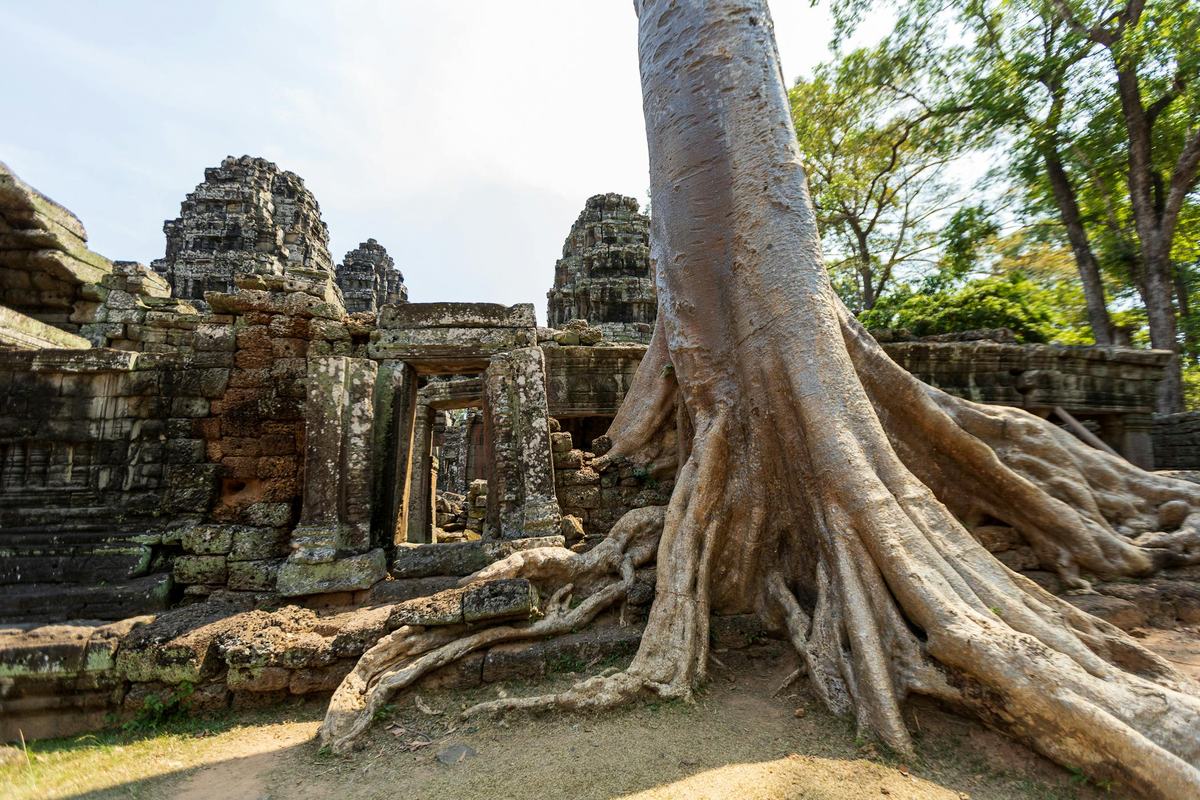
The École française d'Extrême-Orient (EFEO) made a deliberate methodological choice in the early 20th century to leave Ta Prohm in its partially collapsed, vegetation-entangled state rather than pursue full anastylosis restoration. This decision was partly aesthetic - preserving the romantic "discovered ruin" character - but carried genuine scientific value. Ta Prohm now functions as a control site against which restoration interventions at other Angkor temples can be measured, providing baseline data on unmanaged structural deterioration rates over century-long timescales.
How Tree-Root Entanglement Provides Data on Temple Decay Rates
The Tetrameles nudiflora and Ficus species roots threading through Ta Prohm's galleries exert documented lateral pressure on stone blocks, with some displacement measurements exceeding 30 centimeters over 50-year monitoring periods. Paradoxically, in several documented cases, root systems have stabilized collapsed sections by binding scattered stones into cohesive masses, preventing further dispersal. Researchers from the German Apsara Conservation Project have used Ta Prohm's decay patterns to model future structural risks at fully restored sites - turning an architectural casualty into an ongoing natural laboratory.
Cambodia's Unique Political and Legal Curiosities
Cambodia's Unique Political and Legal Curiosities
Cambodia Is One of the Few Countries That Explicitly Bans Water Guns in Its Constitution Period
The 2001 Law That Made Phnom Penh's Water Festival Significantly Less Fun
Cambodia's 2001 sub-decree prohibiting water pistols during public festivals stands as one of Southeast Asia's more unusual legislative acts. The ban emerged directly from Khmer New Year and Water Festival (Bon Om Touk) celebrations, where escalating water gun usage had reportedly contributed to public disorder and several injury incidents. The law carries fines for vendors and participants caught using pressurized water devices in public spaces during designated festival periods.
Comparing Cambodia's Unusual Bans to Thailand and Laos Festival Regulations
Thailand's Songkran celebrations operate under an entirely different regulatory philosophy - water gun use is not only permitted but commercially encouraged, generating an estimated $400 million in tourism revenue annually. Laos takes a moderate approach, with local municipalities issuing temporary restrictions rather than national-level prohibitions. Cambodia's blanket legislative approach reflects broader governmental tendencies toward centralized public order management rather than localized enforcement.
The Cambodian King Has Virtually No Executive Power But Immense Symbolic Authority
How the Throne Council Selects Kings Instead of Hereditary Succession
Cambodia's 1993 constitution established an elective monarchy unique in modern Asia. Upon a king's death or abdication, a nine-member Throne Council - comprising the presidents of the National Assembly and Senate, the Prime Minister, heads of Buddhist orders, and senior royal family members - selects the next monarch within seven days. Candidates must be male members of three specific royal bloodlines, aged between 30 and 60. King Norodom Sihamoni was selected through this process in 2004 following his father's abdication.
Comparing Cambodia's Monarchy Model to Bhutan and Thailand
Bhutan maintains strict hereditary succession through the Wangchuck dynasty, with the monarch retaining genuine executive authority over key policy domains. Thailand's constitutional monarchy more closely resembles Cambodia's ceremonial model, though Thai kings historically wielded considerably more political influence. Cambodia's arrangement deliberately minimizes royal executive power - the king cannot veto legislation, dissolve parliament unilaterally, or appoint ministers independently.
Cambodia Had More Landmines Per Square Kilometer Than Any Nation in History
The Ongoing Demining Effort That Will Last Until at Least 2040
Estimates suggest between 4 and 6 million landmines and unexploded ordnance remain embedded across approximately 2,000 square kilometers of Cambodian territory. The Cambodian Mine Action Authority projects full clearance no earlier than 2040, despite decades of systematic demining operations.
Comparing Cambodia's Landmine Density to Angola and Bosnia
Angola contains roughly 3 million landmines across a territory 16 times larger than Cambodia's affected zones. Bosnia's contamination, covering approximately 1,000 square kilometers, represents a similar geographic scale but with lower overall device density.
How Demining Has Transformed Agricultural Land Availability
Since 1992, demining operations have cleared over 3,000 square kilometers, directly returning roughly 1.2 million hectares to productive agricultural use and reducing annual landmine casualties from approximately 4,000 in 1996 to under 100 by 2020.
Hidden Facts About Cambodia's Connections to the Wider World
A Chinese Diplomat's 13th Century Travel Diary Is Still the Most Accurate Account of Angkor
Zhou Daguan's Descriptions That Modern Archaeology Has Repeatedly Confirmed
Zhou Daguan arrived at Angkor in 1296 as part of a Chinese diplomatic mission and spent approximately 11 months documenting everything he observed. His text, The Customs of Cambodia (Zhenla Fengtu Ji), remained the single most reliable written account of the Khmer Empire at its peak - and modern archaeological excavations keep proving why.
When researchers began systematic LiDAR surveys of the Angkor region between 2012 and 2015, they mapped a urban network extending over 1,000 square kilometers, largely matching Zhou's descriptions of a densely populated administrative complex. He recorded wooden palace structures surrounding stone temples, a detail that confused early Western archaeologists who found no evidence of residential buildings - because they were looking for stone. Excavations eventually confirmed extensive wooden infrastructure exactly where Zhou said it existed.
What His Record Reveals About Khmer Daily Life That Stone Carvings Cannot
Stone temple reliefs document warfare, religious ceremony, and royal procession. Zhou documented everything else: market economics, sexual customs, disease treatment, fishing techniques, and the role of women in commerce. He noted that Khmer women dominated local trade, a social pattern corroborated by later Portuguese and Spanish accounts from the 16th century. He also described a population that bathed multiple times daily in the moat systems - practical hygiene infrastructure that temple carvings never bothered to depict.
Cambodia Was a Neutral Country During the Cold War That Got Bombed More Than Any Neutral Nation Ever
Comparing US Bombing Tonnage in Cambodia to All of World War II in Europe
Between 1965 and 1973, the United States dropped approximately 2.7 million tons of ordnance on Cambodia. The Allied forces dropped roughly 2.7 million tons across all of Europe during the entirety of World War II. Cambodia, a country that had declared neutrality under Prince Sihanouk, absorbed a bombing campaign statistically equivalent to the entire European theater of the deadliest conflict in human history.
How Operation Menu's Secrecy Changed International Law on Covert Military Action
Operation Menu, launched in 1969 under Nixon, involved falsified military records to conceal strikes from Congress. Pilots filed false coordinates; official documents listed missions as occurring inside South Vietnam. When the program was exposed in 1973, it directly contributed to the War Powers Resolution passed that same year, which legally required presidents to notify Congress within 48 hours of committing forces to military action. Cambodia's destruction produced one of America's most significant constraints on executive military power.
Cambodian Silk Was Traded Along the Maritime Silk Road Before China's Silk Became Dominant
Textile Evidence From Ancient Mediterranean Trade Routes
Sericulture in Cambodia predates widespread Chinese export dominance in Southeast Asia. Archaeological textile fragments and iconographic evidence from Funan-period sites (roughly 1st to 6th century CE) indicate active silk production integrated into Indian Ocean trade networks. Khmer silk reached South Asian markets through ports along the Gulf of Thailand, operating within the same Maritime Silk Road system that later Chinese and Arab merchants would formalize.
The Revival of Cambodian Mulberry Silk and Its Comparison to Vietnamese and Thai Silk
Khmer silk uses a distinctive two-layer weaving technique called ikat (chong kiet), producing simultaneous pattern control on warp and weft threads - a technical complexity that differentiates it from Vietnamese silk's predominantly single-layer weft ikat. Thai silk, particularly from the northeast, shares regional weaving traditions but typically employs different dye profiles, favoring synthetic colorants commercially. Cambodian mulberry silk revival programs, supported by organizations including UNESCO since the early 2000s, have reestablished traditional natural dye processes using plants like Shorea obtusa for yellows and indigo for blues, recovering techniques that industrial production had nearly eliminated.