Why Central African Republic Is One of the World's Most Overlooked Nations
The Country Sits on One of Earth's Most Ancient Geological Formations
How the Congo Craton Shapes CAR's Landscape Differently From Neighboring Countries
The Central African Republic rests atop the Congo Craton, a stable Precambrian shield estimated to be between 2 and 3.5 billion years old. Unlike the geologically active Rift Valley systems shaping eastern Africa, this ancient basement rock creates CAR's characteristically flat-to-rolling plateau terrain, averaging 600 meters above sea level. The craton's rigidity prevents the dramatic mountain-building and volcanic activity seen in Rwanda or the Democratic Republic of Congo's eastern edge, giving CAR a subdued but geologically fascinating landscape carved primarily by river erosion rather than tectonic violence.
The Mineral Wealth Hidden Beneath Its Surface: Diamonds, Gold, and Uranium Compared to Global Reserves
The same ancient geology that flattened CAR's terrain concentrated extraordinary mineral wealth beneath it. CAR holds an estimated 3–5% of global diamond reserves, with artisanal mining producing roughly 300,000 to 400,000 carats annually before the 2013 conflict disrupted output. The Bakouma uranium deposit in the southeast contains approximately 18,000 tonnes of uranium oxide, modest by global standards but significant for a landlocked, infrastructure-poor nation. Gold deposits remain largely unmapped and underexploited, representing a substantial unknown economic variable.
CAR Is One of the Least Light-Polluted Countries on the Planet
What Makes Its Night Skies Among the Darkest in the World
With a population density of roughly 7 people per square kilometer and virtually no industrial infrastructure outside Bangui, CAR generates negligible artificial light at night. Light pollution maps consistently place the majority of CAR's territory in Bortle Class 1 or 2 zones - the darkest classifications on the scale - where the naked eye can detect stars down to magnitude 7.6 and the Milky Way casts visible shadows. The Dzanga-Sangha reserve in the southwest represents one of the most pristine dark-sky environments on Earth.
How CAR's Light Pollution Levels Compare to France, the USA, and Even Chad
France averages a Bortle Class 6–7 across most inhabited regions; the continental USA rarely dips below Class 4 outside designated dark-sky parks. Even Chad, another sparsely populated Sahelian nation, shows greater light contamination around N'Djamena and its northern oil infrastructure. CAR's near-total absence of grid electricity - with national electrification rates below 15% - inadvertently creates conditions that astronomers actively travel thousands of kilometers to find elsewhere.
It Is the Only Country in the World Named After Its Geographic Position Within a Continent
The Deliberate Naming Logic Behind 'Central African Republic'
Upon independence from France in 1960, the country's founders chose a name that was purely descriptive and intentionally neutral, avoiding ethnic, colonial, or dynastic references. "Central African Republic" directly translates its French name, République Centrafricaine, signaling geographic identity over political or cultural allegiance - a conscious modernist choice among newly decolonized states.
How This Name Compares to Other African Countries Named After Geography
Most geographically named African states reference specific physical features: Cameroon derives from Rio dos Camarões (River of Prawns), Niger and Nigeria from the Niger River, and Equatorial Guinea from the equator. None, however, name themselves solely by continental position. CAR remains uniquely abstract in this regard - not a river, mountain, or coastline, but simply a coordinate within a continent, making it singular in global nomenclature.
Surprising Geographic and Environmental Facts About Central African Republic
CAR Is One of the Few Countries Entirely Within the Tropics Yet Has No Coastline
Central African Republic sits entirely between roughly 2°N and 11°N latitude, placing every square kilometer of its 622,984 km² within the tropics - yet it has zero coastline. This combination is rarer than it sounds. Most tropical nations have at least some coastal access; CAR shares this landlocked-tropical status with only a handful of countries including Uganda, Rwanda, and Burundi.
How Its Landlocked Status Affects Trade Routes Compared to Landlocked Switzerland or Bolivia
Switzerland compensates for its landlocked status with exceptional rail infrastructure, negotiated river-access rights through Germany and the Netherlands, and GDP per capita exceeding $90,000. Bolivia, also landlocked and tropical, at least borders Chile and Peru with functional Pacific corridors. CAR has none of these advantages. Its nearest functional port is Douala, Cameroon - roughly 1,500 km away over deteriorating roads - making import and export costs among the highest on the continent as a percentage of cargo value.
The Distance to the Nearest Ocean and What That Means for Daily Life
Bangui, the capital, sits approximately 1,200 km from the Atlantic coast and over 2,500 km from the Indian Ocean. Fuel, medicine, and manufactured goods must traverse multiple international borders before reaching markets. This geographic reality contributes directly to consumer prices that can run 30–50% higher than coastal neighbors for identical goods.
The Country Contains the Headwaters of Three Major African River Systems
The Ubangi, Sangha, and Chari Rivers: Where They Begin and Where They End
CAR's elevated central plateau, reaching around 600–900 meters, feeds three distinct drainage basins. The Ubangi flows south to join the Congo River. The Sangha drains southwest into the Congo basin as well. The Chari (Shari) runs northward into Lake Chad - a completely separate terminal basin. Few countries simultaneously feed both the Congo system and the Lake Chad system.
How CAR Acts as a Water Tower for Central and West Africa
The Chari River supplies approximately 90% of Lake Chad's inflow, making CAR's rainfall patterns directly relevant to water security across Chad, northeastern Nigeria, and Niger. Deforestation in CAR's north has measurable downstream effects on a lake already reduced to roughly 10% of its 1960s surface area.
Dzanga-Sangha Is One of the Last Refuges for Forest Elephants and Western Lowland Gorillas
The Dzanga Bai Clearing: A Natural Wildlife Phenomenon Rarely Seen Elsewhere in Africa
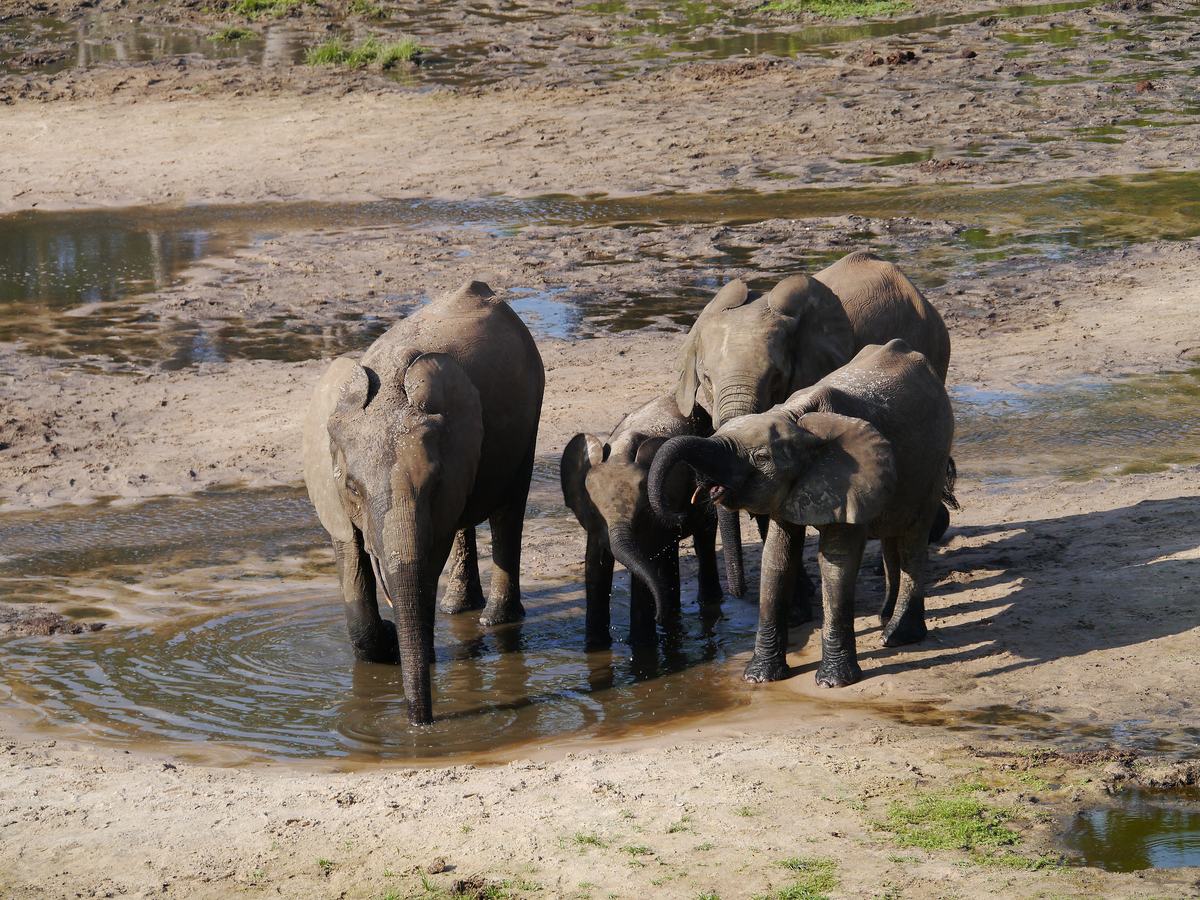
Dzanga Bai is a 1 km² mineral-rich forest clearing in the southwestern corner of CAR where forest elephants congregate in numbers rarely observed anywhere else - sometimes exceeding 100 individuals simultaneously. Researchers have identified over 4,000 individual elephants at this single site using ear-notch identification.
Comparing CAR's Forest Elephant Population Density With Gabon and Congo
Gabon holds the largest forest elephant population globally, estimated at 60,000–95,000 individuals. CAR's Dzanga-Ndoki sector maintains exceptional density within a much smaller protected area, making it scientifically disproportionate in conservation value relative to its size.
CAR Has One of the Lowest Road Density Ratios in the World
How Many Kilometers of Paved Road Exist Per Square Kilometer of Territory
CAR has approximately 24,000 km of roads total, but only around 700–800 km are paved - giving a paved road density of roughly 0.001 km of paved road per km² of territory. The national network was already inadequate at independence in 1960 and has degraded further since.
Comparing CAR's Infrastructure Density With Mongolia, Greenland, and Other Sparse Nations
Mongolia, often cited as a sparse-infrastructure nation, has approximately 4,800 km of paved road across 1.56 million km² - a comparable ratio, but Mongolia's nomadic population has historically required less fixed infrastructure. Greenland's road network barely connects individual towns. What distinguishes CAR is that it has a population of approximately 5.5 million people - genuinely needing road connectivity - yet the infrastructure gap remains structurally unfilled due to chronic conflict and institutional underfunding.
Little-Known Historical Facts About Central African Republic
The Banda and Baya Peoples Built Complex Stateless Societies Before Colonial Arrival
How Decentralized Governance Worked Among CAR's Pre-Colonial Populations
The Banda and Baya (also called Gbaya) peoples, who together represent a significant portion of CAR's population, organized themselves without chiefs, kings, or centralized authority. Governance operated through elder councils, age-grade systems, and lineage networks that mediated disputes, coordinated agriculture, and managed inter-village relations. Decision-making was deliberately distributed - no single individual accumulated binding political authority. This wasn't an absence of governance; it was a deliberate architecture resistant to external domination.
Comparing These Structures to the Centralized Kingdoms of Neighboring Cameroon and Sudan
Contrast this with the Sultanate of Dar al-Kuti in what is now northern CAR and southern Sudan, or the Bamum Kingdom in Cameroon - both hierarchical, tribute-based states with standing armies. The stateless Banda and Baya proved extraordinarily difficult to subjugate precisely because there was no central authority to capture or co-opt. French colonial administrators found this deeply frustrating and administratively expensive.
The Bokassa Empire: The Only Modern African Country to Briefly Become an Empire
Why Jean-Bédel Bokassa Crowned Himself Emperor in 1977 in a Ceremony That Cost a Third of the National Budget
On December 4, 1977, Jean-Bédel Bokassa renamed the Central African Republic the Central African Empire and crowned himself Emperor Bokassa I. The coronation cost an estimated $20–30 million USD - approximately one-third of the country's annual national budget at the time, largely funded by France. The event was modeled explicitly on Napoleon Bonaparte's 1804 coronation, down to the hand-sewn robes, white horses, and imperial eagle motifs.
How the Bokassa Coronation Compared in Cost to Napoleon's Coronation Adjusted for Inflation
Napoleon's coronation cost roughly 8.7 million French francs in 1804 - equivalent to approximately $50–60 million in 2024 USD when adjusted for inflation. Bokassa's ceremony, while nominally cheaper in absolute terms, represented a catastrophically larger share of national GDP. France, then providing substantial budget support to CAR, essentially financed a spectacle for a country with one of the world's lowest per capita incomes.
The French Colonial Name 'Oubangui-Chari' and Its Forgotten Cultural Legacy
What the Name Oubangui-Chari Meant and Why It Was Abandoned at Independence
Oubangui-Chari derived from the two major rivers defining the territory's borders - the Ubangi (Oubangui) River to the south and the Chari (Sangha-Chari) River to the north. France administered it as part of French Equatorial Africa from 1910 until independence in 1960. The name was purely geographic and administratively convenient, carrying no indigenous cultural meaning - one reason new leadership rejected it immediately at independence.
How Colonial Borders Cut Across Ethnic Groups in Ways Unique Even by African Standards
CAR's borders divided at least 80 distinct ethnic groups across multiple modern nation-states. The Zande people, for instance, were split between CAR, Democratic Republic of Congo, and South Sudan. The Chadian-CAR border bisected Sara-speaking communities. Unlike some colonial boundaries that occasionally followed geographic or ethnic logic, CAR's frontiers were drawn almost entirely for French administrative convenience during the 1884–1885 Berlin Conference era, producing ethnic fragmentation with measurable consequences for post-independence cohesion.
CAR Was One of the First African Nations to Experience a Coup Within Two Years of Independence
The 1966 Coup and Its Historical Pattern Compared to Other Post-Independence African States
CAR gained independence on August 13, 1960. By January 1, 1966 - just five years later - Colonel Jean-Bédel Bokassa overthrew President David Dacko in a bloodless coup. While Ghana's 1966 coup against Nkrumah is better known, CAR's instability fit a documented pattern: a 2016 study covering 1960–2010 identified sub-Saharan Africa as experiencing over 80 successful coups, with the highest concentration occurring in the decade immediately following independence.
Why CAR's Political Instability Has Deep Structural Historical Roots
CAR's instability isn't random. The French extracted rubber, ivory, and labor through concessionary companies that systematically destroyed local economic structures between 1900 and 1930. Infrastructure investment was minimal - CAR received far less colonial development spending than coastal West African territories. At independence, the country had fewer than 100 university graduates and virtually no administrative class. These structural deficits created conditions where military intervention became a rational political strategy for ambitious actors lacking legitimate institutional pathways to power.
Remarkable Cultural Facts About Central African Republic
Sango: A Creole Trade Language That Became a National Identity Symbol
How Sango Evolved From a Riverine Trade Pidgin Into a Full National Language
Sango originated along the Ubangi River in the late 19th century as a simplified contact language between Ngbandi-speaking riverine traders and neighboring communities. French colonial administrators accelerated its spread by using it as an administrative lingua franca across a territory containing over 80 mutually unintelligible languages. By independence in 1960, Sango had already penetrated markets, military barracks, and mission schools. Today it is spoken by approximately 92% of the population as a second language, with roughly 350,000–500,000 native speakers - a striking expansion for a language that began as functional pidgin. Linguists classify modern Sango as a creole: it has a stabilized grammar, an expanding native speaker base, and expressive capacity extending well beyond trade contexts into poetry, politics, and religious liturgy.
Comparing Sango's Role in CAR With Swahili in East Africa and Hausa in West Africa
Swahili serves roughly 200 million speakers across 10+ East African countries; Hausa reaches an estimated 100 million across the Sahel. Sango, by contrast, unifies a single country of approximately 5.5 million people - yet its penetration rate within CAR rivals these regional giants proportionally. Unlike Hausa, which carries strong Islamic cultural associations, Sango is ethnically and religiously neutral, making it a rare example of a genuinely unifying national language without dominant-group baggage.
The Aka Pygmies of CAR Practice One of the World's Most Complex Polyphonic Music Traditions
Aka Vocal Polyphony: Recognized by UNESCO and Compared to Georgian Polyphony and Sardinian Cantu
UNESCO inscribed Aka Polyphony on its Intangible Cultural Heritage list in 2008, placing it alongside Georgian three-part vocal traditions and Sardinian cantu a tenore as among the world's most sophisticated oral musical systems. Aka singers produce simultaneous, interlocking melodic lines - often four or more independent voices - without a designated conductor or written score. Field recordings by ethnomusicologist Simha Arom in the 1970s–80s demonstrated that Aka polyphony involves hocket technique, yodel, and contrapuntal improvisation operating within precise structural rules invisible to untrained listeners.
How Aka Music Is Structurally Different From Any Western Musical Tradition
Western polyphony is fundamentally hierarchical: a harmonic framework governs which combinations of notes are permissible. Aka polyphony operates instead through a process called "dense interlock," where each voice contributes a fragmentary melodic cell that only acquires coherence in combination with others. No single voice carries the melody. This means removing any one singer collapses the entire musical structure - a social metaphor the Aka explicitly recognize. The system has no parallel in European classical or folk traditions.
CAR Has One of the World's Highest Rates of Belief in Witchcraft Intersecting With Daily Legal Life
How Witchcraft Accusations Are Handled in CAR Courts Compared to Legal Systems in South Africa and Kenya
CAR's Penal Code criminalizes witchcraft under Article 149, making it one of relatively few African states to codify supernatural harm as a prosecutable offense. South Africa's Witchcraft Suppression Act of 1957 (amended 1970) similarly criminalizes the accusation of witchcraft rather than its practice - a legally inverted approach. Kenya has no equivalent statute. In CAR, courts regularly hear cases where defendants are accused of causing illness or death through mystical means, and convictions occur. A 2011 study by the United Nations estimated that witchcraft-related violence - including mob killings - accounts for a measurable percentage of extrajudicial deaths in rural prefectures.
The Role of Nganga Traditional Healers in Parallel Justice Systems
Nganga - traditional healer-diviners - function as investigators, judges, and therapists simultaneously in communities where state courts are physically inaccessible, which describes the majority of CAR's territory. A nganga may identify a witch, prescribe a counter-ritual, and mediate family compensation, resolving a dispute that would otherwise go unaddressed for years. This parallel system is not merely tolerated; in many prefectures it is the primary justice mechanism. Anthropologist Susan Rood documented cases in the 1990s where local administrators quietly deferred witchcraft disputes to nganga rather than attempting formal prosecution - a pragmatic acknowledgment of institutional limits.
The Country Has More Than 80 Distinct Ethnic Groups in a Territory Smaller Than Texas
A Comparison of Ethnic Density in CAR vs. Nigeria, Cameroon, and Papua New Guinea
CAR's 623,000 km² hosts over 80 ethnic groups among 5.5 million people. Nigeria contains approximately 250–400 ethnic groups across 923,000 km² with 220 million people - a far larger absolute number but a much lower density relative to population. Cameroon, sometimes called "Africa in miniature," hosts roughly 250–280 groups across 475,000 km². Papua New Guinea remains the global outlier with 800+ languages in 463,000 km². By the metric of ethnic groups per capita, CAR's figure is extraordinary: roughly one distinct ethnic identity per 68,000 citizens.
How This Diversity Shapes Marriage Customs, Burial Rites, and Food Traditions Across Regions
Among the Banda of the central plateau, bride wealth is negotiated in livestock and labor service over multiple years. The Baya of the west practice masked funeral ceremonies lasting up to a week, with distinct ritual roles for maternal and paternal lineages. Northern Runga communities follow Islamic dietary laws, while southern Zande traditions involve fermented cassava preparations and communal millet beer entirely absent from Muslim-majority northern prefectures. These differences are not superficial: they represent distinct cosmological systems operating simultaneously within one national border.
Body Scarification in CAR Carries Precise Ethnic and Social Coding Still Practiced Today
What Different Scarification Patterns Signal About Identity, Status, and History
Among the Ngbaka, facial scarification patterns indicate clan membership with a specificity comparable to heraldry - particular line configurations identify a person's paternal lineage, residential origin, and initiation status. Among the Gbaya, chest and abdominal scarification historically marked male warriors who had killed in combat, a practice that declined but did not disappear following colonial pacification. Scarification continues among adolescents in rural areas as initiation marking, signaling the transition to social adulthood in contexts where state-issued identity documents remain inconsistently available.
How CAR Scarification Traditions Compare to Those of the Nuer in South Sudan and the Tiv in Nigeria
Nuer gaar (forehead scarification) consists of six parallel horizontal lines cut across the entire forehead at male initiation - a single standardized pattern applied uniformly across a large ethnic group. Tiv scarification in Nigeria uses a broader vocabulary of abdominal patterns but similarly functions as group identity marking. CAR's scarification traditions are distinctive in their regional and clan-level specificity: rather than one pattern per ethnicity, multiple sub-group patterns coexist within single ethnic categories, producing a more granular identity-coding system with hundreds of meaningful variations documented by anthropologists including Eric de Dampierre in his mid-20th century fieldwork among the Nzakara.
Startling Economic and Development Facts About Central African Republic
CAR Consistently Ranks at or Near the Bottom of the Human Development Index
What HDI Score CAR Holds and How It Compares to Niger, Chad, and South Sudan
The Central African Republic recorded an HDI score of 0.394 in the 2023 UNDP Human Development Report, placing it 188th out of 193 countries - one of only a handful of nations clustered at the absolute floor of global development metrics. Niger (0.394), South Sudan (0.381), and Chad (0.394) occupy the same grim neighborhood, but CAR distinguishes itself by the consistency of its bottom ranking across nearly every sub-index: life expectancy at birth hovers around 53 years, mean years of schooling sit below 4.3 years, and gross national income per capita remains under $1,000 PPP annually.
The Paradox of Extreme Mineral Wealth and Extreme Human Poverty in the Same Territory
CAR sits atop verified deposits of diamonds, gold, uranium, cobalt, and coltan. The contradiction is stark: a territory endowed with resources that power global electronics and jewelry markets cannot provide reliable electricity to its own capital city for more than a few hours daily. Less than 15% of the population has access to electricity nationally. This is not a resource curse in the conventional sense - it is a governance and security vacuum that prevents extraction from translating into fiscal revenue, infrastructure, or social services.
Diamonds Are Mined Largely by Hand Using Methods Unchanged Since the Colonial Era
Artisanal Diamond Mining in CAR Compared to Industrial Mining in Botswana and South Africa
Approximately 400,000 Central Africans depend on artisanal and small-scale diamond mining, using hand sieves, shovels, and rudimentary sluicing equipment across alluvial riverbeds - technology essentially identical to what Belgian and French concessionaires used in the 1930s. Contrast this with Botswana's Jwaneng mine, one of the world's most productive, which deploys fully mechanized open-pit operations generating over $3 billion in revenue annually and contributing roughly 70–80% of Botswana's export earnings through a structured state-corporate partnership. CAR's entire formal diamond export value rarely exceeds $30–40 million per year, a figure that likely represents a fraction of actual production given pervasive smuggling.
How the Kimberley Process Has Struggled to Monitor CAR's Conflict Diamond Trade
CAR was suspended from the Kimberley Process Certification Scheme in May 2013 following the Séléka coup, which saw armed groups seize direct control of mining zones. Although partially reinstated in 2015 with a zonal compliance system, independent monitors have repeatedly documented that diamonds from non-compliant zones - controlled by armed factions - continue entering certified supply chains through fraudulent provenance documentation. The fundamental problem is structural: the KP requires functioning state customs infrastructure that CAR simply does not possess in most diamond-producing territories.
The Capital Bangui Generates the Majority of the Country's Formal Economic Activity
How CAR's Urban Primacy Compares to France's Paris Dominance and Thailand's Bangkok Concentration
Bangui, home to roughly 950,000 people in a country of approximately 5.5 million, accounts for an estimated 60–70% of formal GDP - a concentration extreme even by developing-world standards. Thailand's Bangkok contributes around 44% of national GDP while holding 17% of the population. Paris, often cited as Europe's most dominant primate city, generates approximately 31% of French GDP. Bangui's dominance is less a sign of urban productivity than of how thoroughly economic formality has collapsed elsewhere in the country.
Why Economic Activity Outside Bangui Is Almost Entirely Informal and Subsistence-Based
Beyond Bangui, the absence of paved roads connecting major towns, the collapse of rural banking infrastructure, and persistent armed group activity have made market integration functionally impossible across vast interior regions. Prefectures like Vakaga, Haute-Kotto, and Mbomou operate almost entirely through barter, subsistence agriculture, and informal cross-border trade with Sudan, DRC, and Cameroon. These transactions generate no tax revenue, appear in no national accounts, and leave rural populations exposed to price shocks with zero formal safety net.
CAR Has One of the Lowest Mobile Phone Penetration Rates in Africa Despite Abundant Coltan Deposits
The Irony of Exporting Minerals Used in Electronics While Having Almost No Digital Infrastructure
CAR exports coltan - the ore refined into tantalum, a critical component in capacitors found in virtually every smartphone - yet mobile penetration stands at approximately 22–25%, among the lowest on a continent where the sub-Saharan African average exceeds 50%. The country exports the raw material for digital connectivity while remaining digitally isolated, a circularity that encapsulates the broader resource-governance failure.
Comparing Mobile Penetration Rates in CAR With Rwanda, Ethiopia, and Democratic Republic of Congo
Rwanda, which has invested aggressively in ICT infrastructure since the mid-2000s, now reports mobile penetration above 85%. Ethiopia, despite being a much larger and historically less connected country, crossed 50% penetration following market liberalization and Safaricom's 2022 entry. Even the Democratic Republic of Congo - which shares CAR's conflict history and governance challenges - maintains penetration rates above 45%. CAR's figure reflects not consumer disinterest but the absence of tower infrastructure, reliable power for charging, and per-capita income sufficient to sustain airtime expenditure.
Fascinating Wildlife and Biodiversity Facts About Central African Republic
CAR Is Home to the Largest Contiguous Block of Rainforest in Central Africa After DRC
The Lobaye and Mambéré-Kadéï Forests and Their Global Biodiversity Significance
The southwestern corner of CAR holds roughly 58,000 square kilometers of dense lowland rainforest, anchored primarily by the Lobaye and Mambéré-Kadéï prefectures. These forests form part of the broader Congo Basin ecosystem-the second-largest tropical rainforest on Earth-and harbor confirmed populations of western lowland gorillas, forest elephants, bongo antelope, and over 650 documented bird species. The Dzanga-Sangha Protected Area Complex, spanning approximately 4,500 square kilometers within this zone, is recognized under the UNESCO World Heritage framework as a site of outstanding universal value, particularly for its dense forest elephant concentrations at the Dzanga Bai mineral clearing.
How Deforestation Rates in CAR Compare to Brazil's Amazon and Indonesia's Borneo
CAR's annual deforestation rate hovers around 0.06%, substantially lower than Brazil's Amazon at approximately 0.3% and Indonesia's Borneo forests at over 1% annually during peak years. This relative preservation owes less to policy success and more to low population density-CAR averages roughly 8 people per square kilometer-and limited road infrastructure. However, artisanal logging, charcoal production, and agricultural encroachment are accelerating pressure, particularly within 50 kilometers of Bangui.
The Giant Lord Derby Eland Found in CAR's Savanna Is the World's Largest Antelope
Physical Dimensions and Behavioral Traits That Set Lord Derby Eland Apart
Taurotragus derbianus derbianus, the western giant eland, reaches shoulder heights of up to 1.8 meters and can weigh over 900 kilograms in mature bulls. Unlike common elands, Lord Derby elands display dramatic vertical white body stripes-up to 15 in number-and possess a prominent dewlap and spiraling horns exceeding 120 centimeters. They are notably secretive, favoring dense woodland-savanna transition zones and demonstrating crepuscular movement patterns that complicate population surveys.
Why CAR's Population Is Critical to the Species' Survival Compared to Senegal and Cameroon Populations
The IUCN classifies the western giant eland as Critically Endangered. Senegal's Niokolo-Koba National Park holds fewer than 50 individuals, while Cameroon's population remains fragmented and under persistent poaching pressure. CAR's Manovo-Gounda St. Floris National Park historically sheltered the largest remaining population, estimated at several hundred individuals before armed conflict severely disrupted wildlife monitoring after 2012.
CAR Has Documented Populations of the Rarely Seen African Golden Cat
Why the African Golden Cat Is One of the Least Studied Wild Cats on Earth
Caracal aurata occupies dense equatorial forest and remains one of the most poorly understood felids globally. No reliable global population estimate exists. Camera trap studies across its range collectively number fewer than 1,000 independent photographic detections.
Comparing Camera Trap Data From CAR With Findings From Gabon and Uganda
Research within Dzanga-Sangha has yielded sparse but confirmed detections, consistent with its extremely low trap rates-often below 0.5 captures per 100 trap-nights-documented in Gabon's Lopé National Park and Uganda's Bwindi Impenetrable Forest. Bwindi data suggests density estimates of roughly 3–5 individuals per 100 square kilometers, figures likely applicable to CAR's southwestern forests given habitat similarity.
Unexpected Political and Social Facts About Central African Republic
CAR Has Had More Coups and Coup Attempts Per Year of Independence Than Almost Any Other Nation
A Statistical Comparison of Coup Frequency in CAR vs. Bolivia, Thailand, and Sudan
Since independence in 1960, CAR has experienced at least six successful coups and numerous additional attempts, yielding a coup frequency roughly equivalent to one successful overthrow every decade. Bolivia - historically considered the world's coup capital - recorded over 180 coups in its first 160 years but has stabilized dramatically since the 1980s. Thailand averaged a coup roughly every eight years throughout the 20th century. Sudan experienced significant instability but built longer periods of consolidated authoritarian rule. CAR stands apart because its coups have never produced durable governance - each regime typically collapsed within years, creating a recursive cycle rather than episodic disruption.
What Structural Factors Drive CAR's Exceptional Political Instability
Three reinforcing factors explain this pattern. First, CAR's colonial borders enclosed dozens of ethnic and linguistic communities without creating integrative institutions. Second, the state's revenue base is almost entirely dependent on extractive industries concentrated in peripheral regions, meaning armed groups controlling those zones can perpetually challenge Bangui's authority. Third, external patronage - from France, Libya under Gaddafi, and later Russia - has repeatedly propped up or destabilized successive governments based on foreign interests rather than domestic legitimacy.
Russian Mercenaries From the Wagner Group Have Played a Larger Role in CAR Than in Any Other African Country
How Wagner's Involvement in CAR Differs From Their Operations in Mali, Libya, and Mozambique
Wagner entered CAR around 2018, embedding personnel directly within presidential security structures - a level of institutional penetration not replicated in Mali or Libya, where their role remained more operationally transactional. In Mozambique, Wagner withdrew after suffering significant casualties in 2019. In CAR, their presence expanded, with estimates placing between 1,000 and 2,000 personnel in the country by 2021–2022, functioning simultaneously as palace guards, military trainers, and frontline combatants against armed coalitions like the CPC.
The Economic Concessions Exchanged for Security: Mines, Timber, and Influence
Security provision came with a price. Wagner-linked companies secured concessions in diamond and gold mining, notably in Ndassima - one of CAR's most productive gold deposits. Timber rights in western regions were also reportedly transferred to Russian-affiliated entities. State media outlets were effectively replaced by Wagner-produced content, including a radio station and newspaper. This model - security for resource extraction rights - represented a more comprehensive economic integration than Wagner achieved anywhere else on the continent.
CAR Has a Constitution That Explicitly Separates State and Religion Despite High Religious Diversity
How CAR's Secular Constitutional Framework Compares to Neighboring Chad and Sudan
CAR's 2016 constitution explicitly establishes a secular republic, prohibiting the establishment of a state religion. This positions CAR differently from Sudan, whose 2019 transitional documents only partially dismantled decades of Islamic law, and from Chad, whose constitution declares secularism but has historically accommodated significant Islamic influence in northern governance structures. Given that CAR's population is approximately 50% Christian, 35% Muslim, and 15% practitioners of indigenous religions, the secular framework was designed as a neutral ground rather than a reflection of majority preference.
The Tension Between Constitutional Secularism and the Role of Religious Armed Groups
The constitutional text, however, contrasts sharply with ground reality. The Séléka coalition, which seized power in 2013, was predominantly Muslim, while the Anti-Balaka militias that emerged in response were largely Christian. Both groups committed atrocities framed in religious terms, producing what the UN described as potential crimes against humanity. The conflict has periodically displaced over one million people internally and created over 700,000 refugees abroad. Constitutional secularism has proven insufficient without institutions capable of enforcing it.
Bangui Has Served as a Refuge City for Displaced Populations From Multiple Neighboring Conflicts
How CAR Simultaneously Produces and Receives Refugees Compared to Uganda and Lebanon
CAR occupies a paradoxical position in regional displacement dynamics: it is simultaneously one of Africa's largest refugee-producing nations and a recipient of refugees from Sudan, DRC, and Chad. Uganda hosts over 1.5 million refugees with robust UNHCR infrastructure; Lebanon absorbed over one million Syrians relative to a population of four million, under acute economic strain. Bangui's situation differs because the capital itself has experienced direct conflict, meaning the city absorbs displaced populations while remaining insecure. UNHCR estimates that by 2023, over 700,000 CAR nationals were refugees abroad while approximately 490,000 remained internally displaced.
The Role of MINUSCA as One of the UN's Most Complex Active Peacekeeping Missions
MINUSCA - the UN Multidimensional Integrated Stabilization Mission in CAR - was established in 2014 and by 2023 comprised approximately 15,000 uniformed personnel, making it one of the UN's largest active missions by headcount. Its mandate is unusually broad, encompassing civilian protection, support for transitional justice, disarmament programs, and electoral assistance. Critically, MINUSCA operates alongside Wagner forces, creating command ambiguity and documented tensions. The mission has faced criticism for insufficient protection of civilians during major offensives, yet remains the primary international security guarantor for much of the country's non-Wagner-covered territory.
Unusual Food and Daily Life Facts About Central African Republic
Termites Are a High-Protein Dietary Staple Consumed Across Ethnic and Class Lines in CAR
Unlike many cultures where insect consumption carries stigma, termite eating in the Central African Republic cuts across social boundaries. Both urban households in Bangui and rural communities in the Sangha-Mbaéré prefecture treat winged termites as a seasonal delicacy rather than a poverty food.
How Termite Consumption in CAR Compares Nutritionally to Beef and Chicken
Dried termites contain approximately 32–38 grams of protein per 100 grams, comparable to lean beef at roughly 26 grams and significantly higher than chicken breast at around 23 grams. They also deliver essential fatty acids and iron at concentrations that make them nutritionally competitive with conventional livestock. In a country where refrigeration is unreliable and meat spoils quickly, termites offer a shelf-stable protein source that requires no cold chain infrastructure.
The Cultural Significance of Termite Harvesting Seasons in Different Regions
Termite harvesting peaks during the early rainy season, typically April through June, when alates emerge from mounds in massive swarms. Communities treat this as a communal event-children gather termites using light traps or simply collect them by hand near mounds. In the southwest's forest zones, specific termite species differ from those in the savanna north, and preparation methods vary accordingly: pan-frying dominates in urban areas while sun-drying and smoking remain standard in rural zones.
Fufu and Gozo: Staple Foods That Define CAR's Cuisine Yet Are Almost Unknown Outside Central Africa
The Difference Between CAR's Gozo and the Fufu Found in West Africa and DRC
Gozo is made specifically from cassava flour fermented briefly before cooking, giving it a slightly sour profile absent in the blander Congolese fufu or the yam-based West African versions. The texture is denser and the fermentation period shorter than Ghanaian fufu, typically 24–48 hours versus several days. It is eaten daily by an estimated majority of the population, usually paired with a groundnut or leafy green sauce.
How Cassava Became the Foundation of CAR's Food Security Over Sorghum and Millet
Cassava displaced sorghum and millet as the primary caloric crop during the late colonial period partly because it tolerates poor laterite soils and erratic rainfall better. Today, CAR produces roughly 600,000–700,000 metric tons of cassava annually, making it the dominant crop by volume.
CAR Has One of the Lowest Life Expectancies in the World Yet One of the Highest Fertility Rates
Comparing CAR's Demographic Indicators With Niger, Mali, and Angola
CAR's life expectancy sits around 54 years, below Mali's 59 and Angola's 62, though Niger shares similarly low figures. CAR's fertility rate of approximately 6.0 births per woman rivals Niger's world-leading 6.7.
How Conflict, Disease Burden, and Healthcare Absence Interact to Shape CAR's Demographics
Malaria accounts for a significant share of under-five mortality, while CAR's physician density-roughly 0.07 per 1,000 people-leaves most of the country medically underserved. Decades of armed conflict have repeatedly destroyed health infrastructure, creating a cycle where high fertility partially compensates demographically for catastrophic child mortality rates exceeding 110 per 1,000 live births.