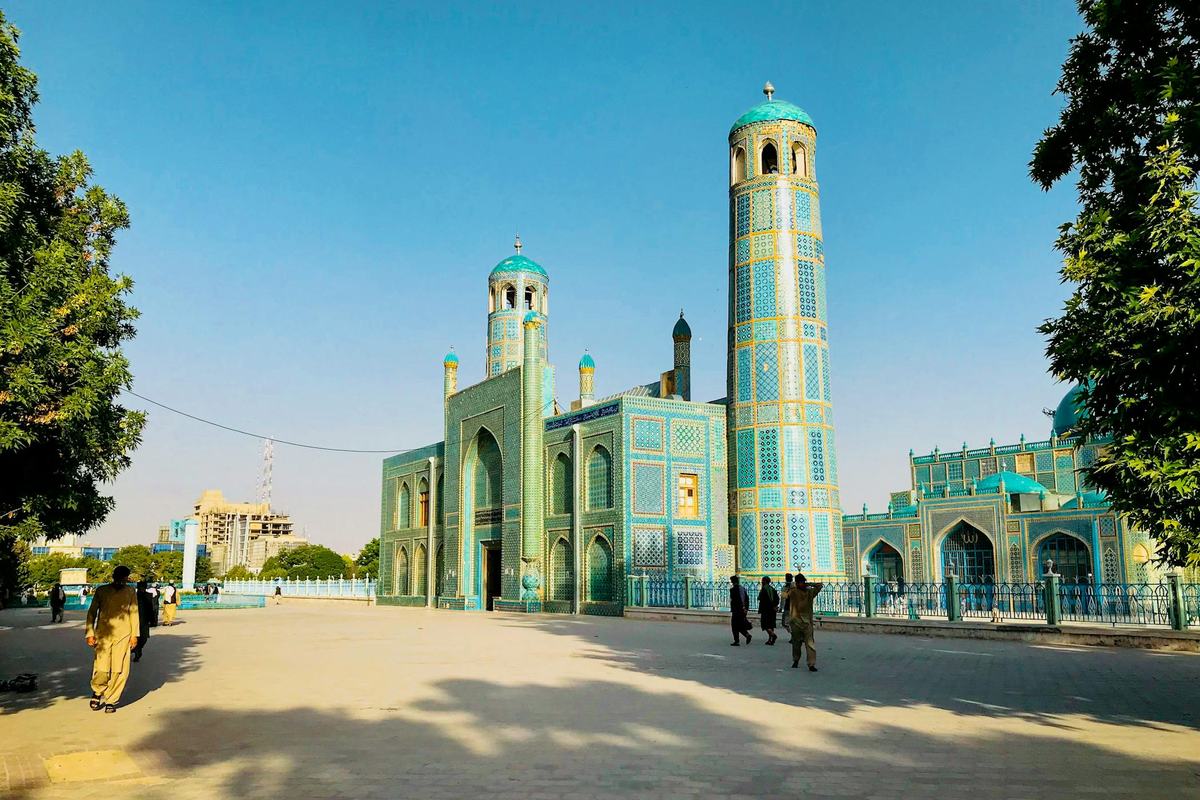
Afghanistan at a glance
- Capital: Kabul [1]
- Population: about 41 million (2023) [2]
- Area: 652,230 km² (251,830 sq mi) [1]
- Official languages: Pashto and Dari [1]
- Currency: Afghani (AFN) [1]
- Landlocked, with the Hindu Kush running across most of the country [3]
I had to look this up twice. Afghanistan shares a 76-kilometer border with China. Not Pakistan, not Iran, not the old Soviet republics, but China. The line runs along a high, narrow mountain valley called the Wakhan Corridor, and it exists because in 1893 the British and the Russians sat down and drew it on purpose, to keep their two empires from touching. The corridor is still there. The empires are not.
That's the kind of country Afghanistan is. Maps that look simple turn out to be the result of a hundred years of pressure from outside, and the place itself keeps on existing in spite of all of it.
The Wakhan Corridor and the Great Game
The Wakhan is a long, thin tongue of land in the far northeast, sometimes only 16 kilometers wide. [3] It pokes east between Tajikistan to the north and Pakistan to the south, and at its tip it hits China. There are no roads connecting the two countries through it. The pass is at over 4,900 meters and snowed in most of the year.
The corridor was carved out as a buffer zone during what the Victorians called the Great Game, the slow strategic standoff between Imperial Russia and the British Empire over Central Asia. [3] Neither side wanted to share a border. So the Wakhan got handed to Afghanistan and the line stuck. Today, the people who live in the corridor are mostly Wakhi and Kyrgyz herders, some of them still nomadic, living a life that would not look unrecognizable to a traveler from the 1800s.
Which, if you think about it, is one of those quiet bits of geography that explains a lot. Afghanistan is not on the way to anywhere by accident. It has been the place between places for as long as there have been places.
The Hindu Kush and a Country Made of Mountains
About three quarters of Afghanistan is mountain or rugged plateau. [3] The spine is the Hindu Kush, an extension of the greater Himalayan system, running northeast to southwest across most of the country with peaks above 7,000 meters. The name in Persian means roughly "Killer of Hindus", a grim reference to the slaves and travelers who used to die crossing the high passes.
The Hindu Kush has shaped almost everything about Afghan life. It splits the country into separate valley worlds, each with its own dialect and its own history. It made centralized rule difficult for any government, foreign or domestic, going back to Alexander the Great. It also gave Afghanistan some of the most spectacular high-altitude landscapes anywhere on Earth, from the deep blue of the Band-e Amir lakes to the ice fields above the Panjshir.
Back home in Montana, I grew up thinking I knew something about mountain country. Afghanistan is mountain country at a different scale. Whole provinces are accessible only by donkey path for half the year.
A Crossroads of Civilizations
Long before any of the modern borders, Afghanistan sat at the heart of the Silk Road, the trade network that connected China, India, Persia, and the Mediterranean for nearly fifteen centuries. [4] The cities that grew up along it, Balkh, Herat, Kandahar, Bamiyan, were among the richest and most cosmopolitan in the ancient world.
Balkh, in northern Afghanistan, is one of the oldest continuously inhabited cities on the planet, with traces of settlement going back over 3,500 years. [4] It was a center of Zoroastrianism, then a major Buddhist hub, then a Persian, then an Islamic capital. Bamiyan, west of Kabul, was for centuries home to the largest standing Buddha statues in the world, carved into a sandstone cliff between the 6th and 7th centuries. [5] The Taliban dynamited them in 2001. UNESCO designated the surrounding cultural landscape a World Heritage Site in 2003. [5]
Turns out, the more recent history of Afghanistan tends to overwrite a much older one. The country is not new to outside attention. It has been a meeting point for over two thousand years.
The Trillion Dollar Ground
Underneath the mountains is one of the more remarkable mineral stories in the world. A 2010 US Geological Survey assessment estimated Afghanistan's mineral wealth at roughly $1 trillion in then-current value, with later Afghan government estimates running higher. [6] The deposits include iron, copper, gold, rare earths, and an enormous reserve of lithium.
The single biggest known site is Mes Aynak, about 40 kilometers southeast of Kabul. [6] It sits on what may be the second largest unexploited copper deposit on Earth. It also sits, awkwardly, on top of an ancient Buddhist monastic city, with thousands of artifacts dating back over 1,500 years. The standoff between archaeology and mining there has been one of the strangest preservation stories of the last decade.
Lithium is the newer chapter. Afghanistan's salt flats and pegmatite veins hold reserves that some early reports compared in scale to Bolivia's. [6] Whether any of it gets to market in the next twenty years is a political question more than a geological one. The geology is, as it has been for a long time, very real.
Why People Call It the Graveyard of Empires
The phrase gets thrown around a lot, but the historical pattern is real. The British fought three Anglo-Afghan wars between 1839 and 1919 and walked away with a damaged empire and no lasting control. [3] The Soviet Union invaded in 1979, fought for nine years, and pulled out in 1989 with the USSR itself two years from collapse. The United States and NATO arrived in 2001 and left in 2021 after the longest war in American history.
Afghanistan didn't beat any of these armies on a single battlefield. It absorbed them. The terrain, the tribal structure, the sheer endurance of rural communities, the lack of any single capital you could capture and call it over, all of it worked against the kind of war foreign powers knew how to fight. The cost to Afghans, across all three of those conflicts, has been enormous. The cost to the empires has also been enormous, and that is what the phrase is really about.
Frequently Asked Questions
What is Afghanistan most known for?
Afghanistan is best known for its rugged Hindu Kush mountains, its position at the crossroads of the ancient Silk Road, and its long modern history of resisting foreign occupation by the British, the Soviets, and the United States. It is also home to large unexploited reserves of copper, lithium, and other minerals.
Why is Afghanistan called the graveyard of empires?
Afghanistan earned the name after wearing down three major foreign powers in roughly two centuries: the British in the 1800s, the Soviet Union in the 1980s, and the US-led NATO coalition in the 2000s and 2010s. None of them established lasting control, in large part because of the country's mountainous terrain and decentralized society.
What languages do they speak in Afghanistan?
Pashto and Dari, a variant of Persian, are the two official languages of Afghanistan. Dari serves as the main language of government and inter-ethnic communication, while Pashto is most widely spoken in the south and east. Other significant languages include Uzbek, Turkmen, Hazaragi, and Balochi.
Does Afghanistan really border China?
Yes. Afghanistan and China share a 76-kilometer border at the eastern tip of the Wakhan Corridor, a narrow strip of mountain valley in the far northeast of the country. The border was set in 1895-1896 as part of an agreement between the British and Russian empires, and it remains one of the highest and most remote international boundaries in the world.