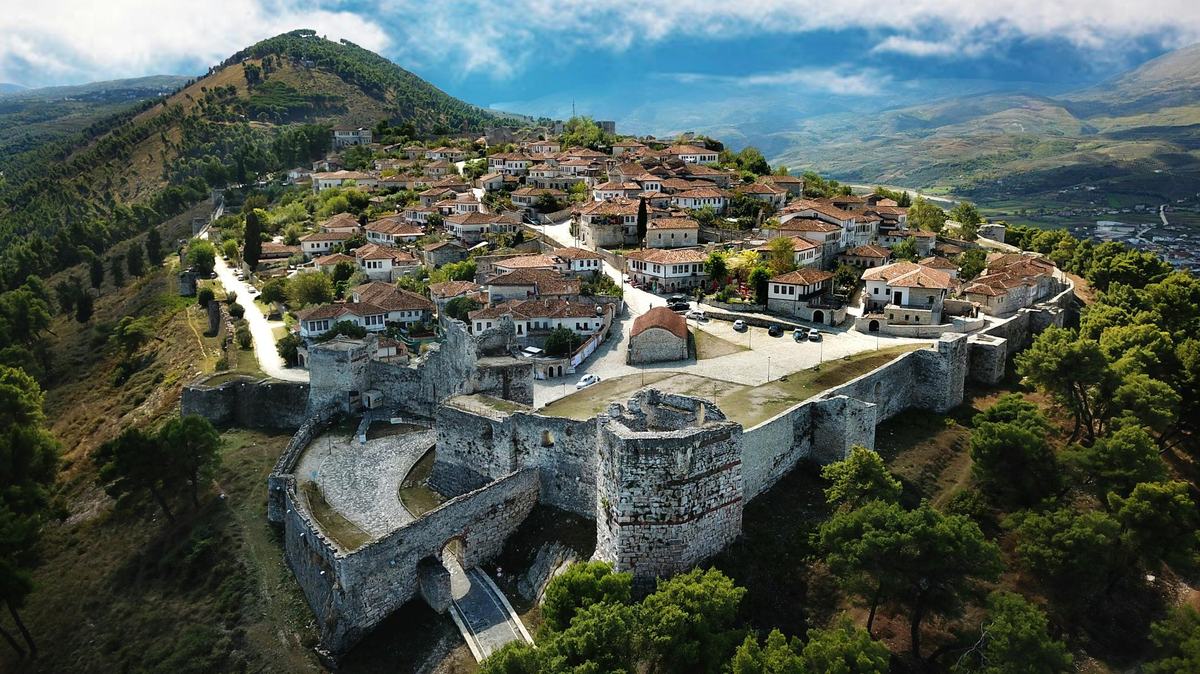
Albania at a glance
- Capital: Tirana [1]
- Population: about 2.8 million (2023) [2]
- Area: 28,748 km² (11,100 sq mi) [1]
- Official language: Albanian [1]
- Currency: Albanian lek (ALL) [1]
- Home to roughly 173,000 concrete bunkers built during the Cold War [3]
Here's something that'll ruin the next geography quiz you take: Albania built around 173,000 concrete bunkers between the 1960s and 1980s, in a country smaller than the state of Maryland. [3] Most of them are still there. Almost none were ever used.
That's the kind of country Albania is. Small, mountainous, mostly overlooked by the rest of Europe, and quietly carrying a stockpile of stories most people will never hear. Thirty years out from one of the strangest dictatorships of the twentieth century, it is rebuilding itself into one of the busier corners of the Balkans, and the contrast between what was and what is keeps catching travelers off guard.
The Bunker Country
The bunkers were the project of Enver Hoxha, the communist dictator who ran Albania from 1944 until his death in 1985. [3] Convinced that the country was about to be invaded by the Soviets, the Yugoslavs, NATO, the Americans, or some combination of the above, he ordered a national fortification program that lasted decades. The standard small bunker, a domed concrete pillbox roughly two meters across, weighed about five tons and could in theory shelter two soldiers with rifles. [3]
The official tally varies by source, but the figure most commonly cited is around 173,000, or roughly one for every eleven people in the country at the time. [3] They went up on beaches, in fields, in cemeteries, on mountain ridges, in town squares. After the regime fell in 1990, Albania had more concrete pillboxes than apartment buildings.
A handful have been turned into bars, cafes, museums, and weekend rentals. Most are simply still there, half-buried, slowly cracking, the strangest infrastructure inheritance any small country has ever had to manage.
A Language With No Close Relatives
Albanian is one of the orphans of Indo-European linguistics. [5] It sits on its own branch of the family tree, with no close cousins like the way Spanish has Italian or German has Dutch. Linguists have argued for over a century about whether Albanian descends from ancient Illyrian, the language of the Iron Age peoples of the western Balkans, or from another lost tongue. The honest answer is that nobody can prove it.
What is clear is that Albanian developed in relative isolation for a very long time, picked up a heavy load of borrowings from Latin, Greek, Turkish, and Slavic languages, and came out the other side as something genuinely its own. The two main dialects, Gheg in the north and Tosk in the south, are different enough that the standard literary form had to be hammered out by national congress in 1972. [5]
Which, if you think about it, is part of why Albania feels like its own world even inside the Balkans. The language doesn't lean on any of its neighbors.
Skanderbeg and the Ottoman Holdout
In 1443, an Albanian nobleman named Gjergj Kastrioti, better known as Skanderbeg, switched sides during a battle against the Ottomans and rode home to lead a 25-year resistance against the largest empire of the age. [6] From his mountain stronghold at Krujë, north of modern Tirana, he held off Ottoman armies that vastly outnumbered him until his death in 1468.
For Albanians, Skanderbeg is roughly what George Washington is for Americans, except his portrait shows up on more bottles of brandy and on a great deal of the country's flag iconography. The flag itself is one of the oldest national symbols in continuous use anywhere: a black, double-headed eagle on a deep red field, taken directly from his battle standard. [6]
The Ottomans absorbed Albania after Skanderbeg died, and it stayed inside that empire for more than four centuries, until independence in 1912. [4] That long Ottoman period is why Albania today has a Muslim majority alongside Catholic and Orthodox Christian communities, and why the food, the music, and even some of the architecture sit somewhere between Italy and Istanbul.
The Only Officially Atheist State
In 1967, Hoxha banned religion outright. [3] All forms of it. Mosques, churches, monasteries, and tekkes were either closed, demolished, or repurposed as warehouses and gymnasiums. Clergy were imprisoned or executed. The constitution adopted in 1976 declared the country, in its own words, the first atheist state in the world. [3]
That experiment lasted until 1990, when religious practice was allowed again as the regime collapsed. The result is a country with a complicated, layered religious landscape. Tirana hosts the world headquarters of the Bektashi Sufi order, which the Ottoman authorities had pushed out of Turkey in the 1820s. [7] In 2024, the prime minister of Albania announced plans to give the order its own micro-state inside Tirana, a sort of religious sovereign enclave on the model of the Vatican. [7]
Turns out, the country that once banned religion is now experimenting with hosting one inside its own capital.
The Alps, the Riviera, and a Tourism Boom
Albania has roughly 450 kilometers of coastline along the Adriatic and Ionian Seas, the southern stretch known as the Albanian Riviera. [1] Inland, the Albanian Alps in the north, called the Bjeshkët e Nemuna, or "Accursed Mountains" in English, hold some of the wildest country left in Europe, with valleys that until recently had no paved roads at all. [4]
Back home in Montana, I grew up around mountains that felt remote because they were big and empty. The Albanian Alps are remote in a different way. Villages there still operate under traces of an old customary law called the Kanun, codified in the fifteenth century, which governs everything from hospitality to blood feuds. [4] Most of it is now ceremonial. Some of it is not.
The country has gone from almost no foreign visitors in 1990 to over ten million in 2023. [9] By Balkan standards, that is a tidal wave. The infrastructure is racing to keep up. The bunkers, on the beaches at least, have started to make their way into the brochures.
Frequently Asked Questions
What is Albania most known for?
Albania is best known for its 173,000 Cold War bunkers, the Albanian Riviera along the Ionian coast, the medieval national hero Skanderbeg, and a unique language that forms its own branch of the Indo-European family. Its long Ottoman history and recent communist past have shaped a culture distinct from its Balkan neighbors.
Why does Albania have so many bunkers?
Albania's communist leader Enver Hoxha ordered the bunkers built between the 1960s and 1980s out of fear of invasion from the Soviet Union, Yugoslavia, NATO, or the United States. About 173,000 were constructed across the country, roughly one for every eleven citizens at the time, and most still stand today.
Is Albanian related to any other language?
Albanian sits on its own branch of the Indo-European language family and has no close living relatives. Linguists generally trace it back to an ancient Balkan language, possibly Illyrian, but its long isolation and centuries of borrowings from Latin, Greek, and Turkish make it genuinely unique among European tongues.
What religion is most common in Albania?
Albania has a Muslim majority, a legacy of more than four centuries of Ottoman rule, alongside significant Roman Catholic and Eastern Orthodox Christian communities. Religion was banned outright between 1967 and 1990, when Albania declared itself the world's first officially atheist state. Practice resumed after the regime fell.
Is Albania a good country to visit?
Albania has become one of the fastest growing tourist destinations in southern Europe, with more than 10 million foreign visitors in 2023. Travelers come for the Adriatic and Ionian beaches, the Albanian Alps, UNESCO-listed towns like Berat and Gjirokastra, and prices that remain well below most of the Mediterranean. [8]
Sources
- CIA World Factbook - Albania
- World Bank - Albania country data
- Britannica - Enver Hoxha
- Britannica - Albania
- Britannica - Albanian language
- Britannica - Skanderbeg
- Reuters - Albania PM plans Bektashi sovereign state in Tirana
- UNESCO World Heritage Centre - Historic Centres of Berat and Gjirokastra
- INSTAT - Albania Tourism Statistics