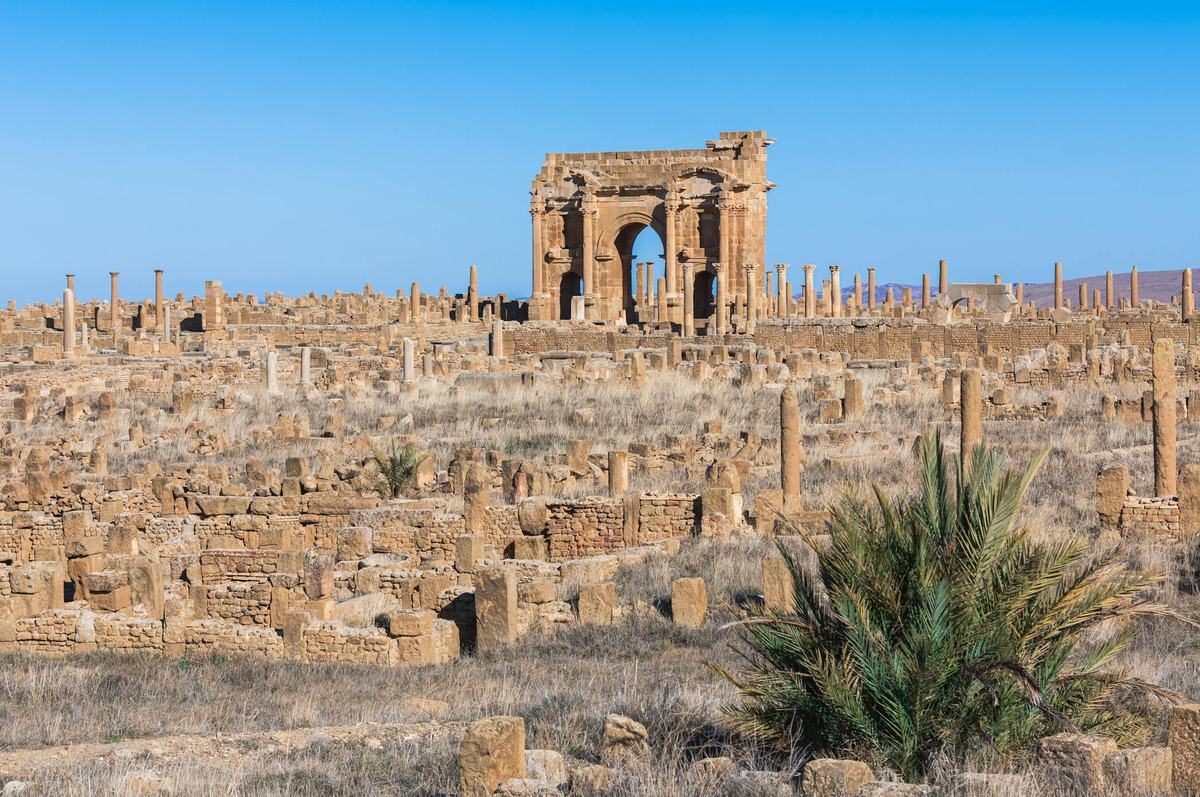
Algeria at a glance
- Capital: Algiers [1]
- Population: about 45.6 million (2023) [2]
- Area: 2,381,741 km² (919,595 sq mi), the largest country in Africa and the tenth-largest in the world [1]
- Official languages: Arabic and Tamazight (Berber) [1]
- Currency: Algerian dinar (DZD) [1]
- Home to seven UNESCO World Heritage Sites, including roughly 15,000 prehistoric drawings at Tassili n'Ajjer [3]
Here's something that will ruin the next geography quiz you take: the largest country in Africa is not Egypt, not Nigeria, not the Democratic Republic of the Congo. It is Algeria. About four-fifths of it is the Sahara. [1]
That is the first thing to understand about the place. Algeria is mostly desert, mostly empty, and mostly looking inward, away from the Mediterranean coastline that gets all the postcards. The country is the size of Western Europe stitched together, with a population smaller than Spain's clustered along the top edge. Everything south of that is rock, sand, and the longest road trip you will probably never take.
A Country Built Mostly of Sand
Algeria became the largest country in Africa in 2011, when South Sudan voted to secede from Sudan and demoted its old neighbor to second place. [4] Since then, no other African country has come close. Algeria covers about 2.38 million square kilometers, more than three times the size of Texas, and it stretches roughly 1,900 kilometers from the Mediterranean down into the heart of the Sahara. [1]
The Sahara takes up around 80 percent of the territory. [4] The mountain ranges along the northern coast, the Tell Atlas and the Saharan Atlas, do most of the heavy lifting in terms of climate. South of them, the rain stops, the towns thin out, and the highways start running for hundreds of kilometers between gas stations. The Trans-Saharan Highway, an unfinished but partly paved corridor that links Algiers to Lagos, runs straight down the middle of the country before crossing into Niger. [4]
Back home in Montana, I thought I knew what empty looked like. The Algerian Sahara is a different scale of empty. Towns appear out of the haze, palm trees and pastel walls, and then nothing for another day's drive.
Rock Art Older Than the Pyramids
Up on a sandstone plateau in the southeast, near the Libyan border, there is a place called Tassili n'Ajjer. UNESCO listed it as a World Heritage Site in 1982, and it is one of the strangest archaeological sites on the planet. [3] Across roughly 72,000 square kilometers of eroded canyons, ancient peoples left around 15,000 paintings and engravings on the rock walls. The earliest panels date back to around 6000 BCE, which puts parts of the gallery several thousand years ahead of the Egyptian pyramids. [3]
What the paintings show is the part nobody expects. Hippos. Crocodiles. Elephants. Cattle herds. Hunters chasing antelope through what looks like savanna. The Sahara, when these were painted, was green. It had rivers and lakes and a wet climate, and it stayed that way until roughly 5,500 years ago, when the rains pulled south and the desert closed in. [3]
The Tassili panels are essentially a visual record of that closing door. The hippos disappear from the artwork. The cattle thin out. Later panels show camels and dromedaries, the desert animals that took over once the water was gone. [3] It still seems hard to believe. The same rocks that now bake in 50 degree Celsius heat once sat next to a lake.
The 132-Year French Question
France invaded Algeria in 1830 and stayed for 132 years. [5] The relationship was unlike most European colonial arrangements. Paris did not treat Algeria as a separate territory but folded it into the French Republic itself, organized as three administrative departments, with hundreds of thousands of European settlers known as pieds-noirs putting down roots over generations. [5]
That made the unwinding all the more violent. The Algerian War of Independence ran from 1954 to 1962 and remains one of the bloodiest decolonization fights of the twentieth century, with hundreds of thousands of Algerian deaths and a near civil war inside France itself. [5] When independence finally came in July 1962, almost the entire pieds-noirs population, around one million people, left for France within months.
The most famous Algerian-born French writer, Albert Camus, grew up poor in a settler family near Mondovi (now Dréan) and spent his career trying to write his way through that double identity. [6] He won the Nobel Prize for Literature in 1957, while the war was still raging, and his ambivalence about which side he belonged on followed him to the grave.
Tamazight and the Berber Revival
Long before Arabic, before French, before the Romans even, Algeria was Berber country. The Amazigh peoples, whose own name means roughly "free people", have lived across North Africa for at least 4,000 years. [7] They are the indigenous population, and in Algeria they remain the demographic backbone, especially in the mountainous Kabylia region east of Algiers.
For most of the post-independence era, Tamazight, the Berber language, had no formal status. Successive governments pushed Arabic as the single national language under a long campaign of Arabization, and authorities quietly punished the use of Tamazight in schools and public administration. [7] That changed slowly, then quickly. The constitution recognized Tamazight as a national language in 2002. In 2016, a constitutional amendment made it a co-official language alongside Arabic. [7]
You can now see the Berber alphabet, called Tifinagh, on road signs in Kabyle towns, on currency, and on the labels of state ministries. Which, if you think about it, is a serious course correction from a country that spent decades insisting it was monolingual.
Gas, Football, and What Comes Next
Algeria sits on top of one of the largest natural gas reserves in Africa and is a major supplier to Europe, especially since 2022, when European buyers started looking hard for alternatives to Russian pipelines. [8] The state energy company Sonatrach is the country's economic engine, and hydrocarbons account for the vast majority of export earnings. [4]
The other thing Algerians take seriously, on a level that is sometimes hard to overstate, is football. The national team won the Africa Cup of Nations in 1990 and again in 2019, and matches in cities like Algiers and Oran routinely shut down traffic, conversation, and most reasonable plans. [9] Local clubs in the top division draw fierce regional loyalty, and the rivalry between MC Alger and USM Alger is one of the oldest derbies in Africa.
Turns out, the country with the most desert in Africa also has one of the most passionate stadium cultures on the continent. The two facts feel less contradictory the longer you sit with them.
Frequently Asked Questions
Is Algeria really the largest country in Africa?
Yes. Algeria has been the largest country in Africa by area since 2011, when South Sudan split from Sudan. It covers about 2,381,741 square kilometers, roughly the size of Western Europe, and is the tenth-largest country in the world. About 80 percent of its territory lies within the Sahara Desert.
What language do people speak in Algeria?
Arabic and Tamazight (Berber) are both official languages of Algeria. French remains widely used in business, media, and higher education as a legacy of the colonial period, and the Algerian variety of Arabic, called Darija, is the everyday spoken language. Tamazight became co-official under a 2016 constitutional amendment.
How old is the rock art at Tassili n'Ajjer?
The oldest paintings and engravings at Tassili n'Ajjer go back at least 8,000 years, with the earliest panels dating to around 6000 BCE. UNESCO inscribed the plateau as a World Heritage Site in 1982. The art records a green Sahara of hippos and cattle, then the dry desert that took over after the rains pulled south about 5,500 years ago.
Was Algeria a French colony?
Algeria was under French rule from 1830 to 1962, longer than almost any other French overseas territory. France treated it administratively as part of the Republic itself, organized as three departments, until the Algerian War of Independence ended in July 1962. Around one million European settlers left for France in the months that followed.
Is Algeria safe to visit?
Algeria is generally safe in its main cities and along the Mediterranean coast, where most travel takes place. Independent travel into the deep Sahara typically requires a licensed guide or organized tour, both for practical reasons and because some southern border zones remain restricted. Tourist numbers are growing but still modest compared to neighboring Morocco and Tunisia.
Sources
- CIA World Factbook - Algeria
- World Bank - Algeria country data
- UNESCO World Heritage Centre - Tassili n'Ajjer
- Britannica - Algeria
- Britannica - Algerian War
- Britannica - Albert Camus
- Britannica - Berber languages
- Reuters - Algeria's Sonatrach sees gas exports to Europe rising
- Britannica - Africa Cup of Nations