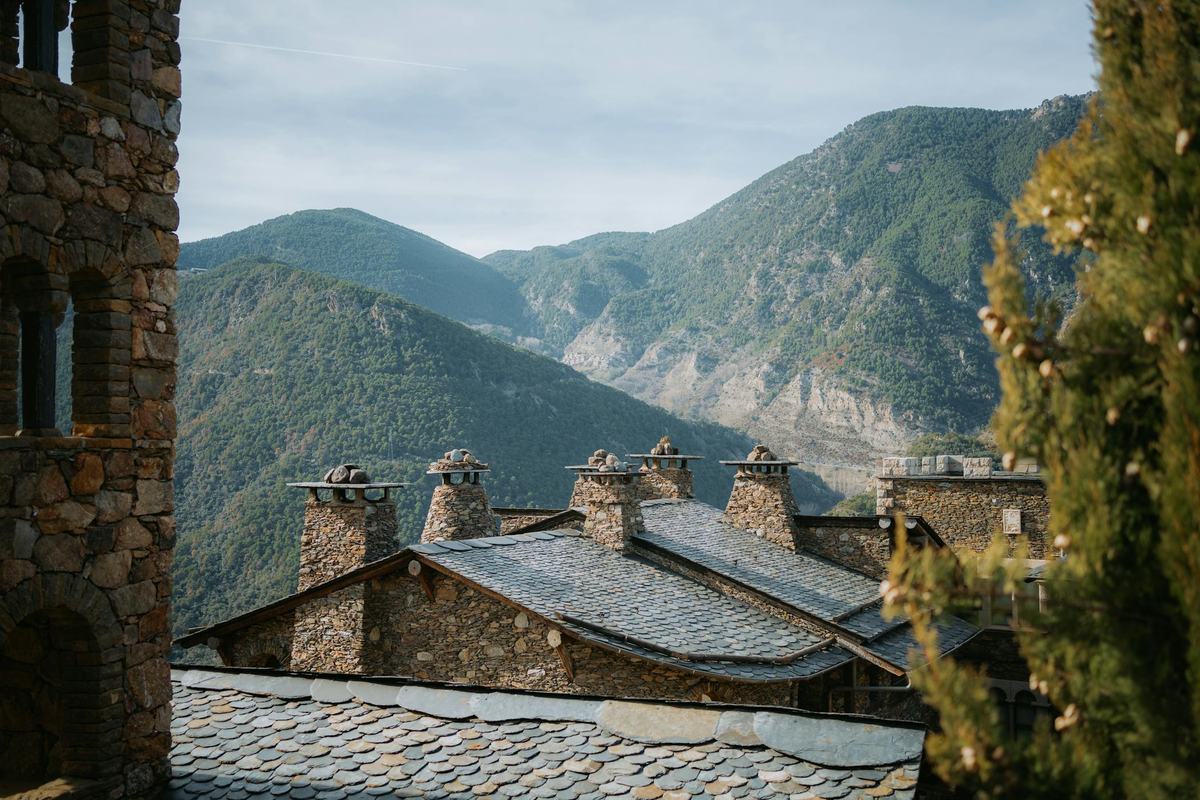
Andorra at a glance
- Capital: Andorra la Vella, the highest capital city in Europe at 1,023 meters (3,356 ft) [1]
- Population: about 81,000 (2023) [2]
- Area: 468 km² (181 sq mi) [1]
- Official language: Catalan, the only country where it is the sole official language [1]
- Currency: euro (EUR), though Andorra is not in the European Union [3]
- Two heads of state: the President of France and the Bishop of Urgell, an arrangement in place since 1278 [4]
Most people couldn't tell you whether Andorra is a country, a duty-free shop, or a ski resort. The honest answer is that it's all three, packed into 468 square kilometers of the eastern Pyrenees and run by an arrangement that should not legally exist anywhere else. [1]
Here's the part that surprised me when I started reading: Andorra's two heads of state are the sitting President of France and a Spanish Catholic bishop. That is not a quirky tradition or a ceremonial leftover. It's the actual law, written down in 1278, and the country has never changed it. [4]
The Co-Principality That Should Not Work
The official name of the country is the Principality of Andorra, but it has not one prince. It has two, and they share the job. The Paréage of 1278 was a peace treaty between the Bishop of Urgell, just south of the Pyrenees in Spain, and the Count of Foix, a French nobleman. Both claimed jurisdiction over these mountain valleys. Rather than fight, they agreed to rule jointly. [4]
The Count of Foix's claim eventually passed up to the kings of France, and from there, after the Revolution, to the French head of state. Today the President of France is automatically a co-prince of Andorra, whether or not he asked for the title. The Bishop of Urgell still holds the other half. [4]
A Spanish Catholic clergyman and a republican French head of state co-sign Andorran laws together, more than seven centuries after the original deal. I had to look this up twice. It is the longest continuous personal union in Europe, and it still works.
A Country Built for Skiing and Shopping
Andorra's economy used to run on cattle and tobacco. Now it runs on tourism. Around eight to nine million visitors come every year, mostly from France and Spain, mostly for two reasons: skiing in winter and shopping the rest of the time. [3]
The country has two big ski areas, Grandvalira and Vallnord, that together cover most of the eastern half of the country. Grandvalira is the largest ski resort in the Pyrenees, with around 200 kilometers of pistes. [3] The slopes are why Andorra has hosted Alpine Ski World Cup races and where most of its national athletes compete.
The shopping side is older. For most of the twentieth century, Andorra had unusually low import duties and no value-added tax, which turned the capital into a duty-free shopping town for half of southern Europe. A general indirect tax was introduced in 2013 at a starting rate of 4.5%, still well below most EU rates. [3] The shops are still busy.
Catalan, the Last Holdout
Catalan is the official language. [1] That is unusual for two reasons. First, Andorra is the only country in the world where Catalan stands alone as the official tongue, even though the language has roughly ten million speakers spread across Spain, southern France, and the Italian island of Alghero. Second, daily life in Andorra is multilingual to a degree that surprises visitors. Spanish, French, and Portuguese are all widely spoken, and most signage runs at least two of them in parallel.
That mix is partly history and partly demographics. Less than half of the residents are Andorran citizens. The rest are mostly Spanish, Portuguese, and French nationals who came for work in tourism, construction, and retail. [2] Naturalization is strict and typically requires more than two decades of residence.
No Army, No Airport, No Train Station
Andorra has not had a standing army for centuries. Its formal defense, by treaty, falls to France and Spain. [4] In practice, the country runs a small police force and a fire and rescue service, and that is it. The only military requirement on the male adult population is a ceremonial one tied to the head of household, and it has not been called up in living memory.
There is also no commercial airport, no train station, and no port. The only way in by public transport is by bus or car, on roads that climb up over passes from Toulouse, Barcelona, or Lleida. The nearest airports are in Toulouse, France, and La Seu d'Urgell, just across the Spanish border. Most international visitors fly into Barcelona and drive up. [3]
Back home in Montana, plenty of small towns are harder to get to than Andorra. None of them happen to be sovereign states.
The Madriu Valley and What Stays Wild
For all the ski resorts and shopping streets, most of the country is still mountain. The Madriu-Perafita-Claror Valley, in the southeast, covers roughly 9% of Andorra's territory and was added to the UNESCO World Heritage List in 2004 as a cultural landscape. [5] It is a place of glacial cirques, pine forests, and stone shepherds' huts, with terraced fields that have been worked the same way for centuries.
The valley has no road into it. You walk in. That is part of the reason it survived in the form it has, and part of why UNESCO recognized it. In a country whose other main valleys are full of cable cars and outlet stores, the Madriu is a quiet reminder of what the rest of Andorra used to look like.
Frequently Asked Questions
What is Andorra most known for?
Andorra is best known as a small Pyrenean country jointly ruled by the President of France and the Bishop of Urgell, for its ski resorts (Grandvalira is the largest in the Pyrenees), for tax-friendly shopping, and for having Catalan as its only official language. It is one of Europe's six microstates.
Is Andorra a country or part of Spain?
Andorra is a fully independent sovereign state, not part of Spain or France. It is a co-principality whose two heads of state are the French President and the Spanish Bishop of Urgell, an arrangement that has held since 1278. Andorra is a member of the United Nations and the Council of Europe.
What language do they speak in Andorra?
The official language of Andorra is Catalan, and it is the only country in the world where Catalan holds that status alone. In daily life, Spanish, French, and Portuguese are also widely spoken, reflecting the makeup of the resident population, less than half of whom are Andorran citizens.
Is Andorra in the European Union?
Andorra is not a member of the European Union, though it uses the euro under a monetary agreement signed in 2011. It has a customs union with the EU for industrial goods and is currently negotiating a broader association agreement that could give it deeper access to the single market. [6]
Do you need a visa to visit Andorra?
Most travelers do not need a separate visa for Andorra. Because the only land entry points are through France or Spain, both of which are in the Schengen Area, anyone with a valid Schengen visa or a visa-exempt passport for Schengen can drive in without further checks. There is no separate Andorran consular visa system.