Angola at a glance
- Capital: Luanda [1]
- Population: about 36.7 million (2023) [2]
- Area: 1,246,700 km² (481,354 sq mi), the seventh-largest country in Africa [1]
- Official language: Portuguese [1]
- Currency: Angolan kwanza (AOA) [1]
- Home to the giant sable antelope, a national symbol that lives nowhere else on Earth [3]
Most Americans I have talked to could not tell you a single fact about Angola. Which is strange, because the country is bigger than Texas and France combined, runs on Portuguese, and produces enough oil to put it among the top suppliers in Africa most years. [4]
It is also the largest Portuguese-speaking country in Africa, and the second-most populous Portuguese-speaking country on Earth, after Brazil. [4] Most of what I had absorbed about the place was about a long war and a lot of oil. Both are true. Neither is the whole picture.
A Country the Size of Texas and France Combined
Angola covers about 1.25 million square kilometers, which makes it the seventh-largest country in Africa and bigger than Texas and France stitched together. [1] It runs along the southwest Atlantic coast for around 1,600 kilometers, from the Republic of the Congo in the north down to Namibia in the south. [4]
The geography is more varied than the postcard version of Africa would suggest. The northern interior is humid and forested. The central highlands run cool, with temperatures that drop below freezing on winter nights at altitude. The far south slopes into the Namib Desert, one of the oldest deserts in the world, where the rare welwitschia plant lives for more than a thousand years. [4]
Then there is Cabinda. The province sits north of the Congo River, separated from the rest of Angola by a thin strip of the Democratic Republic of the Congo, and it produces most of the country's offshore oil. [4] Maps usually show it as a small detached square. On the ground, it is the reason Angola sits on every energy analyst's spreadsheet.
The 27-Year War That Shaped Everything
Portugal ruled Angola for almost 500 years, and when it left in 1975 the exit was hurried and messy. [5] Within hours of independence on November 11 of that year, three rival liberation movements were already fighting one another. The MPLA held the capital, the FNLA pushed in from the north, and UNITA dug into the central highlands. The Cold War poured in fast. Cuban troops backed the MPLA. South Africa and the United States backed UNITA. [5]
What followed was one of the longest civil wars of the twentieth century, running from 1975 to 2002 and ending only after UNITA's leader Jonas Savimbi was killed in combat. [5] Lower-end estimates put the dead at around half a million, with millions more displaced and the country saturated with land mines. Angola is still one of the most heavily mined countries on Earth, and demining teams have been working through the backlog for more than two decades. [6]
Back home in Montana, when people talk about a long war, they usually mean a few years. Twenty-seven straight years is a different category of damage, and the gap between the war generation and the kids who grew up after Savimbi is one of the biggest social fault lines in the country.
Oil, Diamonds, and Luanda's High Prices
Angola is one of the largest oil producers in Africa, alternating with Nigeria and Libya near the top of the table depending on the year. [7] Crude exports account for the majority of government revenue. The country also sits on serious diamond reserves in the northeast, long used to fund UNITA during the war and reorganized after 2002 under the state company Endiama. [4]
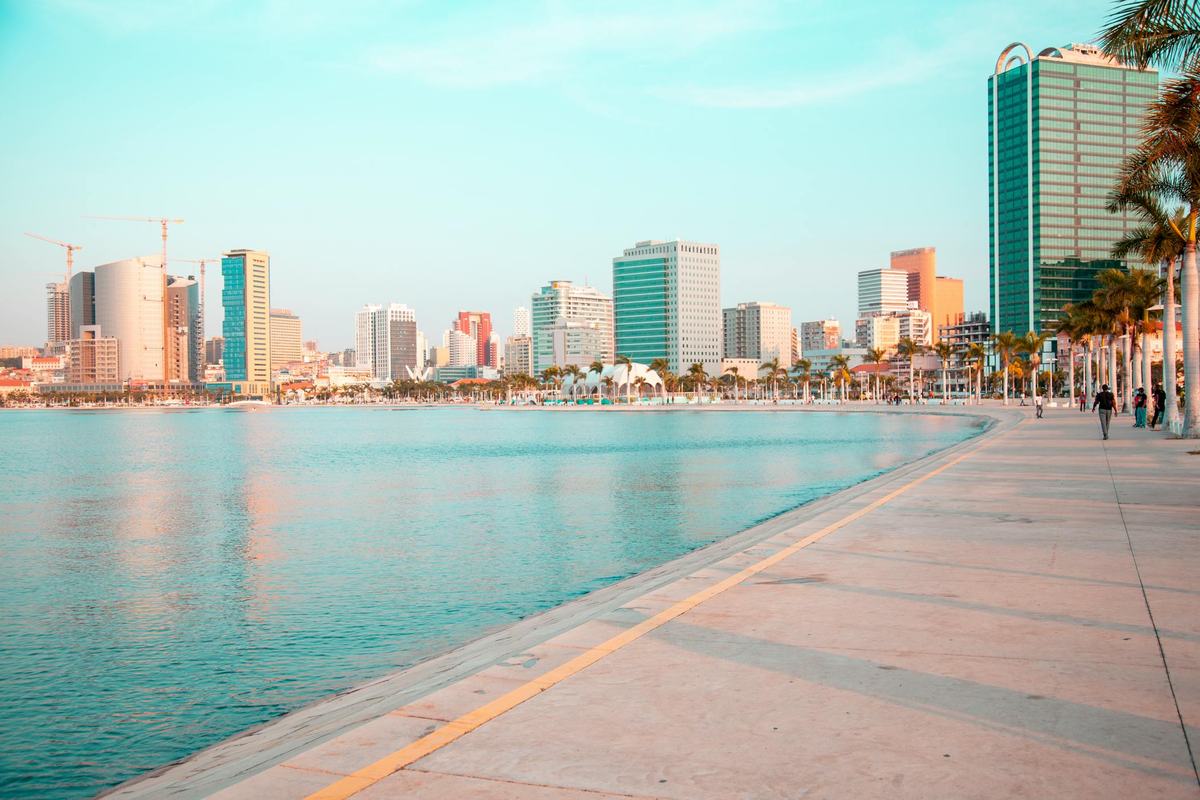
All that money piled up in Luanda. The capital sits on a curved Atlantic bay, with high-rise towers along the waterfront and a steep ravine of informal settlements behind them. For most of the 2010s, expatriate cost-of-living surveys ranked Luanda as one of the most expensive cities in the world for foreign workers. [8] Imported groceries cost what they would in Tokyo or Geneva, while the median Angolan still lives on a few dollars a day.
That contradiction, an oil-rich capital with grocery prices to match Manhattan and a hinterland still rebuilding, is the central economic fact of the country.
The Antelope That Lives Only Here
The giant sable antelope, called palanca negra gigante in Portuguese, is found nowhere else in the world. [3] The males carry curved black horns more than 1.5 meters long, and the species lives in a narrow band of woodland between the Cuango and Luando rivers in north-central Angola. For decades, biologists assumed the war had wiped them out. They were not seen in the wild between the late 1980s and 2002. [3]
Then a team led by Angolan biologist Pedro vaz Pinto set up camera traps and started getting back images of living animals. Conservation work has slowly rebuilt the population, which is still small and still endangered. [3] The palanca negra now appears on the national soccer jersey, the kwanza banknotes, and the tail of TAAG Angola Airlines, the closest thing the country has to a unifying symbol.
Where Capoeira and Kizomba Came From
A lot of what the world thinks of as Brazilian, musically and physically, has Angolan roots. The leading scholarly view traces capoeira's footwork and rhythm back to a southern Angolan ritual called n'golo, performed by Mucubal and other groups during initiation ceremonies. [9]
Modern Angolan music has been quietly exporting itself for decades. Semba, the older urban dance music that fed into Brazilian samba, is still the country's signature style. Kizomba, a slow couples dance born in 1980s Luanda, has spread across Europe and Latin America and now anchors a global circuit of weekend festivals. Kuduro, harder and faster, came out of Luanda's clubs in the 1990s. [4]
Turns out, the country most outsiders cannot place on a map has been shaping how the rest of us move our feet for centuries.
Frequently Asked Questions
What language do people speak in Angola?
Portuguese is the official language and the main language of government, schools, and media. Around 70 percent of the population speaks it, which makes Angola the largest Portuguese-speaking country in Africa. Several Bantu languages are also widely spoken at home, including Umbundu, Kimbundu, and Kikongo.
How big is Angola?
Angola covers about 1,246,700 square kilometers, or roughly 481,354 square miles. That makes it the seventh-largest country in Africa and bigger than Texas and France combined. It has around 1,600 kilometers of Atlantic coastline and shares borders with the two Congos, Zambia, and Namibia.
When did Angola become independent?
Angola became independent from Portugal on November 11, 1975, after almost five centuries of colonial rule. Independence triggered a 27-year civil war between rival liberation movements, which ended in 2002. The country marks Independence Day each November 11 as a national holiday.
Is Angola safe to visit?
Luanda and the main provincial capitals are generally safe for organized travel, though petty crime is common in crowded areas. Independent travel into rural regions is complicated by the legacy of land mines from the civil war, and certain areas still require caution and a local guide.
What is Angola known for?
Angola is known as the largest Portuguese-speaking country in Africa, a major producer of oil and diamonds, and home to the rare giant sable antelope. The capital Luanda has long been one of the most expensive cities in the world for foreign workers, and Angolan music styles like kizomba and kuduro have spread across the global dance circuit.
Sources
- CIA World Factbook - Angola
- World Bank - Angola country data
- IUCN Red List - Hippotragus niger variani (giant sable antelope)
- Britannica - Angola
- Britannica - Angolan Civil War
- HALO Trust - Angola landmine clearance
- Reuters - Africa oil production rankings
- Mercer Cost of Living Survey - Luanda ranking
- Britannica - Capoeira