Antigua and Barbuda at a glance
- Capital: Saint John's, on the island of Antigua [1]
- Population: about 94,000 (2023) [2]
- Area: 442 km² (171 sq mi), spread across Antigua, Barbuda, and the uninhabited rock of Redonda [1]
- Official language: English [1]
- Currency: Eastern Caribbean dollar (XCD), pegged to the US dollar at 2.7 to 1 [1]
- Independent from the United Kingdom since 1981, still a Commonwealth realm with King Charles III as head of state [3]
Antigua's tourism board says the island has 365 beaches, one for every day of the year. I had to look this up twice. The figure isn't a marketing flourish; it shows up in geographic surveys and travel writing going back decades, and on a coastline this convoluted, it might actually be conservative. [3]
What gets less attention is that this is a country of two very different islands. Antigua, the larger one, runs the airport, the cruise port, the resorts, and the capital. Barbuda, sixty kilometers north, has fewer than two thousand people, no real town past Codrington village, and one of the largest seabird colonies in the Western Hemisphere. They became one country at independence in 1981, and they are still figuring out exactly what that means.
Two Islands, One Country
The deal between Antigua and Barbuda is a colonial-era arrangement that became a national one. Both were British possessions in the Leeward Islands, and Barbuda was for centuries effectively a private estate of the Codrington family, who used it to supply provisions and labor to Antigua's sugar plantations. [3] When the colony moved toward self-government in the twentieth century, the two islands stayed bundled together. They became an associated state in 1967 and a fully independent country on November 1, 1981. [3]
That history still shapes daily life. Antigua, the larger island at 281 square kilometers, holds about 97% of the population, the capital, the international airport, and the cruise ship docks. Barbuda, sixty kilometers to the north, has fewer than 2,000 residents on 161 square kilometers of mostly low scrub and beach. [1] The two islands are politically equal but economically very different.
A Coastline Built for Beaches
Antigua's tourism slogan, "a beach for every day of the year", has a real geographic basis. The island is roughly oval, but coves, bays, and hidden inlets eat into its edges, most of them with sand and almost none of them developed. [3]
The sand itself varies. Most of Antigua's beaches are the white-to-cream coral sand you would expect from the Caribbean, but Barbuda has stretches of distinct pink sand at Princess Diana Beach and Low Bay, colored by the same crushed coral that tints Bermuda's pink beaches. [3] Reefs offshore keep the water clear and the sand light, and the same reefs feed the small commercial fishing industry the country still keeps alongside tourism.
Nelson's Dockyard and the Georgian Navy
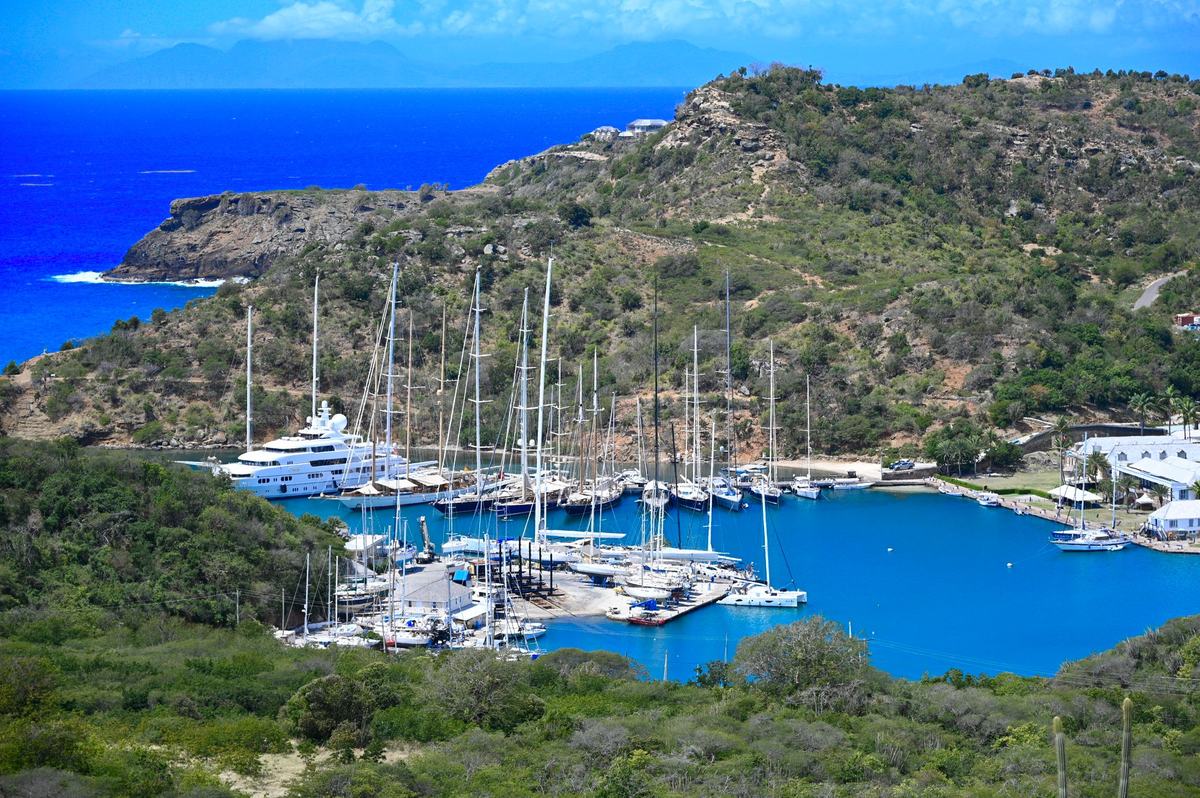
Most countries with a UNESCO World Heritage Site have an obvious one. Antigua and Barbuda's is a working dockyard. Nelson's Dockyard, on the south coast of Antigua at English Harbour, was a British Royal Navy base from the 1720s onward, used for repairing and resupplying warships in the Caribbean theater. It is the only Georgian-era naval dockyard in the world that still functions as one, mostly now for yachts. [4]
The dockyard takes its name from Captain Horatio Nelson, who commanded the Leeward Islands squadron there in the 1780s. He was not popular with the local merchants, partly because he enforced trade restrictions against newly independent American ships with more zeal than common sense. [4] UNESCO added the complex, including the surrounding eighteenth-century fortifications and the harbor itself, to its World Heritage List in 2016 as the Antigua Naval Dockyard and Related Archaeological Sites. [4]
Walking through it, you see the same brickwork, the same boat slips, the same pillars where sail lofts used to stand. The dockyard is a rare Caribbean place that preserves its colonial past as architecture rather than ruin.
Barbuda's Frigatebirds and Hurricane Irma
Codrington Lagoon, on the western side of Barbuda, holds one of the largest frigatebird colonies in the Western Hemisphere, with thousands of birds nesting in the mangroves at peak season. [5] Frigatebirds are the seabirds with the seven-foot wingspan and the bright red throat pouches the males inflate to attract a mate. The only way to visit the colony is by small boat from Codrington village.
In September 2017, Hurricane Irma hit Barbuda directly as a Category 5 storm and nearly destroyed both the mangroves and the village. The storm damaged most buildings on the island, and the entire population of about 1,800 evacuated to Antigua. [3] For roughly a month, Barbuda had no permanent residents at all. Most have since returned, but reconstruction has moved slowly, and Barbudan land tenure, traditionally communal ownership rather than private title, has faced repeated court challenges since.
Cricket as a National Inheritance
If you grow up in Antigua, you learn the names of Sir Vivian Richards, Sir Andy Roberts, and Sir Curtly Ambrose the way kids elsewhere learn presidents. All three carry knighthoods, all three are from Antigua, and all three were central to the West Indies teams that dominated world cricket from the late 1970s through the early 1990s. [3]
The Sir Vivian Richards Stadium, just outside Saint John's, hosts international matches and went up for the 2007 Cricket World Cup, which nine Caribbean countries jointly hosted. Test cricket here is less a sport than an inheritance, and you hear it in casual conversation about who is playing well, who has retired, and who should never have been picked.
Back home in Montana, baseball was the only sport that came with that kind of generational weight. Cricket in Antigua has the same feel.
Frequently Asked Questions
Where are Antigua and Barbuda?
Antigua and Barbuda are in the eastern Caribbean, in the Leeward Islands, about 700 kilometers southeast of Puerto Rico. The two main islands are roughly 60 kilometers apart, with Barbuda to the north of Antigua. The country also includes the small uninhabited island of Redonda.
What language is spoken in Antigua and Barbuda?
The official language is English, a legacy of British colonial rule from 1632 to 1981. In daily life, most people also speak Antiguan Creole, an English-based creole used in informal settings. Government, schooling, business, and media all run primarily in English.
Is Antigua and Barbuda a safe country to visit?
Antigua and Barbuda is generally considered a safe destination for travelers, with tourism-focused security in resort areas and a low rate of violent crime against visitors compared to regional averages. As with any destination, petty theft can occur, particularly around busy beaches and cruise terminals.
What currency does Antigua and Barbuda use?
The country uses the Eastern Caribbean dollar, abbreviated XCD, which is shared by eight member states of the Eastern Caribbean Currency Union. The currency is pegged to the US dollar at a fixed rate of 2.7 XCD to 1 USD, which has held since 1976. US dollars are widely accepted in tourist areas.
When did Antigua and Barbuda become independent?
Antigua and Barbuda gained independence from the United Kingdom on November 1, 1981. The country remains a Commonwealth realm, meaning King Charles III is the formal head of state, represented locally by a governor-general. Day-to-day politics runs through an elected prime minister and a bicameral parliament.