Argentina at a glance
- Capital: Buenos Aires, the largest Spanish-speaking city in the Southern Hemisphere [1]
- Population: about 46.6 million (2023) [2]
- Area: 2,780,400 km² (1,073,500 sq mi), the eighth largest country in the world [1]
- Official language (de facto): Spanish, in a distinctive variety where "ll" and "y" come out closer to "sh" [3]
- Currency: Argentine peso (ARS) [1]
- Home to Aconcagua at 6,961 meters (22,838 ft), the highest peak anywhere outside Asia and the tallest in the Western Hemisphere [4]
Here's something I had to look up twice: Argentina is named after a metal it never actually had. The country's name comes from the Latin word for silver, argentum, which the Spanish stamped onto early maps because they were convinced the rivers had to lead somewhere shiny. They didn't. The conquistadors found a few small caches, then nothing. The name stuck anyway, the silver dream moved north, and the country eventually built itself on something else entirely. [3]
What it built itself on was beef, wheat, and the largest wave of European immigration any country in South America has ever taken in. By the early 1900s, more than half the population of Buenos Aires was foreign-born, and Argentina was briefly one of the ten richest countries on Earth. [3] Today it's the eighth largest country in the world by area, stretching from the subtropics all the way down to the icy edge of Antarctica, and almost nobody outside Argentina realizes how much of the planet it actually covers. [1]
The Country Named for Silver That Wasn't There
The story behind the name is one of those small historical jokes that nobody bothered to undo. In the 1500s, Spanish and Portuguese explorers heard rumors of a great mountain of silver somewhere up the Río de la Plata, the "River of Silver". They renamed everything after the rumor: the river, the region, eventually the country. The actual silver, which existed but in much smaller quantities than they hoped, mostly came from what is now Bolivia, far to the north. [3]
By the time anyone admitted the silver was somewhere else, the maps were already drawn. Argentina, the "Land of Silver", had to settle for being the land of cattle, grain, and grass. Turns out, that was a fair trade.
A Country with Almost Every Climate
Argentina runs about 3,700 kilometers from north to south. [1] That's roughly the distance from Seattle to Mexico City, all inside one country. As a result, almost every climate on Earth has a place inside its borders.
In the north, on the Brazilian and Paraguayan borders, sits Iguazú Falls, a chain of around 275 individual waterfalls strung along almost three kilometers of river. The largest single drop, the Devil's Throat, is almost twice as tall as Niagara, and you can stand on a walkway directly above it. UNESCO listed the Argentine side as a World Heritage Site in 1984. [5]
Out west, the Andes form the spine of the country. Aconcagua, at 6,961 meters, is the highest mountain anywhere outside Asia, the tallest peak in both Americas, and the highest in the Western Hemisphere. [4] You can technically walk to the top without climbing rope, which is why a few thousand people attempt it every year. The altitude does most of the filtering.
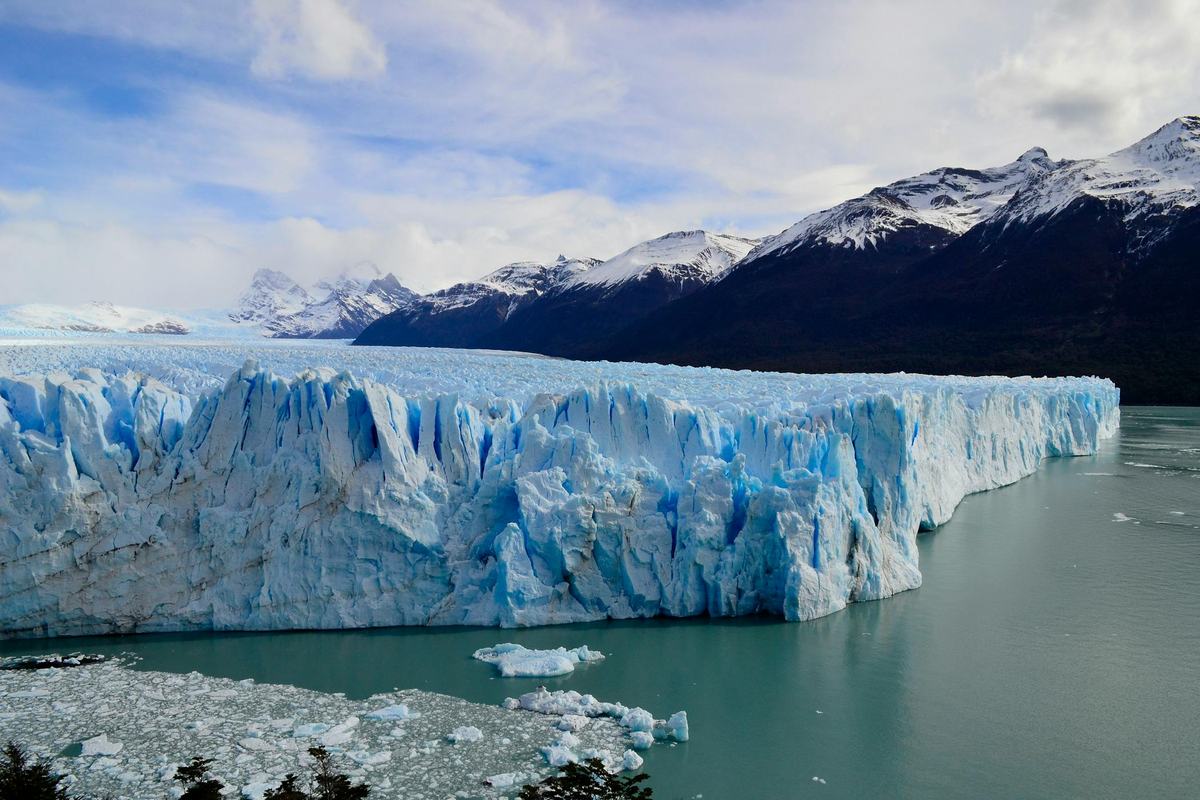
Down in the south, things get strange in a different way. Patagonia is high steppe, scoured by wind, with glaciers tumbling out of the mountains into pale blue lakes. The Perito Moreno glacier, in Los Glaciares National Park, is one of the only major glaciers on Earth that is not currently in retreat. It calves enormous chunks of ice into Lago Argentino with a sound like artillery, and it has done so on a regular cycle for as long as anyone has measured. [6]
Past Patagonia, you reach Tierra del Fuego, the "Land of Fire", which Argentina shares with Chile. Ushuaia, on the Argentine side, calls itself the southernmost city in the world. From there, the next stop is Antarctica, and Argentina maintains permanent research stations on the continent to back up its territorial claim. [1]
Beef, Mate, and a Country That Eats Together
Per person, Argentines eat more beef than almost anyone else on the planet. The country's per capita beef consumption sits around 47 kilograms a year, well above the United States, and the asado, a slow Sunday cookout over wood and embers, is closer to a national ritual than a meal. [3]
The cattle date back to the 1500s, when the Spanish let a few cows loose on the pampas, the vast grass plains in the center of the country. With no native predators large enough to matter and almost limitless grass, the herds exploded. By the 1700s, wild cattle outnumbered humans many times over, and the gaucho, a kind of horseback cattle hand, became the country's defining figure. The gaucho is to Argentina roughly what the cowboy is to the American West, except older, and a lot more central to how the country sees itself. [3]
The other half of the daily diet is yerba mate, a bitter herbal infusion drunk through a metal straw from a hollow gourd. Argentines drink more of it than anyone else, around 6 to 7 kilograms of dry leaves per person per year. You see the gourds everywhere. People bring them to work. They share them on park benches. Refusing a sip you've been offered is, in some circles, just barely on the right side of rude.
The European Inheritance
Between roughly 1860 and 1930, Argentina took in around six million immigrants, most of them from Italy and Spain, with smaller waves from Germany, France, Poland, the Levant, and the Welsh-speaking parts of Britain. [3] In raw numbers, only the United States took in more people during that period. Per capita, Argentina took more than anyone.
Today, around 60% of Argentines have at least some Italian ancestry. [3] You hear it in the food (Buenos Aires pizza is its own thing, thicker and cheese-heavier than anything in Italy), in the gestures, and especially in the language. Argentine Spanish has its own distinct accent, often called rioplatense, where "ll" and "y" come out closer to the "sh" in "shoe", and where the everyday word for "you" is vos rather than tú. The slang, lunfardo, is laced with Italian roots. The result is a Spanish that sounds, to many other Spanish speakers, almost theatrical. [3]
The Welsh settlers ended up in Patagonia, in the Chubut Valley, and somehow held onto the language for over a century. There are still a few thousand Welsh speakers in Argentina today, with bilingual schools and an annual Eisteddfod festival. Back home in Montana, plenty of small towns hold onto languages their grandparents brought across the Atlantic. None of them happen to be speaking Welsh in South America.
Tango, Pope Francis, and Soft Power
For a country with a population a little larger than Spain's, Argentina punches very hard in cultural exports. Tango was born in the working-class neighborhoods of Buenos Aires and Montevideo in the late 1800s, and UNESCO added it to the Intangible Cultural Heritage list in 2009. [7] Argentine writers, especially Jorge Luis Borges and Julio Cortázar, are foundational figures in twentieth-century literature. Argentine cinema has won the Academy Award for Best Foreign Language Film twice, in 1986 and 2010. [3]
In sports, the country produced two of the most famous soccer players who ever lived, Diego Maradona and Lionel Messi, and won the FIFA World Cup three times, most recently in 2022. [3] In religion, Cardinal Jorge Mario Bergoglio of Buenos Aires was elected Pope Francis in 2013, the first Pope from the Americas, and the first Jesuit Pope in the church's history. [3]
The Argentine flag, with its pale blue and white stripes and a sun in the middle, was first raised in 1812 by General Manuel Belgrano. The sun has a face on it. It is officially called the Sun of May, after the May Revolution against Spanish rule, and it has been smiling out from the country's flag for over two centuries. [1]
Frequently Asked Questions
What is Argentina best known for?
Argentina is best known for tango, beef, soccer, and the widest range of climates inside any single Latin American country. It is the eighth largest country in the world by area, the home of Iguazú Falls and Aconcagua, the birthplace of Pope Francis, and the country with the most Italian ancestry outside Italy.
What language do they speak in Argentina?
The de facto official language is Spanish, in a distinctive variety called rioplatense Spanish. Its most recognizable feature is the "sh" sound used where most Spanish speakers say "y", along with the everyday use of vos instead of tú. Italian, German, and several Indigenous languages are also spoken.
Why is Argentina called Argentina?
The name comes from the Latin word argentum, meaning silver. Sixteenth-century Spanish and Portuguese explorers thought the Río de la Plata, the "River of Silver", led to a great hidden silver mountain. The hoard turned out to be in what is now Bolivia, but the hopeful name stuck to the country anyway.
Is Argentina a rich country?
Argentina is classified as an upper-middle-income country by the World Bank and is a member of the G20. [2] It has a long history of economic booms and busts, and was briefly among the world's ten richest countries around 1913. Inflation and currency volatility have been recurring problems for decades.
What is the most famous food in Argentina?
The most iconic Argentine food is asado, a slow-cooked grill of beef ribs, sausages, and offal over wood embers. Other staples include empanadas (stuffed pastries), milanesa (breaded cutlets), dulce de leche, alfajores, and Buenos Aires-style pizza. Yerba mate is the national drink.