"Armenia at a glance"
- Capital: Yerevan, founded in 782 BC and one of the oldest continuously inhabited cities in the world [2]
- Population: about 2.78 million (2023) [3]
- Area: 29,743 km² (11,484 sq mi), the smallest of the former Soviet republics [1]
- Official language: Armenian, written in a unique 38-letter alphabet created in 405 AD [2]
- Currency: Armenian dram (AMD) [1]
- The first country in the world to adopt Christianity as a state religion, in 301 AD [2]
The first nation to make Christianity its state religion wasn't Rome. It wasn't Greece or Egypt either. It was Armenia, in 301 AD, more than seventy years before Theodosius got around to making it official in the empire next door. The Armenians have been quietly first ever since.
First Christian nation. Inventor of one of the only alphabets in modern use that no other language touches. Home to one of the oldest continuously inhabited capitals on Earth. Armenia is small, landlocked, and tucked into the South Caucasus between Türkiye, Georgia, Azerbaijan, and Iran. About 2.8 million people live there. [3] Somewhere between three and four times that many Armenians live somewhere else. [2] You don't usually meet a country whose population abroad outnumbers the one at home, but Armenia has been doing this for a long time, and it shapes almost everything about how the place feels.
The First Christian Nation
The year is 301 AD. The Roman emperor Diocletian is still persecuting Christians on industrial scale across the Mediterranean. Up in the Armenian highlands, King Tiridates III decides to do the opposite. He is converted by Gregory the Illuminator after, depending on which version you read, either thirteen years in a pit or a serious bout of mental illness. [2] Either way, when Tiridates emerges, he declares Christianity the official state religion of the Armenian kingdom.
That makes Armenia the first nation in the world to do so. Rome wouldn't follow until 380 AD, under Theodosius. The Armenian Apostolic Church, founded in those early years, still exists, still uses its own liturgy, and still considers itself the oldest national church in Christendom. [2] Etchmiadzin Cathedral, the spiritual headquarters of Armenian Christianity, was first built around 303 AD on a site where Gregory said he had a vision of Christ pointing to the ground. UNESCO listed it as a World Heritage Site in 2000, alongside the surrounding churches and the Zvartnots ruins. [4] It is one of the oldest cathedrals on Earth still in regular use.
The Alphabet That Saved a Language
Armenia got its alphabet about a hundred years after it got its religion, and the two are tightly connected. In 405 AD, a monk and scholar named Mesrop Mashtots designed a writing system from scratch, specifically so the Bible and the church liturgy could be translated into Armenian. [2] He was working under church sponsorship, in a country newly Christian, surrounded by Greek and Syriac and Persian script, and he decided none of them quite fit.
So he made a new one. Thirty-six letters originally, with two more added in the Middle Ages, bringing it to thirty-eight. [2] No other language uses it. To the unfamiliar eye it looks like a careful cross between cuneiform and a typewriter font, all confident vertical strokes and tidy curves. To Armenians, it's the reason the language survived a thousand years as a minority tongue inside Persian, Byzantine, Arab, Mongol, Ottoman, and Russian empires. The alphabet kept the language. The language kept the people.
Mount Ararat, Just Across the Border
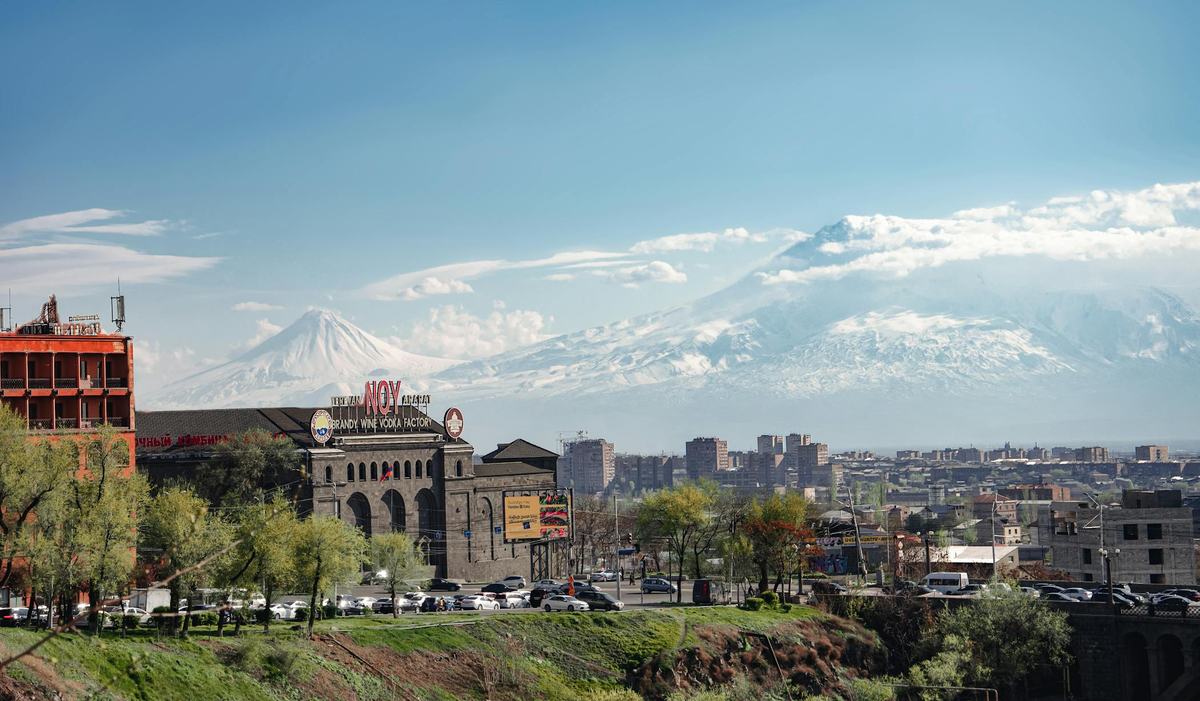
Open an Armenian passport, look at any official seal, walk past any souvenir shop in Yerevan, and you will see Mount Ararat. The twin-peaked mountain is the symbol of the nation, the place Genesis says Noah's ark came to rest, and the dominant feature on the southern horizon of the capital. [2]
Here's the thing: Mount Ararat is not in Armenia. It hasn't been for a hundred years. Ararat sits in eastern Türkiye, on the other side of a closed border, a few dozen kilometers from Yerevan as the crow flies. You can see it clearly from the city on a clear day, looming above the plain like an unfinished sentence. The country puts the mountain on its coat of arms anyway. When the Soviet Union complained that Armenia couldn't put a foreign mountain on its emblem, Armenian officials reportedly responded that the Soviet flag had a moon on it, and the Soviets didn't own the moon either. [2]
Apricots, Pomegranates, and Churchill's Brandy
The apricot is so closely tied to Armenia that botanists once classified it as Prunus armeniaca, "the Armenian plum". It is the national fruit, the color of one of the three stripes on the flag (officially called "apricot orange"), and the wood used to make the duduk, the soft-toned reed instrument UNESCO added to the Intangible Cultural Heritage list in 2008. [5] If you have ever heard the haunting woodwind in the soundtrack of "Gladiator" or "The Last Temptation of Christ", that was a duduk.
The pomegranate is everywhere too: in carpets, paintings, jewelry, weddings. Both fruits show up in the cooking, often in the same meal. But the most internationally famous Armenian product comes in a bottle. Armenian brandy, distilled at the Yerevan Brandy Company since 1887, was famously a favorite of Winston Churchill, who reportedly went through a bottle a day during the war years and was supplied with cases of it by Stalin himself. [2] Locals will tell you, with no small pride, that this brandy is what kept the Allies focused.
A Diaspora Larger Than the Country
Around 2.8 million people live in Armenia. Somewhere between 7 and 10 million Armenians live elsewhere. [2] The exact number depends on who's counting, but it dwarfs the home population by a factor of three or more, and it has done so for over a century.
Most of that diaspora traces back to one event: the genocide of 1915, in which an estimated 1.5 million Armenians were killed during the late Ottoman period. [2] Survivors scattered. Today there are large Armenian communities in Russia, the United States, France, Lebanon, Syria, and Argentina, and smaller ones almost everywhere else. The Kardashians are Armenian. So is System of a Down. Cher is half-Armenian on her father's side. The diaspora has done a lot to keep the country in the global conversation, and it sends back money: remittances are a meaningful share of Armenia's GDP every year. [3]
Yerevan, the capital, is itself older than Rome. It was founded in 782 BC as the Urartian fortress of Erebuni, which makes it 29 years older than the city the Romans built. [2] A capital older than Rome, in a country older than half the alphabets in use today, with a population scattered across six continents and a mountain on its passport that it does not legally own. There is a lot going on for a place the size of Maryland.
Frequently Asked Questions
What is Armenia best known for?
Armenia is best known for being the first country in the world to adopt Christianity as a state religion, in 301 AD. It is also known for its unique 38-letter alphabet, Mount Ararat as a national symbol, apricots and pomegranates, the duduk, and a globally scattered diaspora that outnumbers the home population.
Where is Armenia located?
Armenia is a landlocked country in the South Caucasus, bordered by Türkiye to the west, Georgia to the north, Azerbaijan to the east, and Iran to the south. Its capital, Yerevan, sits on the Hrazdan River with Mount Ararat visible across the Turkish border to the south.
What language do Armenians speak?
The official language is Armenian, an Indo-European language with its own branch of the family. It uses a unique 38-letter alphabet created in 405 AD by Mesrop Mashtots. Russian and English are widely spoken as second languages, and many older Armenians grew up bilingual under the Soviet Union.
How old is Yerevan?
Yerevan was founded in 782 BC as the Urartian fortress of Erebuni, making it one of the oldest continuously inhabited capital cities in the world. It is 29 years older than Rome and predates many European capitals by more than a millennium.
What religion is Armenia?
Armenia is overwhelmingly Christian. About 92% of the population belongs to the Armenian Apostolic Church, an Oriental Orthodox church founded in the early 4th century. It is one of the oldest national churches in Christendom and uses its own liturgy and calendar.