- Capital: Canberra
- Population: approximately 26.5 million [1]
- Area: 7.69 million km² (2.97 million sq mi) - the sixth-largest country by total area [1]
- Official language: None at the federal level; English is the de facto national language [2]
- Currency: Australian dollar (AUD)
- Distinguishing claim: Australia is the world's largest country with no land borders - an entire continent governed by a single nation [1]
Here's something that'll ruin the next geography quiz you take: Australia has no official national language. A country of 26 million people, English spoken coast to coast, and yet - nothing in the constitution. They just never got around to it. That's the kind of detail that makes you look twice, and Australia is full of them.
The Oldest Continuous Culture on Earth
Before the British showed up in 1788, Aboriginal and Torres Strait Islander peoples had been living on this continent for somewhere between 50,000 and 65,000 years [3]. That's not a typo. Sixty-five thousand years. To put that in perspective: the earliest cave paintings in Europe are around 40,000 years old. By that point, people in Australia had already been here for tens of thousands of years.
There are over 250 distinct Indigenous language groups, each with their own stories, laws, and ways of reading country [3]. The land itself is mapped in a way that Western cartography doesn't capture - songlines running across the continent like invisible highways, connecting sacred sites through music and story. I grew up in Montana with a rough sense of where everything was. This is something else entirely.
Which, if you think about it, makes what happened after 1788 all the more significant. The dispossession of Aboriginal peoples was systematic and brutal. Australia is still working through that history - the Uluru Statement from the Heart in 2017, and the subsequent debates around constitutional recognition, are part of a long, unfinished conversation [3].
Wildlife That Behaves Like It Didn't Get the Memo
Australia split from the ancient supercontinent Gondwana roughly 80 million years ago [4]. That isolation is why its wildlife looks like nothing else. Eighty million years of evolutionary independence will do that.
About 80% of Australia's plants and animals are found nowhere else on Earth [4]. The kangaroo is the obvious example, but the platypus is the one that breaks your brain. It's a mammal that lays eggs, hunts with electroreception, and the males have venomous spurs on their hind legs. When European scientists first saw a specimen in 1799, they thought someone had sewn a duck's bill onto a beaver. A reasonable reaction, honestly.
Then there's the cassowary in Queensland's rainforests - a flightless bird that can reach 6 feet tall and has a reputation for charging humans when threatened. And the box jellyfish off the northern coast, which has 24 eyes and is widely considered the most venomous marine animal on the planet. Australia's reputation for dangerous wildlife isn't exaggerated. It's just concentrated in specific regions, which most travel guides are careful to point out.
A Geography That Doesn't Fit Any One Mental Image
Most people picture Australia as desert. And the interior - the Outback - is genuinely vast and dry. About 35% of the continent is desert, and large parts of the interior receive less than 250mm of rain a year [1]. The red dirt around Uluru, the heat shimmering off the road outside Alice Springs - that image is real.
But Australia also has tropical rainforest in Queensland, alpine snow country in New South Wales and Victoria, temperate wine regions around Adelaide and Margaret River, and a coastline that stretches over 34,000 km [1]. The Great Barrier Reef alone - the largest coral reef system on Earth, visible from space - runs for over 2,300 km along the Queensland coast [4].
The country is so wide that it spans three time zones in the east alone, and the state of Western Australia covers an area larger than Western Europe. Getting between major cities usually means flying. The Nullarbor Plain, crossing the southern edge of the continent between South Australia and Western Australia, has the longest straight stretch of road in Australia - 146 km without a single curve [2].
Cities on the Coast, Space in the Middle
About 90% of Australians live within 50 km of the coast [1]. The interior is staggeringly empty. Most of the population is concentrated in a handful of east-coast cities: Sydney, Melbourne, Brisbane, and a bit further south, the capital Canberra - which exists largely because Sydney and Melbourne couldn't agree on which one should be the capital. So they built a new one in between. That's a real thing that happened in 1913.
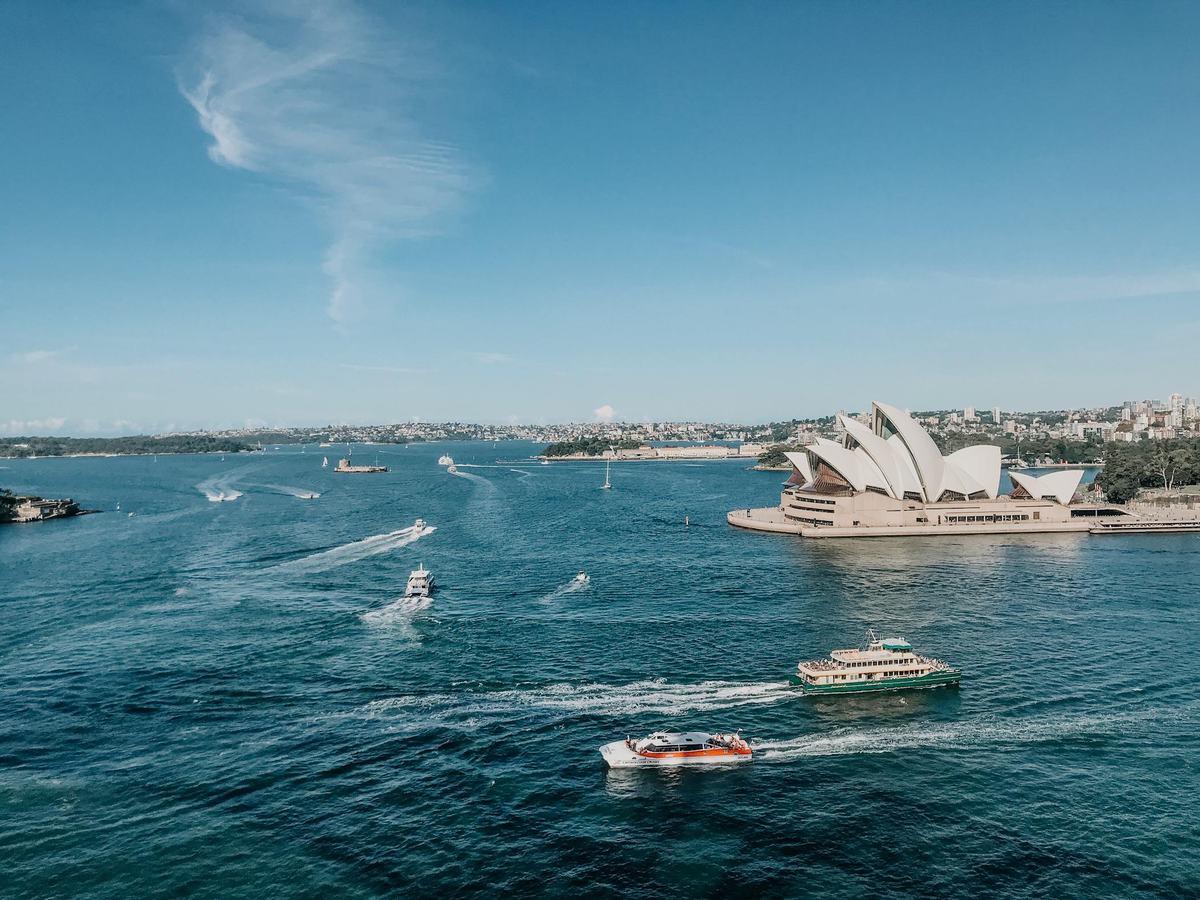
Melbourne and Sydney have been quietly competing ever since. Melbourne has the coffee culture and the trams and the AFL obsession. Sydney has the harbor, the Opera House, and the attitude that it's the only city that matters. Both are genuinely world-class. The rivalry is very real and runs deep in Australian identity in a way that outsiders find disproportionate and locals find completely reasonable.
The Federation Nobody Fully Agreed On
Australia became a federation of six colonies in 1901, but it was never a clean break from Britain [2]. The country remained closely tied to the Crown, fought alongside Britain in both World Wars, and still has the British monarch as its head of state - represented by the Governor-General. There have been republican debates for decades, most notably the 1999 referendum on becoming a republic, which failed 45% to 55% [2].
And nobody talks about this, but Australia runs its federal elections using preferential (ranked-choice) voting - one of the few countries in the world to do so at scale. You rank candidates in order of preference, and if no one wins a majority outright, lower-ranked candidates are eliminated and their votes redistributed. It's been in use since 1918 and is considered one of the reasons Australia has avoided some of the political fragmentation seen in first-past-the-post systems [2].
Frequently Asked Questions
What is Australia best known for?
Australia is best known for its unique wildlife, including kangaroos, koalas, and the platypus, as well as natural landmarks like the Great Barrier Reef and Uluru. It is the world's sixth-largest country by area and the only nation that governs an entire continent. Its Indigenous cultures are among the oldest continuously living cultures on Earth.
What language do they speak in Australia?
English is the de facto national language and spoken by the vast majority of the population. Australia has no official language written into its constitution. Over 160 languages are spoken across the country, including more than 60 Indigenous languages still in active use.
Is Australia dangerous to visit?
For most tourists visiting cities and popular destinations, Australia is a safe and well-regulated country. Dangerous wildlife - including some venomous snakes, spiders, and marine animals - exists primarily in specific regions and remote areas. Following local safety guidance in coastal and outback regions reduces risk significantly.
Why is Canberra the capital of Australia?
Canberra was purpose-built as a compromise after Sydney and Melbourne could not agree on which should be the national capital. The Australian Capital Territory was established in 1911, and Canberra was officially named capital in 1913. It remains the seat of the federal government and home to Australia's major national institutions.
What percentage of Australia is desert?
Approximately 35% of Australia is classified as desert, making it the driest inhabited continent on Earth. The interior - known as the Outback - receives very little annual rainfall, while most of Australia's population lives within 50 km of the coast where the climate is more temperate.