- Capital: Vienna [1]
- Population: about 9.1 million [1]
- Area: 83,879 square kilometers (32,386 sq mi) [1]
- Official language: German (Austrian variety) [1]
- Currency: Euro (EUR) [1]
- The Alps cover roughly 62 percent of the country's land area [2]
I grew up thinking Austria was basically a smaller, quieter Germany with better mountains. Then I started reading, and the more I read the more I realized that's like saying Montana is just a quieter Wyoming. The geography is similar on the map, but the actual place has its own gravity. Austria is a country where a coffeehouse can be on the UNESCO heritage list, where a tiny village in the Alps can claim the world's first picture postcard, and where the national anthem was probably not written by Mozart even though everyone wants it to have been. Here's what I keep coming back to.
A Small Country with an Outsized Cultural Footprint
Austria is roughly the size of Maine, but for a few centuries it ran one of the largest empires in Europe. The Habsburgs held court in Vienna and pulled in composers, scientists, and architects the way a porch light pulls in moths. That's how you end up with a country of nine million people that gave the world Mozart, Haydn, Schubert, Mahler, and Strauss, plus Freud, Schrodinger, and Wittgenstein, plus the snow globe and the sewing machine. Turns out concentration of power plus serious music funding plus a few good universities does something to a place.
Vienna itself was the imperial capital for over six hundred years, and you can still feel that. The city has more than a hundred museums, and the Schonbrunn Palace alone has 1,441 rooms. When the empire collapsed after World War I, Austria was suddenly a small country with a city built for an empire. They've been figuring out what to do with all that infrastructure ever since, mostly by turning it into excellent public space.
The Alps Are Not a Backdrop, They Are the Country
About 62 percent of Austria sits inside the Alps [2]. This isn't a feature, it's the structural condition of the place. The Grossglockner, the country's highest peak, hits 3,798 meters (12,461 feet) [3]. Whole valleys spend the winter without direct sunlight because the mountains are too tall and the angle is too steep. There's a town called Rattenberg that built giant mirrors on the surrounding hillsides to bounce sunlight down into the streets in winter, because otherwise it's just dim for months.
The mountains shape everything. They shape where people live, what they eat, how they get around, and what they do for fun. Austria has more than 250 ski resorts, and skiing isn't a hobby there so much as a civic skill. Kids learn to ski the way kids back home in Montana learn to fish. There's a federal ski school system. The country has won more Olympic medals in alpine skiing than any other nation.
Lakes That Look Photoshopped
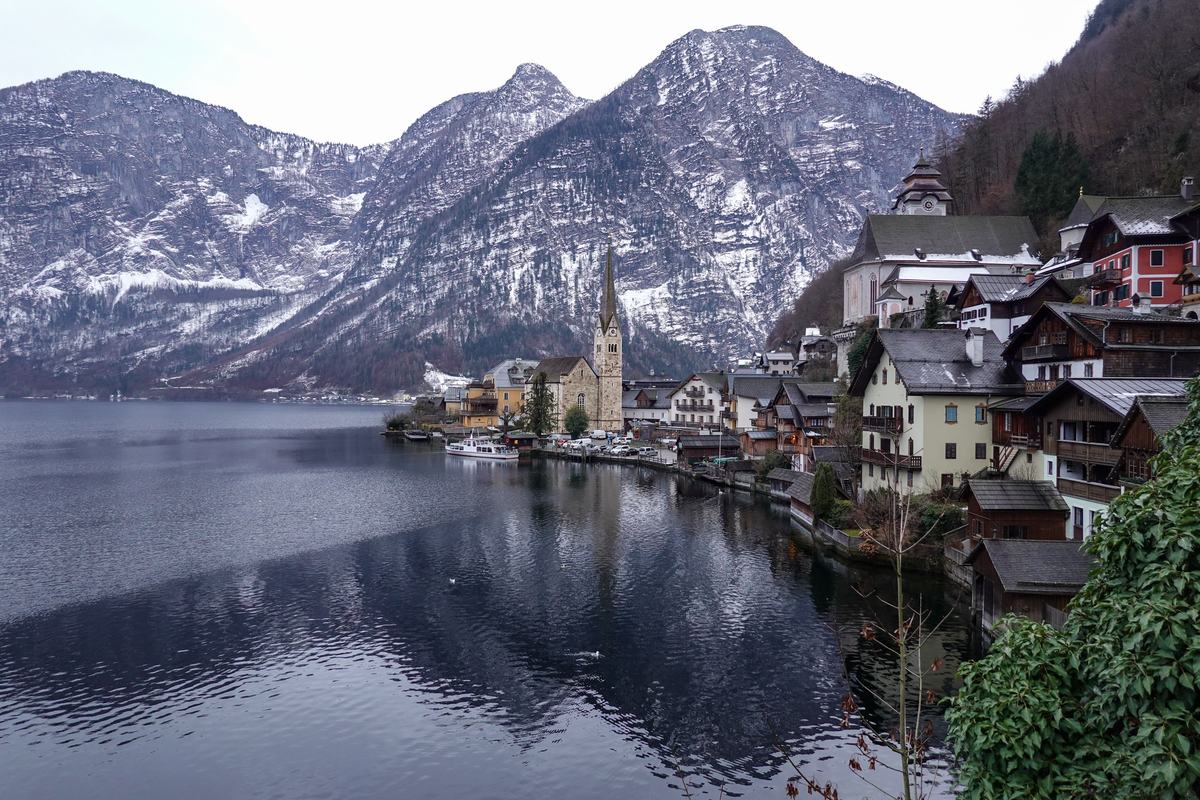
The Alps come with lakes. Hallstattersee, Wolfgangsee, Worthersee. The water in some of them is drinkable straight from the lake, certified by Austrian authorities. Hallstatt, the village on Hallstattersee, is so picturesque that there's a full-scale replica of it in Guangdong, China, built by a mining company in 2012. The original village has fewer than 800 residents and gets close to a million visitors a year, which is its own kind of problem.
Vienna and the Coffeehouse
Vienna's coffeehouse culture is on the UNESCO Intangible Cultural Heritage list. Not the buildings - the practice. The idea that you can buy one cup of coffee and sit there all day, reading newspapers the cafe provides, working on your novel, arguing about Wittgenstein, and nobody will rush you. That's been protected as cultural heritage since 2011 [4].
The coffeehouse tradition started after the Battle of Vienna in 1683, when the retreating Ottoman army left bags of coffee beans behind. A Polish soldier named Jerzy Franciszek Kulczycki figured out what to do with them and opened the city's first cafe. By the 1900s, places like Cafe Central and Cafe Landtmann were where people like Trotsky, Freud, and Klimt did most of their actual thinking. I had to look this up twice, but Trotsky really did spend years playing chess at Cafe Central before going off to help run a revolution.
The coffee menu is its own language. A "Melange" is roughly a cappuccino. An "Einspanner" is black coffee with whipped cream on top in a tall glass. A "Verlangerter" is an Americano. Ordering a "regular coffee" gets you a confused look, the way ordering "soda" in some parts of America gets you a glass of seltzer.
The First Picture Postcard
Here's the thing about postcards. The modern picture postcard, the kind with a photo on the front and space for a message on the back, has its origins in Austria. The first government-issued correspondence card was authorized by the Austrian postal service in October 1869, designed by economist Emanuel Herrmann. Within months, other countries copied it. Within a few years, picture versions appeared. The whole worldwide tradition of "wish you were here" snapshots from your vacation traces back to a paperwork decision in Vienna [5].
Austria also gave the world the snow globe. In 1900, a Viennese surgical instrument mechanic named Erwin Perzy was trying to invent a brighter surgical lamp by putting reflective particles in a water-filled glass globe. The lamp didn't work. But the snow effect was beautiful, and his family has been making snow globes in the same Vienna workshop for five generations. They still make them by hand. A few thousand a day.
Food That Punches Above Its Weight
Austrian food gets dismissed as "schnitzel and strudel", which undersells it about as much as calling Italian food "pizza and pasta". The Wiener Schnitzel is real, and it's protected by law. By Austrian regulation, a "Wiener Schnitzel" must be made from veal. If it's pork, it has to be called Schnitzel Wiener Art ("Vienna-style schnitzel"). This is enforced. Restaurants get fined.
The Sachertorte is a dense chocolate cake with a thin layer of apricot jam, invented by a 16-year-old apprentice named Franz Sacher in 1832 when his boss got sick and a Habsburg prince needed a dessert. The recipe is still a trade secret, and there was a literal seven-year court case in the 1950s and 60s between Hotel Sacher and Demel cafe over who could call their cake the "Original Sachertorte". Hotel Sacher won. Demel can sell theirs as the "Eduard Sacher-Torte". Austrians take their cake very seriously.
Then there's the Apfelstrudel. The dough is rolled so thin that the traditional test is to spread it across a table and read a newspaper through it. If you can't read the newsprint, the dough isn't thin enough.
A Country with Strong Opinions on Recycling
Austria recycles about 63 percent of its municipal waste, one of the highest rates in the European Union. Public transit in Vienna is so good and so cheap that more than half the city uses it daily. An annual transit pass costs 365 euros, exactly one euro per day, deliberately. The city set the price at one euro a day so people would feel okay about not driving.
Vienna also runs an international ranking as one of the most livable cities in the world, year after year. Quality of healthcare, public housing, parks, drinking water from the Alps piped directly into the taps. The city's water comes from Alpine springs more than 100 kilometers away, untreated, by gravity, through aqueducts built starting in 1873. Which, if you think about it, is just a quietly magnificent piece of civic engineering.
Frequently Asked Questions
What is Austria most famous for?
Austria is most famous for classical music (Mozart, Haydn, Schubert), Vienna's coffeehouse culture, the Alps, and skiing. The country also produced figures like Sigmund Freud and Erwin Schrodinger. Vienna is regularly ranked among the world's most livable cities.
What language do they speak in Austria?
The official language is German, specifically Austrian German, which has its own vocabulary and pronunciation. Common Austrian words differ from standard German for everyday items like potatoes (Erdapfel vs Kartoffel) and tomatoes (Paradeiser vs Tomate). English is widely spoken in tourist areas and major cities.
Is Austria part of Germany?
No, Austria is an independent country and has been since 1955, when it regained full sovereignty after World War II. Although Austria and Germany share a language and some historical ties, they have separate governments, currencies were once different, and distinct national identities. Austria was historically the center of the Habsburg Empire.
What currency is used in Austria?
Austria uses the euro (EUR). It joined the eurozone in 1999 and adopted euro banknotes and coins in 2002, replacing the Austrian schilling. Credit cards are widely accepted, but cash is still common in smaller establishments and rural areas.
When is the best time to visit Austria?
The best time depends on what you want. December through March is peak ski season in the Alps. May through September is ideal for hiking, lake visits, and city sightseeing in Vienna and Salzburg. December also brings Christmas markets, particularly in Vienna and Salzburg, which are a major draw.