- Capital: Baku, on the western shore of the Caspian Sea [1]
- Population: Around 10.1 million [2]
- Area: 86,600 square kilometers (about the size of Maine) [1]
- Official language: Azerbaijani (a Turkic language) [1]
- Currency: Azerbaijani manat (AZN) [1]
- Distinguishing claim: Home to roughly 350 of the world's estimated 700 mud volcanoes - more than half on Earth [3]
I grew up thinking fire was something you had to start. Then I read about Yanar Dag, a hillside in Azerbaijan that's been burning continuously for at least sixty years, and apparently a lot longer than that. The flames just come out of the rock. Nobody has to feed them. They're fueled by natural gas seeping up through the porous sandstone, and they don't go out when it rains, when it snows, or when somebody really wishes they would. That's not a campfire. That's the planet exhaling, and somebody put a viewing platform next to it.
This is the kind of country Azerbaijan is. The name itself is often translated as "Land of Fire", and once you spend a few minutes reading about the place, the nickname stops feeling poetic and starts feeling like a weather report.
A Capital Older Than Most Empires
Baku sits below sea level. Twenty-eight meters below, to be exact, which makes it the lowest-lying national capital in the world. The old walled city, Icheri Sheher, is a UNESCO World Heritage Site, and parts of it have been continuously inhabited for over a thousand years. The Maiden Tower at its center is so old that nobody is entirely sure when it was built. Best estimates put parts of it in the 12th century, with foundations possibly dating back to pre-Islamic fire-worship rituals [4].
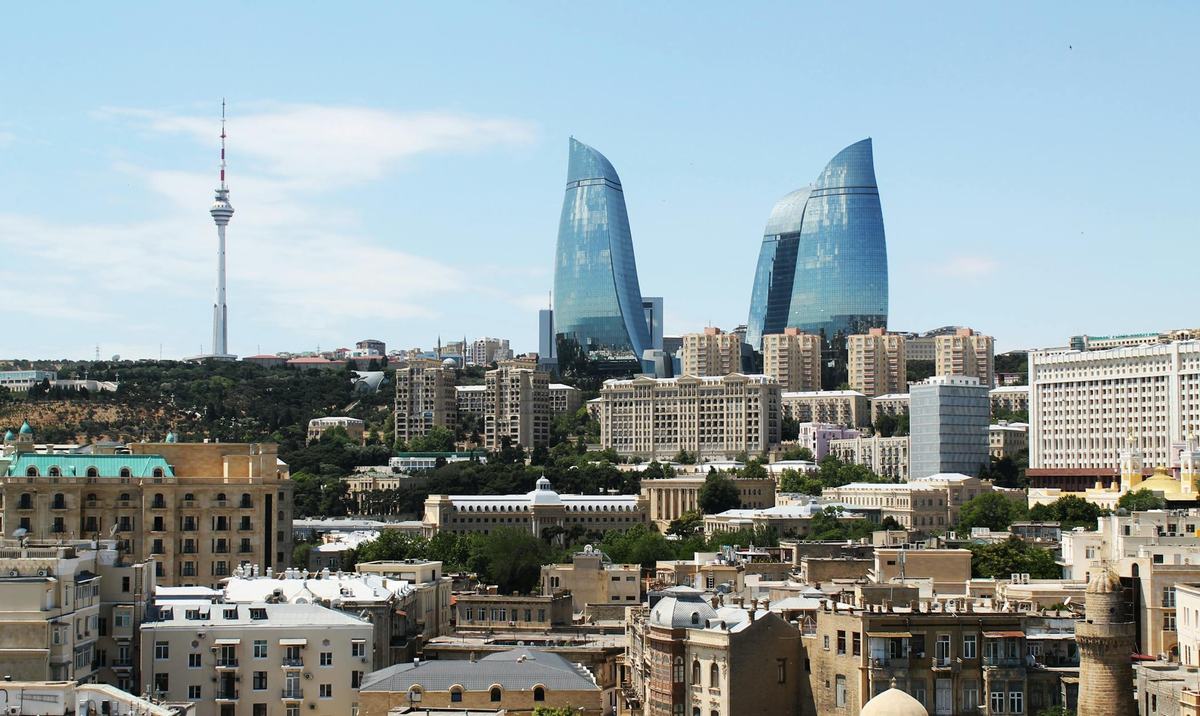
Walk a few blocks and the city flips. The skyline behind the old town belongs to the Flame Towers, three curved skyscrapers shaped like flickering tongues of fire and wrapped in LED screens that turn the entire trio into a giant animated flame at night. The architectural distance between the Maiden Tower and the Flame Towers is about nine hundred years and roughly six hundred meters. They're in the same photograph.
Mud Volcanoes Are a Real Thing
Here's the thing about mud volcanoes. They're not technically volcanoes in the lava-spewing sense. They're cold eruptions of mud, water, and gases pushed up from deep underground. Azerbaijan has somewhere around 350 of them, more than any country on Earth, and most of them sit in a stretch of land between Baku and the Caspian coast [3].
I had to look this up twice, but yes, they sometimes ignite. The methane that bubbles up can catch fire from a spark, and a mud volcano can throw a column of flame hundreds of meters into the air. In 2001, one of them erupted spectacularly near a village called Lokbatan and was visible for kilometers. Mostly, though, they just gurgle. You can stand on a hill outside the city and watch the earth burp gray mud at you like a very slow, very ancient soup.
Petroglyphs Older Than the Pyramids
About forty miles south of Baku, in the rocky hills of Gobustan, there's a collection of more than 6,000 rock carvings. Some date back roughly 40,000 years [5]. These petroglyphs show people dancing, hunting, sailing reed boats across what's now empty desert, and there are also carvings of cattle, deer, and wild horses that haven't lived in the region for thousands of years.
What gets me about Gobustan isn't just the age. It's the boats. The carvings show long reed vessels with sun-shaped figures sitting in them, and the Norwegian explorer Thor Heyerdahl visited in the 1980s and argued that these were the same kind of boats his ancestors might have used to cross oceans. Whether or not he was right, somebody was sailing here when the Caspian was bigger and the climate was wetter, and they took the time to carve it into the rock so we'd know.
The Oil Story
Azerbaijan's connection to petroleum is older than the petroleum industry. Marco Polo wrote about people collecting flammable oil from the ground here in the 13th century. By the late 1800s, Baku was producing roughly half the world's oil supply, and the Nobel brothers - yes, those Nobels - made a significant chunk of their fortune drilling here before Alfred used the proceeds to fund the prizes that bear the family name [6].
The first industrially drilled oil well in the world wasn't in Pennsylvania. It was sunk near Baku in 1846, more than a decade before the famous Drake well in Titusville. Which, if you think about it, reframes the entire history of the modern oil industry. The Caspian was first.
Food, Tea, and the Tandir
Azerbaijani food sits at a crossroads. Persian rice traditions, Turkic kebab culture, and Caucasian herbs all meet on the same table. Plov, a saffron-scented rice dish layered with dried fruit and lamb, is the celebration food. Dolma, the stuffed grape leaf or vegetable, shows up at every family gathering. Bread comes hot out of a tandir, a clay oven sunk into the ground, and you can still find old neighborhoods in Baku where the morning starts with the smell of fresh tandir bread coming up from someone's courtyard.
Tea is the social glue. Black tea, served in a pear-shaped glass called an armudu, sweetened not by stirring sugar in but by holding a sugar cube between your teeth as you sip. Back home in Montana, we drank coffee out of mugs the size of small thermoses. The armudu glass holds about four sips. You're not supposed to gulp tea in Azerbaijan. You're supposed to sit with it.
Frequently Asked Questions
Is Azerbaijan in Europe or Asia?
Azerbaijan straddles both continents. The Caucasus Mountains form a traditional dividing line, with parts of Azerbaijan considered Eastern European and other parts Western Asian. The country is a member of the Council of Europe and competes in European sporting and cultural events, so culturally it often functions as European.
What language do people speak in Azerbaijan?
Azerbaijani is the official language, a Turkic language closely related to Turkish. Russian is widely understood, especially in Baku and among older generations, due to the Soviet era. English is increasingly common among younger Azerbaijanis, particularly in tourism and business sectors.
Is Azerbaijan safe to visit?
Azerbaijan is generally considered safe for tourists, with low rates of violent crime and a strong police presence in Baku. Travelers should check current advisories regarding the border regions with Armenia. Standard precautions against petty theft apply in crowded tourist areas like the old city.
Why is Azerbaijan called the Land of Fire?
The nickname comes from natural gas seeping through the ground, which has produced eternally burning flames in places like Yanar Dag for centuries. Ancient Zoroastrians worshipped at fire temples here, and the country still uses a stylized flame on its national tourism branding.