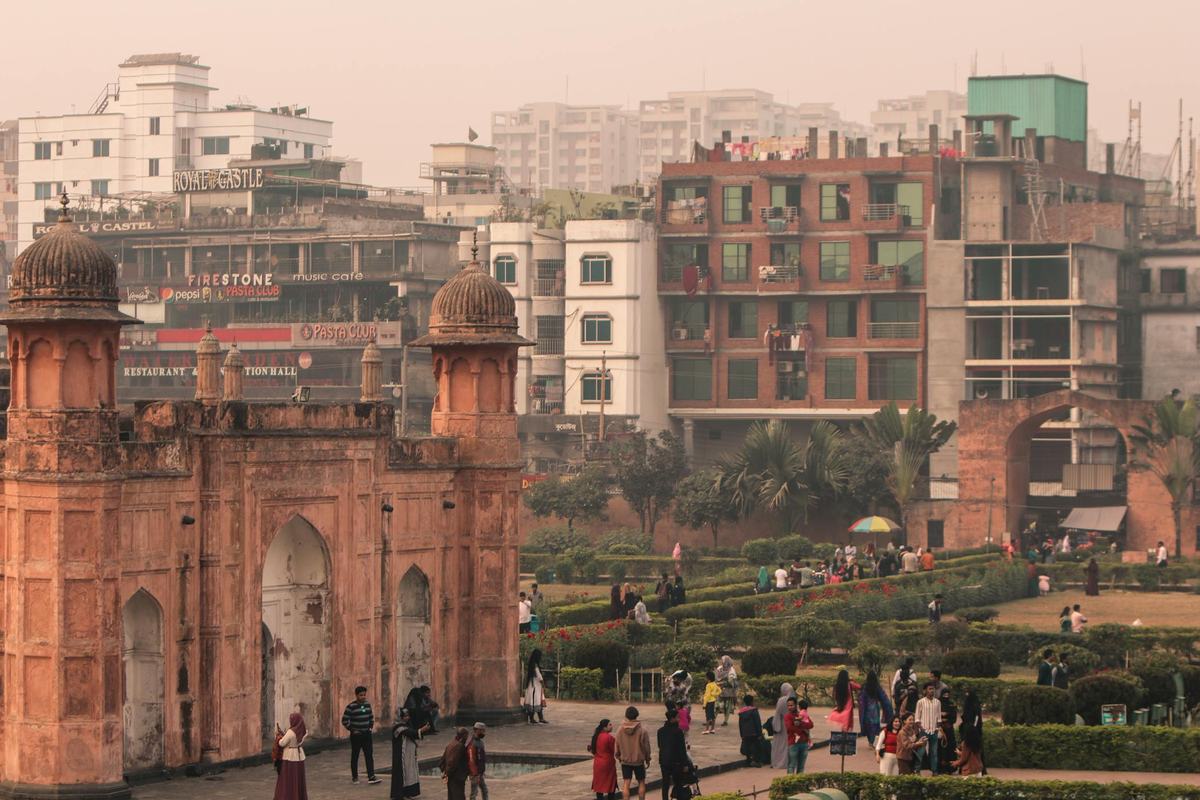
- Capital: Dhaka, a megacity of more than 22 million people in its metro area [1]
- Population: Around 170 million, making it the eighth most populous country in the world [2]
- Area: 148,460 square kilometers, smaller than the U.S. state of Iowa [1]
- Official language: Bengali (Bangla), one of the most widely spoken languages on Earth [3]
- Currency: Bangladeshi taka (BDT) [1]
- Distinguishing claim: Sits on the largest river delta in the world, formed by the Ganges, Brahmaputra, and Meghna rivers meeting the Bay of Bengal [4]
I grew up looking at world maps where Bangladesh was a small green smudge tucked into the corner of India. I knew almost nothing about it. Then I started reading and had to sit down for a minute. This is a country roughly the size of Iowa with the population of Russia and Japan combined, sitting on top of the largest river delta on the planet, where three giant rivers braid themselves into the sea. It's only been a country since 1971. Most of its land is less than ten meters above sea level. And its people fought a war over the right to speak their own language and won.
There's a lot to unpack here, and almost none of it lines up with what most Americans assume.
A Country Made of Water
Bangladesh is, geographically speaking, a delta with people on it. The Ganges (called the Padma here), the Brahmaputra (called the Jamuna), and the Meghna all converge inside its borders before pouring into the Bay of Bengal. The result is the Ganges Delta, also known as the Sundarbans Delta, which covers about 100,000 square kilometers and is the largest river delta in the world [4]. Roughly two-thirds of Bangladesh sits less than five meters above sea level [5].
What that means in practice is that the country is laced with rivers. There are something like 700 of them, most with their own name and their own history. During the monsoon, between a fifth and a third of the entire country can be underwater. Boats are not a hobby, they're transportation. The world's largest passenger ferry network outside of Indonesia runs through here, moving millions of people every week along channels that change shape from year to year [6].
The flip side is that Bangladesh is also one of the most fertile places on Earth. The same silt that makes the rivers so dangerous makes the soil so productive. Three rice harvests a year are normal in much of the country. That fertility is why so many people live here in the first place.
The Sundarbans and the Royal Bengal Tiger
Where the delta meets the sea, the rivers slow down and the salt water mixes with fresh, and you get the Sundarbans. It's the largest mangrove forest in the world, around 10,000 square kilometers shared between Bangladesh and India, and it's a UNESCO World Heritage site on both sides of the border [7]. The trees grow on stilts in tidal mud. The forest floods twice a day.
This is also where the Royal Bengal tiger lives. The Sundarbans population is the only tiger population in the world that has adapted to swimming, salt water, and crab-heavy diets. The current Bangladeshi count is somewhere around 100 to 130 individuals, with strong evidence of recovery from a low point about a decade ago [8]. Local fishermen and honey gatherers wear masks on the back of their heads when they go into the forest, because tigers prefer to attack from behind, and the masks are sometimes enough to confuse them. That's not folklore, that's official guidance from the forest department.
A Country That Fought for Its Language
Most countries are formed over a flag, a border, or a king. Bangladesh was, in a real sense, formed over a language. When British India was partitioned in 1947, the eastern half of Bengal became East Pakistan, separated from West Pakistan by more than 1,500 kilometers of Indian territory. The two halves had different climates, different cuisines, different languages, and almost nothing in common except religion.
In 1948 the government in West Pakistan declared Urdu the sole national language. Bengali speakers, who were the majority of the country's population, refused. On February 21, 1952, students at Dhaka University marched in protest. Police opened fire and killed several of them [9]. That date - February 21st - is now International Mother Language Day, declared by UNESCO in 1999 in honor of the protest [10]. Think about that for a moment. There is a global day of observance, recognized by the United Nations, that exists because students in Dhaka were willing to die for the right to speak Bengali.
The language movement seeded the independence movement, and after a brutal war in 1971, Bangladesh became a country. It's younger than most of its parents.
Dhaka, Density, and Daily Life
Dhaka is one of the most densely populated cities on Earth. Depending on how you draw the boundaries, the metro area holds 22 million people, and the city proper has a population density of more than 30,000 people per square kilometer in some neighborhoods [1]. Rickshaws fill the streets. Hand-painted ones, in screaming colors, with peacocks and movie stars and Bengali poetry on the back panels. The city has more cycle rickshaws than anywhere else in the world. The estimates run into the hundreds of thousands [11].
Cricket is the national obsession in a way that's hard to overstate. The 2011 Cricket World Cup opening ceremony in Dhaka shut the city down. The men's national team has been a Test-playing nation since 2000, and games against India and Pakistan are basically holidays.
The economy is mostly textile. About 80 percent of Bangladesh's export earnings come from ready-made garments, and the country is the second-largest apparel exporter in the world after China [12]. There's a decent chance the t-shirt you're wearing right now was sewn in a factory outside Dhaka. The industry has had real problems with safety and labor conditions, especially after the Rana Plaza collapse in 2013, but it has also pulled the country's poverty rate down by a remarkable amount in a single generation.
The Things You Don't Expect
Here's the thing about Bangladesh that's hardest to convey: it works. The country has more people per square kilometer than almost anywhere else on Earth, sits in the path of cyclones, has rising seas eating its coastline, and still has managed to cut child mortality, raise literacy, and grow its economy faster than India over the last decade [13]. Microfinance was essentially invented here, by Muhammad Yunus, who won the Nobel Peace Prize for it in 2006. NGOs from Bangladesh now consult internationally.
The country also has a sweet tooth that would put my grandmother's Montana church socials to shame. Bengali sweets are their own genre. Roshogolla, a syrup-soaked cheese ball, is the most famous, and there is a literal court case between West Bengal in India and Bangladesh over who invented it. Both sides have geographical indication tags. Both sides are, of course, right.
Frequently Asked Questions
Is Bangladesh a part of India?
Bangladesh is an independent country, not part of India. It became independent from Pakistan in 1971 after a nine-month liberation war and is now the eighth most populous country in the world. India surrounds it on three sides, but the two are separate sovereign states with different governments, currencies, and official languages.
What language do people speak in Bangladesh?
The official language of Bangladesh is Bengali, also called Bangla, spoken by virtually the entire population. English is widely used in business, higher education, and government. Bengali is one of the most spoken languages in the world, with around 230 million native speakers between Bangladesh and the Indian state of West Bengal.
Is Bangladesh a poor country?
Bangladesh has been classified as a lower-middle-income country by the World Bank since 2015, and its economy has grown faster than most of South Asia for over a decade. Poverty rates have fallen sharply since independence, though inequality remains and the country still faces challenges from climate change and rapid urbanization in Dhaka.
What is Bangladesh famous for?
Bangladesh is famous for the Sundarbans mangrove forest and Royal Bengal tigers, the world's largest river delta, its massive ready-made garment industry, the language movement of 1952, and being the home of microfinance. It's also known for Bengali sweets, cricket, and one of the densest populations on Earth in its capital, Dhaka.
Is Bangladesh safe to visit?
Bangladesh is generally safe for tourists, with low rates of violent crime against foreigners and friendly local hospitality. Travelers should follow standard precautions, watch for political demonstrations, and be cautious during the monsoon season from June to September. Most visitors need a visa, which is available on arrival for many nationalities at Dhaka airport.
Sources
- The World Factbook: Bangladesh (CIA)
- Bangladesh Bureau of Statistics: Population and Housing Census
- Bengali Language (Encyclopaedia Britannica)
- Ganges-Brahmaputra Delta (Encyclopaedia Britannica)
- Climate Change Knowledge Portal: Bangladesh (World Bank)
- Bangladesh Inland Water Transport Authority
- The Sundarbans (UNESCO World Heritage Centre)
- Bangladesh Forest Department: Tiger Conservation
- Language Movement of 1952 (Banglapedia)
- International Mother Language Day (UNESCO)
- Dhaka: A Megacity of Rickshaws (BBC)
- World Trade Statistical Review (World Trade Organization)
- World Development Indicators: Bangladesh (World Bank)