- Capital: Bridgetown [1]
- Population: about 282,000 (2023) [2]
- Area: 432 square kilometers (167 square miles) [1]
- Official language: English [1]
- Currency: Barbadian dollar (BBD), pegged at 2 BBD to 1 USD [3]
- The House of Assembly has been meeting since 1639, making it one of the oldest continuous parliaments in the Western Hemisphere [4]
I grew up thinking all Caribbean islands were basically the same kind of place. Volcanic peaks, black sand, lush jungle climbing up the inside of an old crater. Then I read about Barbados and realized I had it wrong. Barbados is not volcanic. It is a slab of coral and limestone that the sea quietly pushed up out of itself, and it sits about a hundred miles east of the rest of the Caribbean chain, off on its own. That little geographic detail explains almost everything else about the place.
A Coral Island, Not a Volcanic One
Most of the Lesser Antilles are the tops of underwater volcanoes. Barbados is not. It formed where the South American tectonic plate slides under the Caribbean plate, scraping up sediment and ancient coral reefs into a low, gentle dome. The highest point, Mount Hillaby, is only 336 meters above sea level [1]. There are no smoking craters and no sulfur springs. Instead the island has caves, sinkholes, and one of the longest cave systems in the region at Harrison's Cave, where an underground river runs through chambers full of stalactites that took tens of thousands of years to grow [5].
Because the bedrock is porous limestone, rainwater filters straight down through it. Barbados has almost no surface rivers. The water you drink there has been underground for a long time, and the local utility says it is among the purest tap water in the world [3]. Back home in Montana the well water tastes like minerals from the Rockies. The water in Barbados tastes like nothing at all, in the best possible way.
Sitting East of Everywhere
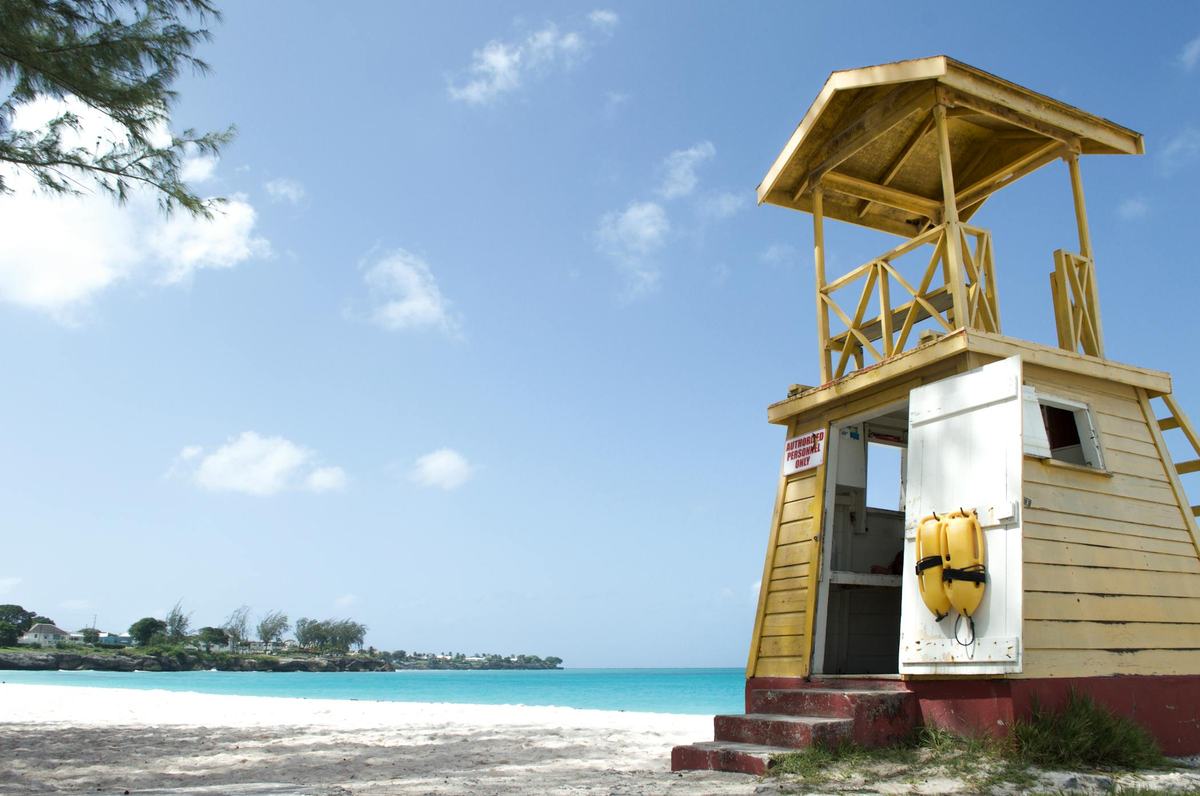
Look at a map of the Caribbean. The islands form a long curve that arcs from Puerto Rico down toward Venezuela. Barbados is not on that curve. It sits about 160 kilometers east of Saint Vincent, alone, sticking out into the Atlantic. That position made it the first stop for ships crossing from West Africa and Europe during the age of sail, which shaped centuries of its history. The trade winds blow in steadily off the open Atlantic, which is why the east coast has dramatic surf and the west coast is the calm, postcard side where the resorts cluster.
That eastward position also gave the country its old nickname, "Little England". The British arrived in 1627 and held the island without interruption until independence in 1966 [4]. No other colonial power ever wrestled it away. Most Caribbean islands changed hands a half dozen times between the French, Spanish, Dutch, and British. Barbados did not. That continuity left fingerprints everywhere, from the parish names (Saint Michael, Saint James, Saint Philip) to the fact that they still drive on the left.
The Parliament Older Than the United States
Here is something that will ruin the next geography quiz you take. The Parliament of Barbados has been meeting continuously since 1639 [4]. That is 137 years before the Declaration of Independence. Only the United Kingdom's Parliament and Bermuda's House of Assembly are older among English-speaking legislatures, and the gap with Bermuda is small. The Barbadian House of Assembly met first in a tavern, then in St. Michael's Cathedral, and now in a Gothic-revival building in Bridgetown that opened in 1874 [4].
In November 2021, Barbados did something that surprised a lot of people who had stopped paying attention. It removed Queen Elizabeth II as head of state and became a republic, with President Sandra Mason taking over the ceremonial role [6]. The country stayed in the Commonwealth, but the constitutional link to the British monarchy ended after almost four hundred years. Rihanna, who is Barbadian, was named a national hero at the same ceremony.
Flying Fish and Cou-Cou
Every country has a national dish, and Barbados has cou-cou and flying fish. Cou-cou is a cornmeal and okra mash that is closer to Italian polenta than anything you would find in the southern United States. The flying fish is exactly what it sounds like, a small silver fish with elongated pectoral fins that lets it glide above the waves to escape predators. Schools of them used to fill the waters between Barbados and Tobago in such numbers that the country was sometimes called "the land of the flying fish". Stocks have moved with shifting ocean temperatures, and Barbados and Trinidad and Tobago actually went to international arbitration in 2006 over fishing rights [7].
The other thing Barbados is famous for is rum. The island is widely considered the birthplace of rum, with Mount Gay distillery operating since 1703, which makes it the oldest continuously running rum distillery in the world [8]. Sugar cane arrived in the 1640s, the byproduct molasses started getting fermented and distilled, and what came out the other end eventually conquered the world's bars. Walk into a rum shop on any Saturday afternoon, especially in the countryside, and you will find old men playing dominoes with a bottle on the table. The rum shop is a social institution, not just a place to drink.
Crop Over and the Sound of the Island
If you visit in summer, you might land in the middle of Crop Over. The festival began in the 1780s as a celebration of the end of the sugar cane harvest, paused for most of the twentieth century, and was revived in 1974 [9]. It now culminates in Grand Kadooment Day in early August, with bands of costumed revelers parading through Bridgetown to a soundtrack of soca and calypso. Calypso has deep roots in Barbados, but the local twist is the genre called spouge, which a singer named Jackie Opel pioneered in the 1960s by mixing ska, R&B, and Bajan rhythm. Spouge faded by the 1980s, but you can still hear its echoes.
And of course there is Rihanna. She grew up in Bridgetown, and the road she lived on was renamed Rihanna Drive in 2017. The country leans into it. The currency, the rum, the cricket, and Rihanna are the four cultural exports that Barbadians abroad will mention if you ask. Cricket especially. Sir Garfield Sobers, widely considered one of the greatest cricketers who ever lived, was born in Barbados, and the national stadium is named after him.
A Country Punching Above Its Weight
Barbados is small. The whole island is about the size of New York City's five boroughs combined. The population is under 300,000, smaller than Cincinnati. And yet the country has produced, per capita, an outsized number of Olympic athletes, Rhodes scholars, and internationally known musicians and writers. The literacy rate sits near 100 percent, among the highest in the Western Hemisphere [3]. The country runs one of the most respected education systems in the Caribbean, and Barbadian universities draw students from across the region.
Climate change is the conversation that runs underneath everything else now. The country's prime minister, Mia Mottley, has become one of the loudest voices in international forums calling for reform of how rich countries finance climate adaptation in vulnerable small island states. The "Bridgetown Initiative", launched in 2022, has reshaped some of the conversation at the IMF and the World Bank [10]. For a country of less than 300,000 people sitting alone in the Atlantic, that is not a small thing.
Frequently Asked Questions
Is Barbados part of the Caribbean?
Yes, Barbados is part of the Caribbean region, but geographically it sits about 160 kilometers east of the main island arc, alone in the Atlantic. It is a member of CARICOM and shares deep cultural and historical ties with the rest of the English-speaking Caribbean.
What is Barbados famous for?
Barbados is famous for being the birthplace of rum, with Mount Gay distillery operating since 1703. It is also known for its calm western beaches, cricket, Crop Over festival, and as the home country of singer Rihanna and former cricketer Sir Garfield Sobers.
What language do they speak in Barbados?
The official language is English, used in government, schools, and media. Most Barbadians also speak Bajan, a creole based on English with West African influences in vocabulary and rhythm. Bajan is mainly spoken at home and in informal settings.
Is Barbados expensive to visit?
Barbados is one of the more expensive Caribbean destinations, especially the west coast where most luxury resorts cluster. The Barbadian dollar is pegged at 2 BBD to 1 USD, which makes mental math easy for American visitors. Costs drop in the south coast and the inland parishes.
When did Barbados become a republic?
Barbados became a republic on November 30, 2021, removing Queen Elizabeth II as head of state. Dame Sandra Mason was inaugurated as the country's first president. Barbados remains a member of the Commonwealth and kept its parliamentary system intact.
Sources
- Barbados - The World Factbook
- Barbados Population - World Bank
- Barbados Country Profile - Government of Barbados
- The Parliament of Barbados - Official History
- Harrison's Cave - Barbados National Conservation Commission
- Barbados becomes a republic and parts ways with the Queen - BBC News
- Barbados v Trinidad and Tobago Maritime Arbitration - Permanent Court of Arbitration
- Mount Gay Rum - Company History
- Crop Over Festival - National Cultural Foundation of Barbados
- The Bridgetown Initiative - Government of Barbados