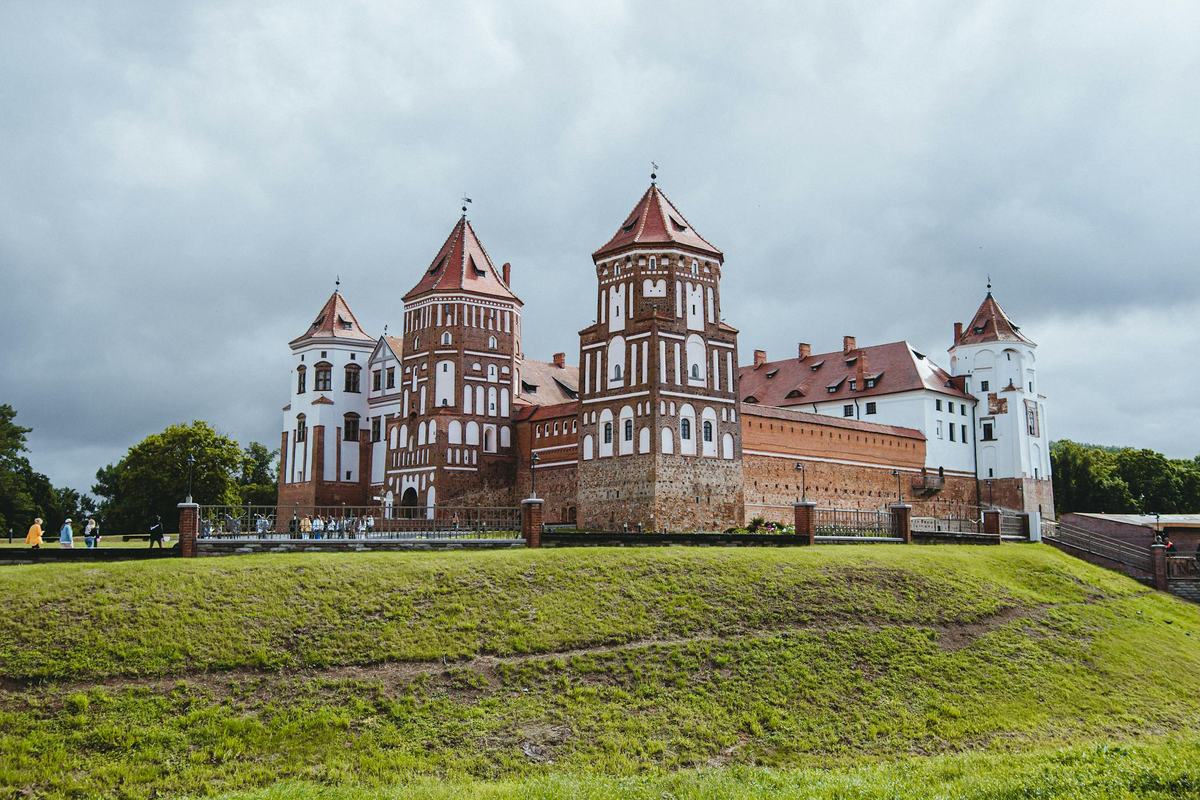
- Capital: Minsk [1]
- Population: about 9.2 million (2023) [2]
- Area: 207,600 square kilometers (80,200 square miles) [1]
- Official languages: Belarusian and Russian [1]
- Currency: Belarusian ruble (BYN) [3]
- Roughly 40 percent of the country is covered in forest, one of the highest shares in Europe [4]
Most Americans I know couldn't place Belarus on a map without two or three guesses. I was the same way until a college professor handed me an atlas and pointed at the green smudge between Poland and Russia. That green is real. Belarus is one of the most heavily forested countries in Europe, sitting on a flat plain of woods, swamps, and slow rivers. There are no mountains. There is no coastline. What there is, in abundance, is trees and water and an unusually long memory of the twentieth century.
A Country Made of Forest and Marsh
Belarus is mostly flat. The highest point in the country, Dzyarzhynskaya Hara, is 345 meters above sea level [1]. Compare that to a single foothill in the Bitterroot range back home in Montana, and you start to get the picture. What the country lacks in elevation it makes up for in trees. About 40 percent of the land is forested, mostly with pine, birch, oak, and spruce, and the share has been growing for decades as old farmland is reclaimed by the woods [4].
The southern third of the country is dominated by the Pripet Marshes, one of the largest wetland systems in Europe. The marshes were so impassable for so long that they shaped the way armies moved across the continent. Napoleon's Grande Armée tried to skirt them in 1812. The Wehrmacht had to plan around them in 1941. They are still wild enough that lynx, wolves, and elk thrive there.
The Last Primeval Forest in Europe
In the southwest of the country, straddling the border with Poland, sits Belovezhskaya Pushcha. It is the last large remnant of the primeval lowland forest that once covered most of Europe, and it has been protected in some form since the 14th century, when Lithuanian and Polish kings used it as a royal hunting ground [5]. UNESCO listed it as a World Heritage Site, and the Belarusian and Polish halves together form a transboundary park.
The forest is famous for one animal in particular. The European bison, called the wisent, is the continent's largest land mammal and was hunted to extinction in the wild by 1927. A handful of captive animals were used to rebuild the population, and Belovezhskaya Pushcha is where the species was reintroduced. There are now around 7,000 wisent worldwide, and roughly 2,000 of them roam Belarus, the largest free-living herd anywhere [5]. I had to look this up twice because the number sounded wrong. It is not.
Eleven Thousand Lakes
Belarus is sometimes called the country of lakes, and the math behind the nickname is real. There are more than 10,000 lakes, with some counts pushing past 11,000 [4]. Most of them are small, shallow, and glacial in origin, gouged out by the ice sheets that pushed down from Scandinavia during the last ice age and then melted in place. The largest, Lake Naroch, covers about 80 square kilometers and is a popular summer destination for Belarusians who want to swim and fish without leaving the country.
The lakes feed a dense network of slow, looping rivers. The Dnieper, Western Dvina, and Neman all rise or run through Belarus on their way to the Black Sea or the Baltic. For a landlocked country, water is everywhere.
Two Languages, One Country
Belarus has two official languages, Belarusian and Russian, but the everyday picture is more complicated than the law makes it sound. Russian dominates daily life in cities, schools, and most workplaces. Belarusian is the first official language of the country and is closer to Ukrainian and Polish than to Russian, with its own Cyrillic script variants and a distinctive sound [1]. There is also a hybrid spoken form called Trasyanka, which mixes the two languages in ways that are hard to standardize.
The split has been a long political conversation. Census data shows that a large majority of citizens identify as ethnic Belarusians, but a smaller share name Belarusian as their primary spoken language at home. Cultural revival efforts have pushed Belarusian back into music, literature, and signage in recent years.
A Country Shaped by the Twentieth Century
Here's the thing about Belarus. To understand the country, you have to sit with what happened to it during World War II. Nazi Germany occupied the territory from 1941 to 1944, and the destruction was on a scale that is hard to comprehend. Roughly one in four people living in what is now Belarus died during the war, the highest per capita loss of any European nation [6]. Hundreds of villages were burned, and the village of Khatyn, where the Nazis killed 149 residents and torched the homes, became a national memorial.
That memory is woven into how the country presents itself. The Brest Fortress, where Soviet defenders held out against the German invasion in June 1941, is preserved as a sprawling memorial. Minsk itself was almost entirely destroyed and rebuilt after the war, which is why so much of the capital is wide socialist boulevards and squared off Stalinist architecture rather than the older European street grid you find in Vilnius or Warsaw.
Potatoes, Draniki, and Black Bread
Ask a Belarusian what the national food is and you will hear potatoes. The country grows them at one of the highest per capita rates in the world, and the ways of cooking them fill cookbooks. Draniki, the Belarusian potato pancake, is the dish people will mention first. It is a simple thing, grated potato fried in oil, served with sour cream, often with a slab of pork or mushrooms on top.
Black bread made from rye is the other staple. Bakeries in Minsk produce dense, dark loaves with a sour tang that goes back centuries, and a slice of it with salt and butter is the kind of snack a grandmother will press into your hand. Pickled vegetables, kielbasa, beet soup, and forest mushrooms in cream round out the rest of the table. None of it is fancy. All of it sticks with you.
Frequently Asked Questions
Where is Belarus located?
Belarus is a landlocked country in Eastern Europe, bordered by Russia to the east and northeast, Ukraine to the south, Poland to the west, and Lithuania and Latvia to the northwest. Its capital, Minsk, sits roughly in the geographic center of the country.
What language do people speak in Belarus?
Belarus has two official languages, Belarusian and Russian. Russian dominates everyday speech in cities, schools, and workplaces, while Belarusian is closer to Ukrainian and Polish and is used in cultural and official settings. Many people also speak a hybrid form called Trasyanka.
Is Belarus part of the European Union?
No, Belarus is not a member of the European Union. It is a member of the Eurasian Economic Union and the Commonwealth of Independent States, and it maintains close political, economic, and military ties with Russia. EU relations have been strained since the disputed 2020 election.
What is Belarus famous for?
Belarus is famous for its dense forests, more than 10,000 lakes, and Belovezhskaya Pushcha, the last primeval lowland forest in Europe and home to the largest free-living herd of European bison. It is also known for potato cuisine, particularly draniki, and for its capital Minsk.
What currency does Belarus use?
Belarus uses the Belarusian ruble, abbreviated BYN. The currency was redenominated in 2016, removing four zeros from the previous version. Cash and card are both common in cities, but smaller towns and rural areas still rely heavily on cash transactions.