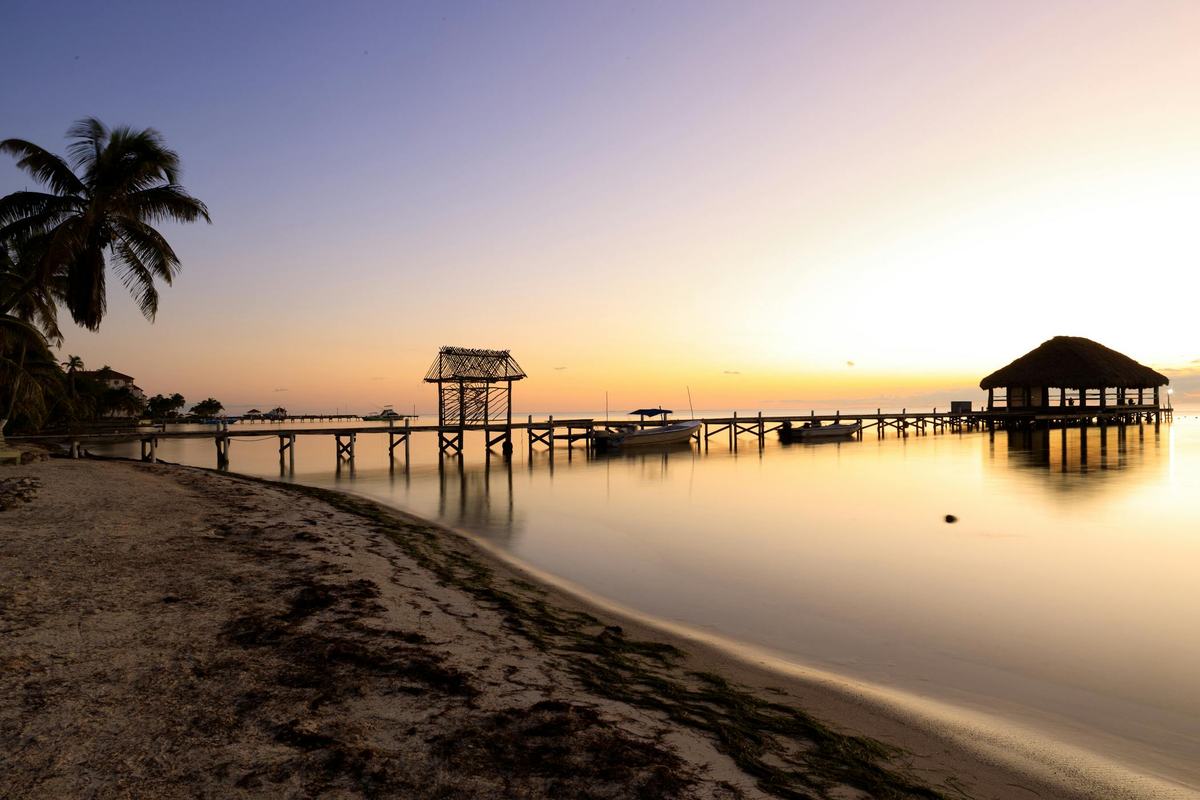
- Capital: Belmopan [1]
- Population: about 410,000 (2023) [2]
- Area: 22,966 square kilometers (8,867 square miles) [1]
- Official language: English [1]
- Currency: Belize Dollar (BZD), pegged 2:1 to the US dollar [3]
- Home to the Belize Barrier Reef, the second-largest coral reef system in the world [4]
I had Belize filed in my head as "that small country next to Mexico" until a marine biologist friend showed me a photo of the Great Blue Hole from the air. A perfect dark circle in turquoise water, four hundred feet deep. I asked where it was, and she said Belize, and I had to look it up twice because I genuinely did not know any country in Central America used English as its first language. Turns out Belize does, and that is just the start of what makes the place feel a little out of step with its neighbors in the best possible way.
The Only English-Speaking Country in Central America
Belize used to be called British Honduras. It was a British colony from 1862 until 1981, when it became fully independent, and the language stuck [1]. Today English is the official language of government, schools, and the courts. About a third of Belizeans also speak Spanish at home, and many speak Belizean Creole, an English-based creole that you can almost follow if you listen closely. Mayan languages, German (spoken by the country's Mennonite communities), and Garifuna are also part of daily life [1].
That mix gives Belize a sound that does not match any other country in the region. You can walk through a market in Belize City and hear a vendor switching between Creole, Spanish, and English in the same sentence, depending on who walks up.
A Reef You Can See from Space
The Belize Barrier Reef runs along almost the entire 240-mile coast, and it is the second-largest coral reef system on the planet after Australia's Great Barrier Reef [4]. UNESCO listed the reserve system as a World Heritage Site in 1996, and a big chunk of the country's tourism revolves around it.
The Great Blue Hole, which sits about 50 miles off the coast inside Lighthouse Reef, is the part most people have seen in photos. It is a vertical cave that collapsed during the last ice age, then flooded as sea levels rose. The hole is 1,043 feet across and about 410 feet deep [5]. Jacques Cousteau brought his ship there in 1971 and put the place on the international diving map. Recent expeditions found stalactites and old hurricane debris near the bottom, along with unexpectedly low levels of life because there is almost no oxygen down that deep.
Maya Ruins in the Jungle
Long before the British showed up, Belize was part of the Maya world. At its peak around 1,000 years ago, the area held more than a million people, more than live there today [6]. Archaeologists have found roughly 600 Maya sites in Belize, and only a fraction of them have been fully excavated.
Caracol, deep in the jungle of the Cayo District, is the largest. Its main pyramid, Caana, rises 143 feet and is still the tallest man-made structure in the country [6]. Lamanai, on a lagoon in northern Belize, was occupied for almost three thousand years and only emptied out for good in the 17th century when Spanish missionaries pushed the last residents out. Xunantunich sits on a hilltop near the Guatemalan border, and you reach it by hand-cranked ferry across the Mopan River. Standing on top of El Castillo there, you look out at jungle and farmland that runs all the way to the horizon, and it is genuinely hard to remember which century you are in.
The Country Moved Its Capital After a Hurricane
Belize City was the capital until Hurricane Hattie tore through in 1961, killing more than 300 people and flattening huge sections of the coast [7]. The government decided that putting the capital on the open Caribbean was a bad bet long term, and in 1970 it moved the seat of government inland to a brand-new planned city called Belmopan, about 50 miles southwest.
Belmopan was built from scratch on a low ridge thought to be safer from storms and flooding. Today it has about 25,000 residents, which makes it one of the smallest national capitals in the world by population [1]. Most Belizeans still live in or near the old capital. Belize City has the airport, the cruise port, the largest hospital, and most of the country's commercial life. Belmopan has the parliament and the foreign embassies and not much else.
Jaguars, Howler Monkeys, and a Lot of Forest
More than 60 percent of Belize is still covered in forest, one of the highest percentages in Central America [8]. The country's small population helps. So does an unusually strong network of protected areas, which covers around 36 percent of the territory.
The Cockscomb Basin Wildlife Sanctuary, set up in 1986, is the world's first jaguar preserve. Researchers estimate that Belize has one of the densest jaguar populations in Central America, though spotting one is still a matter of pure luck. Black howler monkeys, called "baboons" locally even though they are not, live in troops along the Belize River and produce a deep guttural roar that carries for miles through the canopy. The country's national animal is the Baird's tapir, a shy, pig-shaped rainforest mammal that almost no tourist ever sees.
Frequently Asked Questions
What language do they speak in Belize?
The official language of Belize is English, making it the only country in Central America where English is the primary language of government and schools. Many Belizeans also speak Belizean Creole, Spanish, Mayan languages, and Garifuna at home.
Is Belize a safe country to visit?
Belize is generally safe for tourists in resort areas, on the cayes, and around major Maya sites. Belize City has higher crime rates and is usually best treated as a transit point. Travelers stick to organized tours and well-traveled routes without major issues.
What currency is used in Belize?
The official currency is the Belize Dollar, which is pegged at a fixed rate of two Belize dollars to one US dollar. US dollars are widely accepted throughout the country, and most prices for tourists are quoted in both currencies.
Where is Belize located?
Belize is in Central America, on the eastern coast facing the Caribbean Sea. It borders Mexico to the north and Guatemala to the west and south. The country is about the size of the US state of Massachusetts, with a long coastline and hundreds of small offshore islands called cayes.
What is Belize famous for?
Belize is famous for the Great Blue Hole, the Belize Barrier Reef, ancient Maya ruins like Caracol and Xunantunich, and being the only English-speaking country in Central America. It is also known for jaguar reserves and a wide range of jungle and reef ecotourism.
Sources
- Belize - The World Factbook
- Belize Population - World Bank
- Central Bank of Belize
- Belize Barrier Reef Reserve System - UNESCO World Heritage Centre
- Great Blue Hole - Belize Audubon Society
- Caracol Archaeological Reserve - Institute of Archaeology, Belize
- Hurricane Hattie 1961 - National Hurricane Center
- Belize Forest Cover - Food and Agriculture Organization of the United Nations