- Capital: Porto-Novo (official); Cotonou is the seat of government and the largest city [1]
- Population: about 13.7 million [2]
- Area: 114,763 square kilometers (44,310 sq mi) [1]
- Official language: French; major national languages include Fon, Yoruba, and Bariba [1]
- Currency: West African CFA franc (XOF) [3]
- Distinguishing claim: birthplace of Vodun, the religion the Western world reshaped into "voodoo" [4]
I had to look this up twice. The country most Americans have never placed on a map is the same one that gave the world voodoo, hosted one of the most disciplined armies in nineteenth century Africa, and still has a village of around 20,000 people living on stilts above a lake. Benin is a thin slice of West Africa, narrower than Montana is tall, and it has been quietly punching above its weight for about four hundred years.
A Country Shaped Like a Key
Benin sits between Togo and Nigeria, with a short coastline on the Gulf of Guinea and a long body that stretches north toward Niger and Burkina Faso. The whole country is about 700 kilometers from top to bottom, but only around 125 kilometers wide where it meets the sea. That shape matters. Trade, religion, and people have moved up and down that corridor for centuries, and modern Benin still feels like a country built around movement rather than borders.
The south is humid and green, with palm groves and lagoons. The north dries out into savanna and, eventually, the edge of the Sahel. Pendjari National Park, up in the northwest, is one of the last strongholds in West Africa for lions, elephants, and cheetahs. Conservation groups have worked there for years to bring the wildlife back, and it has become one of the more hopeful places on the continent for big cats [5].
The Kingdom of Dahomey
Before there was a Benin, there was Dahomey. From roughly 1600 to 1894, this kingdom ruled much of what is now southern Benin, with its capital at Abomey. Dahomey was wealthy, organized, and uncomfortable to be next to. It built its economy partly on the Atlantic slave trade, selling captives to European traders at the port of Ouidah, and that history is impossible to walk around in this country. You feel it in the museums, the monuments, and the road that leads from Ouidah to the beach, known as the Route des Esclaves.
Here's the thing about Dahomey that surprised me. Its army included a corps of women soldiers, the Mino, who Europeans called the "Dahomey Amazons". They were not symbolic. They trained, they fought, they led units, and by some nineteenth century estimates they made up a third of the kingdom's standing army [6]. The 2022 film "The Woman King" pulled from their story, but the real history is rougher and more complicated than any movie.
The royal palaces of Abomey are still there, designated a UNESCO World Heritage Site, with bas-reliefs on the walls that tell the kingdom's story in pictures [7]. Walking through them feels less like visiting ruins and more like reading a stone newspaper.
Where Vodun Was Born
Voodoo, the version Hollywood put in zombie movies, is a heavily distorted American descendant of something real. The original is Vodun, and it comes from here. Benin recognizes Vodun as an official religion, and around 12 percent of the population practices it openly, with many more weaving its rituals into Christian or Muslim life [4].
January 10 is National Vodun Day. The town of Ouidah hosts the biggest celebration, with drumming, dance, and ceremonies that draw practitioners from across the African diaspora, including from Brazil, Haiti, and the American South. It is not a tourist costume party. It is a working religion with priests, sacred forests, and a theology far older than most countries on earth. If you grew up thinking voodoo was about pins and dolls, a day in Ouidah will rearrange your assumptions.
A Town Built on a Lake
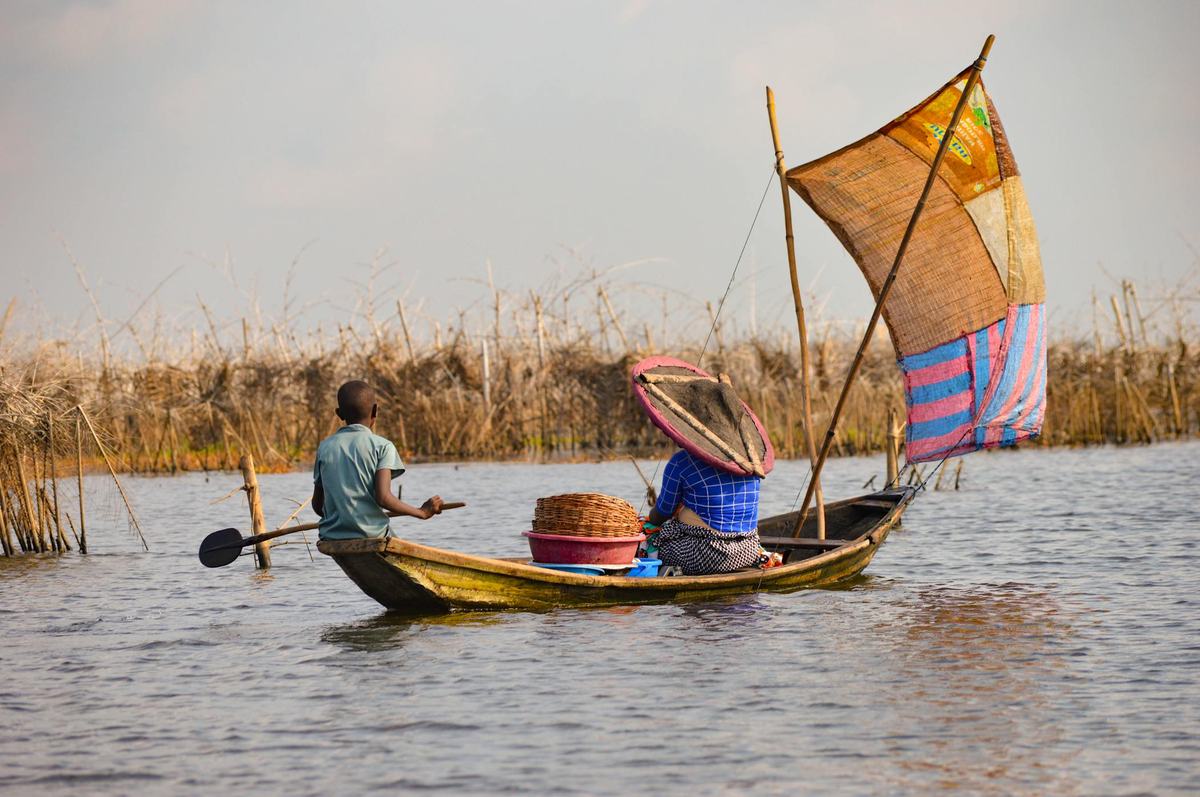
Ganvié sits on Lake Nokoué, just north of Cotonou. Around 20,000 people live there, in houses raised on wooden stilts, with markets, a school, a church, and a mosque all floating or perched above the water. People move by pirogue. Kids paddle to school. Women paddle out to sell fish from canoe to canoe.
The town exists because of Dahomey. The Tofinu people, fleeing slave raiders, hid in the lake because Dahomey's religion forbade its warriors from attacking on water [8]. So they stayed. The hiding place became home, and home became one of the largest stilt villages in Africa. Which, if you think about it, is a town founded on an exploitable loophole in someone else's belief system, and it has lasted three hundred years.
Languages, Food, and Daily Life
French is the official language, a leftover of colonial rule that ended in 1960. But day to day, you'll hear Fon in the south, Yoruba near the Nigerian border, Bariba up north, and dozens of others in between [1]. Fon is the largest, and a lot of Beninese pop music is sung in it. Angélique Kidjo, the Grammy winning singer, was born in Cotonou and still records in Fon and Yoruba alongside French and English.
Food in Benin leans on corn, yams, beans, and palm oil. Pâte, a soft dough made from corn or cassava, is the staple, served with sauces of tomato, peanut, or okra. On the coast you get a lot of fish. In the markets you'll see akassa wrapped in leaves, fresh pineapple, and street vendors frying beignets in palm oil. Nothing about it tries to impress you. It's just good, and the portions are honest.
Frequently Asked Questions
What is Benin known for?
Benin is best known as the birthplace of Vodun, the religion that became voodoo abroad. It is also famous for the historic Kingdom of Dahomey, the women warriors of Abomey, the stilt town of Ganvié on Lake Nokoué, and the wildlife of Pendjari National Park.
Is Benin the same as the Benin Empire?
No. The modern country of Benin was named in 1975 after the Bight of Benin, the body of water on its coast. The historical Benin Empire was based in what is now southern Nigeria and was a separate kingdom. Modern Benin's main precolonial state was the Kingdom of Dahomey.
What language do they speak in Benin?
French is the official language and is used in government, schools, and business. Most people also speak at least one of more than 50 indigenous languages, the largest being Fon, Yoruba, and Bariba. Many Beninese are fluent in two or three languages.
Is Benin safe to visit?
Southern Benin, including Cotonou, Porto-Novo, Ouidah, and Abomey, is generally considered safe for travelers, with normal urban precautions. The far north, near the borders with Burkina Faso and Niger, has seen security concerns from regional armed groups, and travel advisories often recommend avoiding it.
What currency is used in Benin?
Benin uses the West African CFA franc, abbreviated XOF. It is shared with seven other West African countries and is pegged to the euro at a fixed rate, which makes prices stable but not always cheap by regional standards.