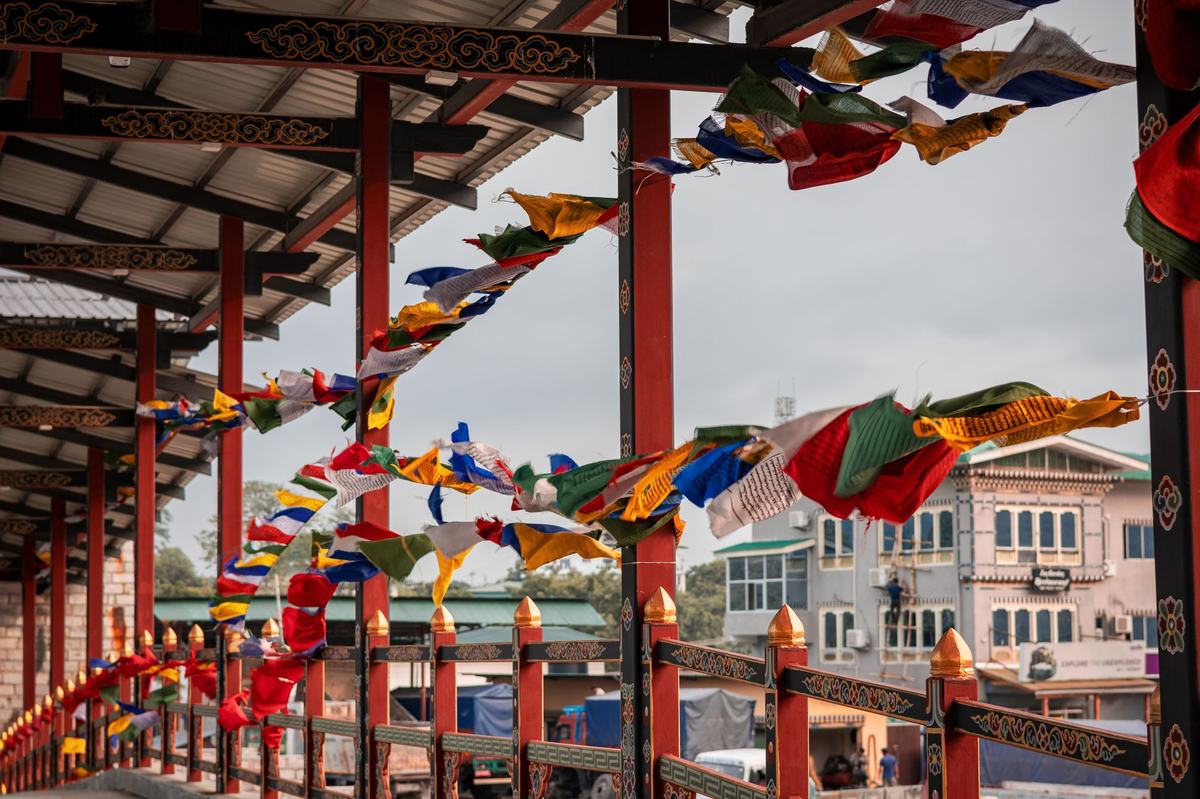
- Capital: Thimphu [1]
- Population: about 787,000 (2023) [2]
- Area: 38,394 square kilometers (14,824 square miles) [1]
- Official language: Dzongkha [1]
- Currency: Ngultrum (BTN), pegged to the Indian rupee [3]
- The only country in the world that is carbon negative, absorbing more carbon than it emits [4]
Most people couldn't find Bhutan on a map. That's probably exactly how they like it. The country sits between India and Tibet, tucked into the eastern Himalayas, and for most of its history it has chosen quiet over noisy. There was no television here until 1999. There was no internet until the same year. The first paved road wasn't finished until the 1960s. And yet the place I kept reading about wasn't a museum of the past. Bhutan is a working country with a constitution from 2008, a young king who skis and reads philosophy, and an official policy of measuring happiness instead of just money. Turns out the version of Bhutan in the travel magazines is not quite the version that exists, and the real one is more interesting.
Gross National Happiness
In 1972, the fourth king of Bhutan said something that nobody at the World Bank had on their forms. Gross National Happiness, he said, is more important than Gross National Product [5]. It sounded like a slogan at first. Decades later it has turned into an actual policy framework with nine domains, dozens of indicators, and a national survey that goes out every few years to ask people how they're doing.
The nine domains include the things you'd expect, like health, education, and living standards, but also psychological wellbeing, time use, cultural diversity, good governance, community vitality, and ecological resilience [5]. Bhutanese officials run new laws and big infrastructure projects through a kind of happiness screening before they get approved. It's not a perfect system. Researchers have pointed out that the index is hard to compare with anything else, and the country still has poverty and youth unemployment to deal with. But the framework changes the question that gets asked. Instead of "did GDP go up", planners ask whether people slept enough, whether they trust their neighbors, whether the forests are still standing. That last question matters more than it sounds.
Carbon Negative, Forest First
Bhutan is the only country on Earth that absorbs more carbon than it emits [4]. The constitution requires that at least 60 percent of the country stay forested, forever, and the actual figure right now is around 70 percent [1]. That much standing forest pulls roughly seven million tons of carbon dioxide out of the air each year, which is more than triple what the small economy puts in.
The country also exports clean hydroelectric power, mostly to India, and that exported electricity replaces coal that would otherwise be burned downstream. Plastic bags were banned in 1999, one of the earliest national bans anywhere. Tobacco sales were banned for years and remain heavily restricted [6]. The constitution itself, written in 2008, treats the environment as a constitutional right, not a policy preference. Which, if you think about it, is a wildly different starting point from most countries' environmental laws.
A Young Democracy with a Popular King
Bhutan was an absolute monarchy until 2008. The king at the time, Jigme Singye Wangchuck, decided his country needed a parliament and stepped aside in 2006 in favor of his son, Jigme Khesar Namgyel Wangchuck, who was 26 [7]. Two years later the country held its first national election. The strange part is that a lot of Bhutanese voters didn't want the change. They liked the king. They had to be persuaded that voting was a good idea.
The new constitution kept the monarchy as a ceremonial and unifying figure but moved real political power to an elected parliament. The current king, often called K5 in shorthand, is genuinely popular. He married a commoner in 2011 in a wedding broadcast across the country, and his quiet humility reads more like a dependable older brother than a remote royal. The capital, Thimphu, has no traffic lights. There was one in the 1990s, briefly, but people complained that it felt impersonal compared to the white-gloved police officer who used to direct cars at the main intersection. The officer is still there.
Tourism by Design
Bhutan opened to foreign tourists in 1974, and from the start the country took a "high value, low impact" approach [8]. Visitors pay a Sustainable Development Fee, currently 100 US dollars per person per night for most foreign visitors, on top of their travel costs [8]. The fee funds free education, free healthcare, and conservation work. It also keeps the volume of tourists low. Bhutan welcomed around 316,000 visitors in 2019, a fraction of what neighboring countries see.
The headline destination is Paro Taktsang, the Tiger's Nest monastery, perched on a cliff at 3,120 meters above the Paro valley. The hike up takes about two and a half hours, and the air at that altitude has a way of slowing your pace whether you want it to or not. The story goes that Padmasambhava, the saint who brought Buddhism to Bhutan in the 8th century, flew to the spot on the back of a tigress and meditated there for three years, three months, three weeks, three days, and three hours [9]. The current monastery was built in 1692 around the cave where he sat.
Dzongs and the Living Past
Across the country, you find dzongs, which are part fortress, part monastery, and part regional government office. They were built starting in the 17th century by Zhabdrung Ngawang Namgyal, the Tibetan lama who unified Bhutan, and most of them are still in active use today. Punakha Dzong sits at the confluence of two rivers and is where Bhutan's kings have been crowned since 1907. The architecture, with its inward-sloping white walls, red bands, and elaborate woodwork, is regulated by law. New buildings have to follow traditional design rules, even hotels and apartment blocks. The result is a country that looks, end to end, like a place that knows what it is.
The national sport is archery, taken seriously enough that there are tournaments most weekends, often with traditional bamboo bows but increasingly with modern compound bows too. Targets sit 145 meters apart, much farther than Olympic distances, and teams sing and dance to celebrate hits and to gently distract opponents who are about to shoot.
Frequently Asked Questions
Where is Bhutan located?
Bhutan is a small landlocked country in the eastern Himalayas, between India to the south and the Tibetan region of China to the north. It covers about 38,394 square kilometers and shares no border with any other country.
What is Gross National Happiness?
Gross National Happiness is Bhutan's official development philosophy, introduced in 1972, that measures national progress through wellbeing rather than just economic output. It uses nine domains, including health, education, environment, and psychological wellbeing, surveyed periodically across the population.
Is Bhutan really carbon negative?
Yes, Bhutan is the only country in the world that absorbs more carbon dioxide than it emits. Its forests cover roughly 70 percent of the land, sequester about seven million tons of carbon a year, and are protected by a constitutional minimum of 60 percent forest cover.
Do you need a special permit to visit Bhutan?
Yes, most foreign tourists need a visa and must book through a licensed tour operator. Visitors also pay a Sustainable Development Fee of 100 US dollars per person per night, which funds free public healthcare, education, and conservation projects across the country.
What language do Bhutanese people speak?
The official language of Bhutan is Dzongkha, written in a Tibetan-derived script and spoken mainly in the western valleys. English is the medium of instruction in schools, and other regional languages like Tshangla and Lhotshamkha are widely spoken across different parts of the country.
Sources
- Bhutan - The World Factbook
- Bhutan Population - World Bank
- Royal Monetary Authority of Bhutan
- Bhutan: A carbon negative country - UNDP
- Gross National Happiness - GNH Centre Bhutan
- Bhutan Tobacco Control Act - WHO
- Constitution of the Kingdom of Bhutan, 2008
- Tourism Council of Bhutan - Sustainable Development Fee
- Paro Taktsang Monastery - UNESCO Tentative List