- Capital: Sucre (constitutional) and La Paz (seat of government) [1]
- Population: about 12.4 million (2023) [2]
- Area: 1,098,581 square kilometers (424,164 square miles) [1]
- Official languages: Spanish and 36 recognized Indigenous languages [3]
- Currency: Boliviano (BOB) [1]
- Home to Salar de Uyuni, the largest salt flat on Earth at roughly 10,582 square kilometers [4]
I had to look this up twice. Bolivia is landlocked, has been since 1884, and yet it still keeps a navy. Real ships, real sailors, real ranks. They train on Lake Titicaca and on the rivers, and once a year, on March 23, the whole country marks the Day of the Sea to remember the coastline they lost in a war with Chile. That single fact tells you something important about the place. Bolivia does not let go of things easily, and its identity is stitched together from the things that other people would call contradictions. Two capitals. Two big lakes that used to be one. Two Bolivias, sometimes, the highland one and the lowland one, separated by the Andes and held together by a flag, a memory, and a stubborn sense that the country was meant to be bigger than it ended up being.
Two Capitals, One Country
Sucre is the constitutional capital. La Paz is the seat of government. The Supreme Court sits in Sucre. The president, the parliament, and most of the embassies sit in La Paz. The split goes back to a civil war in 1899, when the silver mines around Sucre were running dry and the tin economy around La Paz was rising. La Paz won the war. Sucre kept the title. Officially, the country has one capital. In practice, the daily business of governing happens at 3,640 meters above sea level in La Paz, which makes it the highest seat of government on Earth [5].
La Paz sits in a bowl. The airport, El Alto, is up on the rim of the bowl at over 4,000 meters, and you fly in over a city that looks like someone tipped a box of buildings down a hillside. There is a public cable car system called Mi Teleferico that connects the lower city to the upper city, ten lines long, the largest urban gondola network in the world [6]. Locals use it like a subway. You glide over rooftops on your way to work.
The Salt Flat That Looks Like the Sky
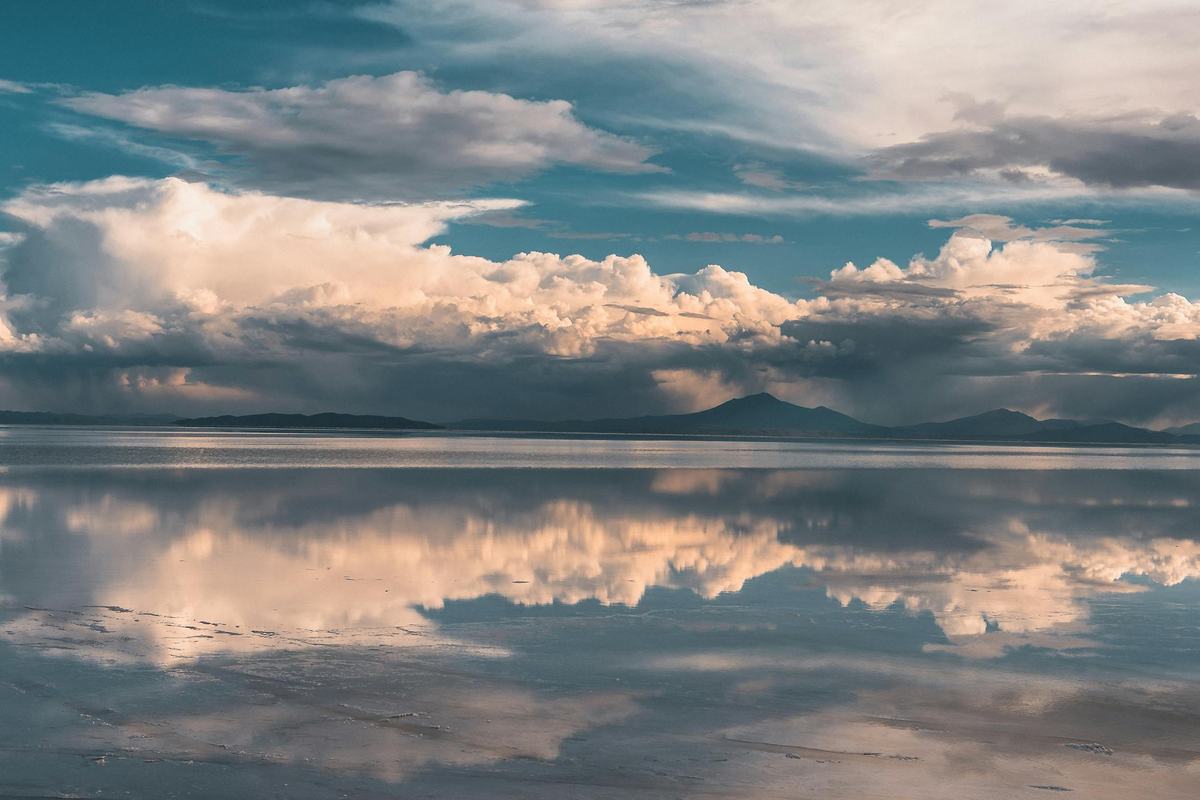
Salar de Uyuni is what is left of an ancient lake that dried up around 40,000 years ago [4]. It covers about 10,582 square kilometers, roughly the size of Jamaica, and it sits at 3,656 meters above sea level. In the dry season the surface is white hexagons of crusted salt. In the wet season a thin layer of water turns the whole place into the largest natural mirror on the planet, reflecting the sky so completely that the horizon disappears and you cannot tell up from down.
Beneath that crust, Bolivia holds an estimated 21 million tons of lithium, possibly the largest reserve in the world [7]. The country has been trying for years to industrialize the resource on its own terms, without simply selling it off to foreign mining companies, and the politics around that ambition are tense and ongoing. For now, the salt is mostly harvested in the old way, by men with shovels who pile it into white cones to dry. The cones are taller than a person and the air at that altitude is thin enough to make the work twice as hard.
Lake Titicaca and the Old Stories
On the border with Peru sits Lake Titicaca, the highest navigable lake in the world at 3,812 meters above sea level [8]. Indigenous Aymara and Quechua tradition holds that this is where the sun was born, and where the founding couple of the Inca civilization, Manco Cápac and Mama Ocllo, first emerged onto land. The Bolivian side includes Isla del Sol, where you can still walk past the ruins of stone temples and terraced fields that pre-date the Inca.
Titicaca is also a working lake. People here build boats out of totora reeds the same way they have for centuries, and small fishing communities still live along its shores. The water is glacier-fed and shockingly clear in places. It is also slowly shrinking, as warmer temperatures and reduced rainfall draw it down faster than it can refill, which is one of the quieter climate stories of South America.
A Country of Many Languages
The 2009 constitution recognizes Spanish and 36 Indigenous languages as official, including Quechua, Aymara, and Guarani [3]. Bolivia has the largest proportion of Indigenous people of any country in the Americas, somewhere around 41 percent of the population by self-identification, and the cultural weight of that fact shows up everywhere. Public officials are required to speak at least one Indigenous language in addition to Spanish. The currency, the boliviano, has notes printed in multiple languages. School curricula teach Indigenous histories alongside the colonial ones.
Evo Morales, elected in 2005, became the first president of Indigenous descent in Bolivia's modern history. His government rewrote the constitution, renamed the country the Plurinational State of Bolivia, and oversaw a long economic boom funded mostly by natural gas exports. His later years and the disputed 2019 election are still argued about, sharply, in the cafés of La Paz and the markets of El Alto. Bolivia argues with itself in public, the way every honest democracy does.
Cholitas, Wrestling, and the Bowler Hat
There is a particular kind of style you see in the streets of La Paz that takes a minute to register. Women in long pleated skirts, layered shawls, and small bowler hats perched at a precise angle on top of long braids. These are cholitas, urban Indigenous women, and the look is a deliberate reclaiming of an identity that was once treated as a reason to be denied entry to certain neighborhoods. There is a story about how the bowler hat got there, involving a shipment from England in the 19th century that turned out to be too small for the men it was meant for, but the fashion stuck.
Today there are cholita lawyers, cholita climbers who summit 6,000-meter peaks in those same skirts, and cholita wrestlers who put on weekly Lucha Libre shows in El Alto. The wrestling is part sport, part theater, part political statement. You buy a ticket, you eat fried pork, you watch women in elaborate dresses throw each other off the top rope. Back home in Montana we had monster truck rallies. Different country, same delight at the spectacle.
Frequently Asked Questions
What are the two capitals of Bolivia?
Bolivia has two capitals. Sucre is the constitutional and judicial capital, where the Supreme Court is based. La Paz is the seat of the executive and legislative branches and is the country's main administrative center, sitting at about 3,640 meters above sea level.
Why does landlocked Bolivia have a navy?
Bolivia lost its Pacific coastline to Chile in the War of the Pacific in 1884. The country still maintains a navy that trains on Lake Titicaca and on its rivers, and it commemorates the lost coast every year on March 23, the Day of the Sea, while pursuing the issue diplomatically.
How big is Salar de Uyuni?
Salar de Uyuni is the largest salt flat in the world, covering about 10,582 square kilometers in southwestern Bolivia. It sits at 3,656 meters above sea level and contains an estimated 21 million tons of lithium beneath its crust, possibly the largest reserve on Earth.
What languages are spoken in Bolivia?
Bolivia recognizes 37 official languages, including Spanish and 36 Indigenous languages such as Quechua, Aymara, and Guarani. Spanish is the most widely spoken, but Quechua and Aymara are common in the highlands and Indigenous languages are protected by the 2009 constitution.
Is Lake Titicaca shared with another country?
Yes, Lake Titicaca straddles the border between Bolivia and Peru. At 3,812 meters above sea level, it is the highest navigable lake in the world, and it holds deep cultural significance in Aymara, Quechua, and Inca tradition as the birthplace of the sun.
Sources
- Bolivia - The World Factbook
- Bolivia Population - World Bank
- Constitution of the Plurinational State of Bolivia, 2009
- Salar de Uyuni - NASA Earth Observatory
- La Paz, Bolivia - Encyclopaedia Britannica
- Mi Teleferico - World Bank Urban Transport Brief
- Lithium Resources in Bolivia - U.S. Geological Survey
- Lake Titicaca - UNESCO Biosphere Reserve