- Capital: Sarajevo [1]
- Population: about 3.2 million (2023) [2]
- Area: 51,209 square kilometers (19,772 square miles) [1]
- Official languages: Bosnian, Croatian, and Serbian [1]
- Currency: Convertible mark (BAM) [1]
- The only country in the world with a rotating three-member presidency, one Bosniak, one Croat, one Serb [3]
I had to look this up twice. Bosnia and Herzegovina has three presidents at the same time, and they take turns being the chair of the presidency every eight months. One is Bosniak, one is Croat, one is Serb. They share the same office, the same flag, and the same job, and the system was written into the country's constitution by an American diplomat at an Air Force base in Ohio in 1995. That is not a setup. That is the actual government. The Dayton Agreement ended the war and built the country on top of itself, and the result is a place that runs on compromise the way other countries run on coffee. Bosnia is small, mountainous, and improbable, and the longer you read about it the more it starts to feel like one of those puzzle boxes where every piece is also a door.
A Capital That Remembers Everything
Sarajevo sits in a long valley with hills on both sides, and from the air it looks like a green ribbon laid between two ridges. Walking the old town you can stand at a single intersection and see a mosque, a Catholic church, an Orthodox cathedral, and a synagogue, all within a couple of minutes' walk of each other. Locals call the spot the Jerusalem of Europe, and the nickname is older than most of the buildings [4]. The Ottomans left mosques and the bezistan covered markets. The Habsburgs left coffee houses and a yellow city hall. The Yugoslav era left brutalist apartment blocks and the 1984 Winter Olympics ski jumps that you can still hike up to in the woods above the city.
The siege of Sarajevo from 1992 to 1996 was the longest siege of a capital city in modern warfare, lasting almost four years [5]. The pockmarks on the buildings are still there. So is a thing called the Sarajevo Rose, which is what locals named the red resin filling on the sidewalk where mortar shells hit and killed people. The roses are scattered across the city and you walk past them on the way to the bakery. The city does not pretend nothing happened, and it also refuses to be defined by it. There is a film festival every August now. There is a tunnel museum in someone's backyard.
Two Entities and a Brčko-Shaped Asterisk
The country is divided into two entities, the Federation of Bosnia and Herzegovina and Republika Srpska, plus a small self-governing district called Brčko in the north [3]. The Federation is mostly Bosniak and Croat, Republika Srpska is mostly Serb, and Brčko is shared. Each entity has its own government, parliament, and police. Above all of that sits the state-level government in Sarajevo. There are 14 separate governments in a country of three million people. It is a lot of meetings.
This is what happens when a peace agreement has to satisfy three sides at once and nobody trusts anybody yet. The system was meant to be temporary. It is now thirty years old. It works in the sense that there has not been a war since 1995, which is the metric that mattered when it was written.
The Bridge at Mostar and the Stone Above the Neretva
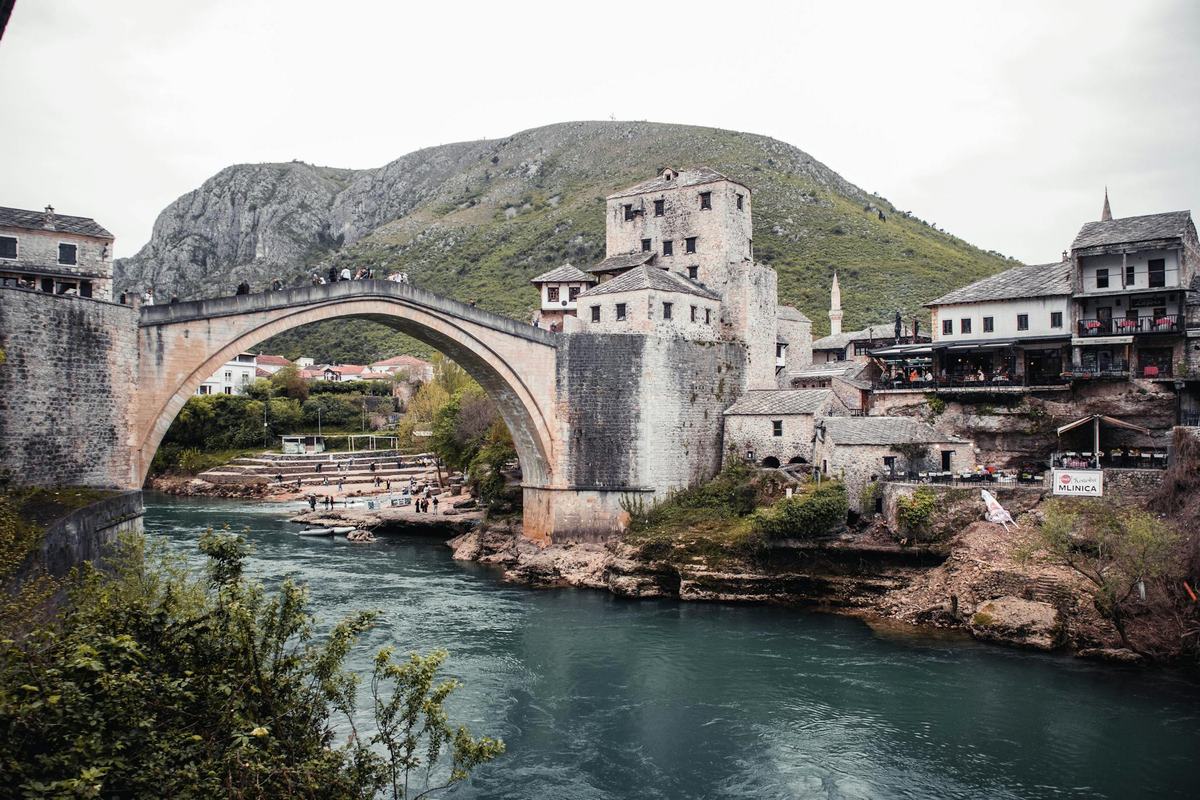
Mostar is a small city in Herzegovina with a single bridge that defines it. The Stari Most was built by the Ottomans in 1566, stood for 427 years, was destroyed in 1993, and was rebuilt with the original stone hauled out of the Neretva River below [6]. UNESCO put the rebuilt bridge and old town on the World Heritage list in 2005. Young men still jump from the bridge into the river, sometimes for tradition, mostly for tourists. The drop is about 24 meters and the water is cold even in August.
The town below the bridge is the kind of place where the stones are smooth from centuries of feet. The view from the bridge is the kind of view you take a photo of and the photo always disappoints, because the trick of it is the light coming off the river and you cannot put that in a frame.
A Country with Pyramids, Apparently
In 2005 a businessman named Semir Osmanagić announced that a hill outside the town of Visoko was actually a 12,000-year-old pyramid built by an unknown civilization, and that there were several other pyramids in the same valley. Mainstream archaeologists have been clear that the hill is a natural geological formation called a flatiron and that the claim has no scientific basis [7]. None of which has stopped the site from becoming one of the most visited tourist attractions in the country. There are tunnels you can walk through. There is a gift shop. There are people who will tell you that the pyramid emits healing energy.
I am not going to tell you what to think about the pyramid. I will tell you that Bosnia is a country that has been through enough that a little harmless mythology about ancient builders is allowed to coexist with the actual archaeology. Which, if you think about it, is how a lot of small countries handle their tourist economy.
Coffee, Cevapi, and the Long Sit
Bosnian coffee is its own thing. Not Turkish coffee, even though it descends from it. You boil the water, you add the finely ground coffee, you let the foam rise, and you serve it in a small copper pot called a džezva with a tiny cup, a sugar cube, and a piece of Turkish delight on the side. You do not gulp it. You sit with it. A coffee in Sarajevo can take an hour and a half if the conversation is good, which it usually is.
Cevapi are small grilled minced-meat sausages served with somun flatbread, raw onion, and sometimes a smear of kajmak. Every town claims theirs is the best. Banja Luka swears by their version, Sarajevo swears by theirs, and the argument is friendly the way arguments about barbecue are friendly back home in Montana. You eat with your hands, you wash it down with a yogurt drink, and you do not check your phone.
Frequently Asked Questions
Why does Bosnia and Herzegovina have three presidents?
The 1995 Dayton Peace Agreement created a three-member presidency to represent the country's three main ethnic groups. One Bosniak, one Croat, and one Serb serve simultaneously, with the chairmanship rotating every eight months among them, ensuring shared executive power after the war.
What languages are spoken in Bosnia and Herzegovina?
Bosnia and Herzegovina has three official languages: Bosnian, Croatian, and Serbian. They are mutually intelligible and share most vocabulary and grammar. Bosnian and Croatian are written in Latin script, while Serbian uses both Latin and Cyrillic, often interchangeably on the same street signs.
Is the Stari Most bridge in Mostar original?
No, the original 1566 Ottoman bridge was destroyed in 1993 during the war. It was rebuilt between 2001 and 2004 using original stone recovered from the Neretva River and traditional techniques. UNESCO added the reconstructed bridge and Mostar's old town to its World Heritage list in 2005.
Are the Bosnian pyramids real?
No, mainstream archaeologists and geologists have rejected the pyramid claim. The Visočica hill outside Visoko is a natural geological formation. Despite that, the site near Visoko remains a popular tourist attraction with tunnels, walking paths, and visitor facilities open to the public year round.
What is the capital of Bosnia and Herzegovina?
Sarajevo is the capital and largest city of Bosnia and Herzegovina, with about 275,000 residents in the city proper. It sits in a valley surrounded by mountains and is known for hosting the 1984 Winter Olympics and for its unusual mix of mosques, churches, and synagogues.
Sources
- Bosnia and Herzegovina - The World Factbook
- Bosnia and Herzegovina Population - World Bank
- The General Framework Agreement for Peace in Bosnia and Herzegovina (Dayton Agreement)
- Sarajevo - Encyclopaedia Britannica
- Siege of Sarajevo - International Criminal Tribunal for the former Yugoslavia
- Old Bridge Area of the Old City of Mostar - UNESCO World Heritage Centre
- The Bosnia-Atlantis Connection - Smithsonian Magazine