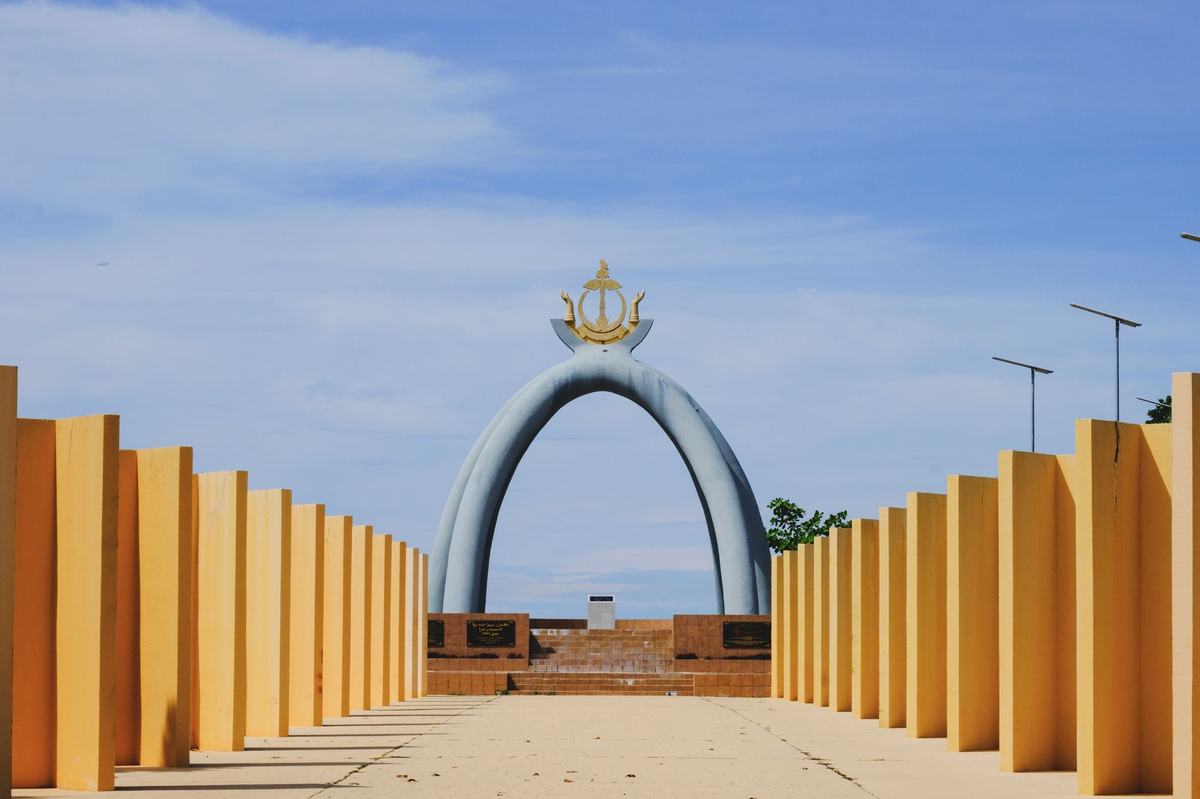
- Capital: Bandar Seri Begawan, population about 100,000 in the metro area [1]
- Population: about 460,000 people, one of the smallest in Southeast Asia [1]
- Area: 5,765 square kilometers, smaller than the U.S. state of Delaware [1]
- Official language: Malay, with English widely used in business and education [1]
- Currency: Brunei dollar (BND), pegged 1:1 to the Singapore dollar [2]
- Ruled by the same royal family for over 600 years, one of the oldest continuous monarchies on Earth [3]
Most people couldn't find Brunei on a map. That's probably exactly how the people who live there like it. The full name is Brunei Darussalam, which translates roughly as "Brunei, Abode of Peace", and the country has spent the last few decades quietly being one of the wealthiest places per capita in Asia while almost nobody in the West thinks about it. It sits on the northern coast of Borneo, wedged between two chunks of Malaysia, with the South China Sea on one side and rainforest on the other. I had to look this up twice when I first read about it: there is a sultanate, smaller than Connecticut, that has been ruled by the same royal family since before Columbus sailed.
A Country Smaller Than You Think, Older Than Most
Brunei covers about 5,765 square kilometers, which is roughly the size of a single county in Texas [1]. The whole population, around 460,000 people, would fit comfortably inside one neighborhood of São Paulo. And yet the country's history runs deeper than most of the nations you've heard of. The Brunei sultanate dates back to the 14th century, and in its peak in the 1500s it controlled most of Borneo and parts of the Philippines [3]. Then European colonial powers chipped away at it for three hundred years, until what's left is the small but stubbornly independent state on the map today.
Britain made Brunei a protectorate in 1888, ran the place behind the scenes for most of the 20th century, and finally let it go in 1984 [3]. The current sultan, Hassanal Bolkiah, has been on the throne since 1967, which means he has been the head of state longer than most countries have existed. Back home in Montana, the longest-serving governor we've had served eight years. The math on a 50-plus year reign is hard to wrap your head around.
The Oil Wealth Nobody Talks About
Here's the thing nobody talks about: Brunei is rich. Really rich. The country sits on substantial offshore oil and natural gas reserves, and oil money has driven the economy since fields were developed in the 1920s. By GDP per capita measured at purchasing power parity, Brunei consistently ranks in the top 25 countries in the world, sometimes in the top ten [4]. Citizens pay no income tax. There is universal free healthcare and free education through university, including subsidized study abroad. The government provides heavily subsidized housing.
Petroleum and natural gas account for roughly 90% of Brunei's exports and over half of its GDP [4]. The country is one of the largest exporters of liquefied natural gas in the region, sending most of it to Japan and South Korea. The flip side of all that oil money is that the economy is almost entirely dependent on it, and the government has spent the last decade or so trying to diversify into things like halal food production, ecotourism, and Islamic finance, with mixed results.
Kampong Ayer: The Water Village That Refused to Move
If you visit Bandar Seri Begawan, the capital, you can't miss Kampong Ayer. It's a settlement built entirely on stilts over the Brunei River, with houses, mosques, schools, fire stations, and shops connected by wooden walkways and water taxis. About 13,000 people still live there, making it the largest water village in the world [5].
Kampong Ayer has existed for more than a thousand years. When the Italian explorer Antonio Pigafetta sailed past in 1521 with Magellan's expedition, he wrote about a "Venice of the East" with thousands of houses standing on poles in the water. He wasn't exaggerating. The settlement was the heart of the Brunei sultanate when European visitors first showed up, and it's still here, still on the water. The government has tried multiple times to relocate residents to land. Most don't want to go. Their grandparents lived on the river, and so will they.
Rainforest That Outdates the Pyramids
About 70% of Brunei is still covered in primary rainforest, an extraordinary number for a country with this much oil wealth [6]. While Borneo as a whole has lost staggering amounts of forest to logging and palm oil over the last fifty years, Brunei made the unusual choice to preserve most of its interior. The Ulu Temburong National Park covers a chunk of the country's eastern half, an area accessible only by longboat up the Temburong River, with some of the oldest undisturbed lowland rainforest left in Southeast Asia.
The forest here is older than human civilization. Borneo's rainforest is estimated at around 130 million years old, making it among the oldest in the world, predating the Amazon by tens of millions of years. It hosts orangutans, proboscis monkeys, clouded leopards, sun bears, and pangolins, plus around 15,000 known plant species. The proboscis monkey, with its absurd dangling nose, is found only on Borneo and lives in the mangroves along Brunei's coast.
A Country Where Sharia and Modernity Sit Side by Side
Brunei is officially an Islamic country, and the sultan is also the head of religion. In 2014, the country began phasing in a sharia-based penal code, completing the rollout in 2019. The legal system runs on a dual track now, with civil courts handling most matters and sharia courts handling family law and certain criminal cases involving Muslims. The introduction of sharia drew international criticism, particularly the more severe punishments on the books, and the sultan announced in 2019 that the death penalty for certain crimes would not be carried out in practice.
At the same time, Bandar Seri Begawan has high-end shopping malls, a thriving café culture, fast internet, and one of the highest rates of smartphone ownership in Southeast Asia. The Sultan Omar Ali Saifuddien Mosque, with its golden dome rising over an artificial lagoon, sits a short drive from a Starbucks. It's a country where two timeframes coexist in a single block.
The Royal Family and a Palace Bigger Than the Vatican
The Istana Nurul Iman, the sultan's official residence, is the largest residential palace in the world. It contains 1,788 rooms, 257 bathrooms, a banquet hall that seats 5,000 people, a mosque for 1,500 worshippers, an underground garage for the royal car collection, and a stable for 200 polo ponies. The total floor area is about 200,000 square meters, larger than the Vatican.
The royal car collection is its own legend. Estimates of how many vehicles the family owns range from 5,000 to 7,000, including hundreds of Rolls-Royces, Ferraris, Bentleys, and one-off custom builds that exist nowhere else. Whether or not those numbers are exact, what's documented is that during the 1990s the sultan's brother spent so heavily on cars and properties that a financial scandal eventually forced public reckoning, and the family had to sell off significant assets.
Quiet, Stable, and Stubbornly Itself
Crime in Brunei is genuinely low. The streets in the capital are clean. Public transportation runs on time, and most things just work. The country has avoided most of the political turbulence that has rolled through Southeast Asia over the last half-century. There has been no civil war, no military coup, no mass protest movement. For a small country surrounded by larger neighbors, Brunei has held onto its independence and its character with a kind of quiet determination.
Whether you find that admirable or stifling probably depends on what you're looking for. But it's hard to argue that Brunei isn't doing things on its own terms. A 600-year-old sultanate, sitting on oil and rainforest, choosing peace and a slower pace while the world sprints around it. Which, if you think about it, is its own kind of statement.
Frequently Asked Questions
Where is Brunei located?
Brunei is on the northern coast of the island of Borneo in Southeast Asia, surrounded on land by the Malaysian state of Sarawak. The South China Sea lies to its north. The country covers about 5,765 square kilometers and shares Borneo with Malaysia and Indonesia.
Is Brunei a rich country?
Yes. Brunei has one of the highest GDP per capita figures in Asia thanks to large offshore oil and natural gas reserves. Citizens pay no income tax and receive free healthcare and education. Petroleum and gas account for around 90% of exports and over half of national GDP.
What is the capital of Brunei?
The capital of Brunei is Bandar Seri Begawan, often shortened to BSB. It has about 100,000 residents in its metropolitan area and sits on the Brunei River. The city is best known for the Sultan Omar Ali Saifuddien Mosque and the historic water village of Kampong Ayer.
What language do they speak in Brunei?
The official language of Brunei is Malay, specifically Standard Malay, which is closely related to the Malay spoken in Malaysia and Indonesia. English is widely used in business, government, and higher education. Mandarin Chinese is also spoken by the country's Chinese minority population.
Who rules Brunei?
Brunei is an absolute monarchy ruled by Sultan Hassanal Bolkiah, who has been on the throne since 1967. The royal family has held power for more than 600 years, making it one of the oldest continuously reigning dynasties in the world. The sultan serves as both head of state and head of government.