- Capital: Sofia, one of Europe's oldest continuously inhabited cities, with roots going back roughly 7,000 years [1]
- Population: about 6.4 million, and shrinking faster than almost any country in the world [2]
- Area: 110,994 square kilometers, a little larger than Tennessee
- Official language: Bulgarian, written in Cyrillic, the only EU country whose official script isn't Latin or Greek [3]
- Currency: the lev (BGN), pegged to the euro at a fixed rate since 1999 [4]
- Distinguishing claim: produces roughly 70 to 85 percent of the world's rose oil, the stuff that makes Chanel No. 5 smell like Chanel No. 5 [5]
I grew up thinking the alphabet I was reading was just the alphabet. One of those things you don't question, like why the sky is blue or why my grandfather always salted his watermelon. Then I found out that the script used by Russians, Serbs, Macedonians, Mongolians, and a chunk of Central Asia, called Cyrillic, didn't come from Russia. It came from Bulgaria. From a small medieval kingdom in the Balkans that decided, in the 9th century, that its people deserved to read in their own language. Turns out a lot of what makes Eastern Europe legible to itself started here. And that's just the alphabet.
Bulgaria Gave the World Cyrillic
Two brothers from Thessalonica, Cyril and Methodius, are usually credited with inventing the script that bears Cyril's name. They didn't, technically. They invented its predecessor, Glagolitic. The actual Cyrillic alphabet was developed by their disciples at the Preslav Literary School in the First Bulgarian Empire, around the late 9th and early 10th centuries [3]. Bulgaria adopted it as the state script and exported it across the Slavic world.
Today around 250 million people read in Cyrillic. May 24th is a national holiday here, called the Day of Bulgarian Education and Culture and of Slavonic Literature. Schoolkids parade through the streets carrying letters of the alphabet. Try to imagine America throwing a parade for the letter Q. You can't, because we wouldn't. Bulgarians do, every year, and they mean it.
The Oldest Gold Ever Found
In 1972, a tractor driver near the Bulgarian city of Varna was digging a trench for an electric cable. He pulled up something gold. Then more gold. Then a lot more gold. Archaeologists eventually unearthed nearly 3,000 gold artifacts from a Copper Age necropolis dating to roughly 4,600 to 4,200 BCE [6]. That makes the Varna gold the oldest worked gold ever discovered, anywhere on Earth. Older than the Egyptian pyramids by about 1,500 years. Older than the wheel in some places.
Which, if you think about it, scrambles the standard story most of us grew up with, where civilization starts in Mesopotamia and Egypt, then trickles outward. The Balkans were already smelting and shaping gold while large parts of the world were still figuring out copper. Most of the Varna treasure now sits in the city's archaeological museum, and it's not behind much glass. You can stand right next to gold that was buried before written language existed.
The Valley of Roses
About 90 minutes east of Sofia, between the Balkan Mountains and the Sredna Gora range, is a long shallow basin called the Rose Valley. The summers are warm, the soil is right, and the morning humidity does something specific to the petals. Bulgarians have been growing rosa damascena here since the Ottoman period, and they figured out how to distill the oil at a scale nobody else could match.
Today the country produces an estimated 70 to 85 percent of the world's commercial rose oil [5]. It takes about 3,000 to 4,000 kilograms of rose petals to produce one kilogram of oil, which is why the stuff costs more per gram than gold most years. Pickers start before sunrise, because the oil content drops as the sun warms the flowers. Every June there's a Rose Festival in the town of Kazanlak, and the whole valley smells the way a perfume counter wishes it could.
Three Civilizations on One Map
Most countries get one founding civilization to brag about. Bulgaria got three, stacked on top of each other. The Thracians came first, an Indo-European people who left behind hundreds of burial mounds across the country. One of them, the Kazanlak Tomb, has 4th century BCE frescoes so well preserved that UNESCO had to seal off the original and build a replica next door [7]. The Thracian gold mask of King Teres, found in 2004, weighs about 690 grams of solid gold and looks like something out of a Marvel movie.
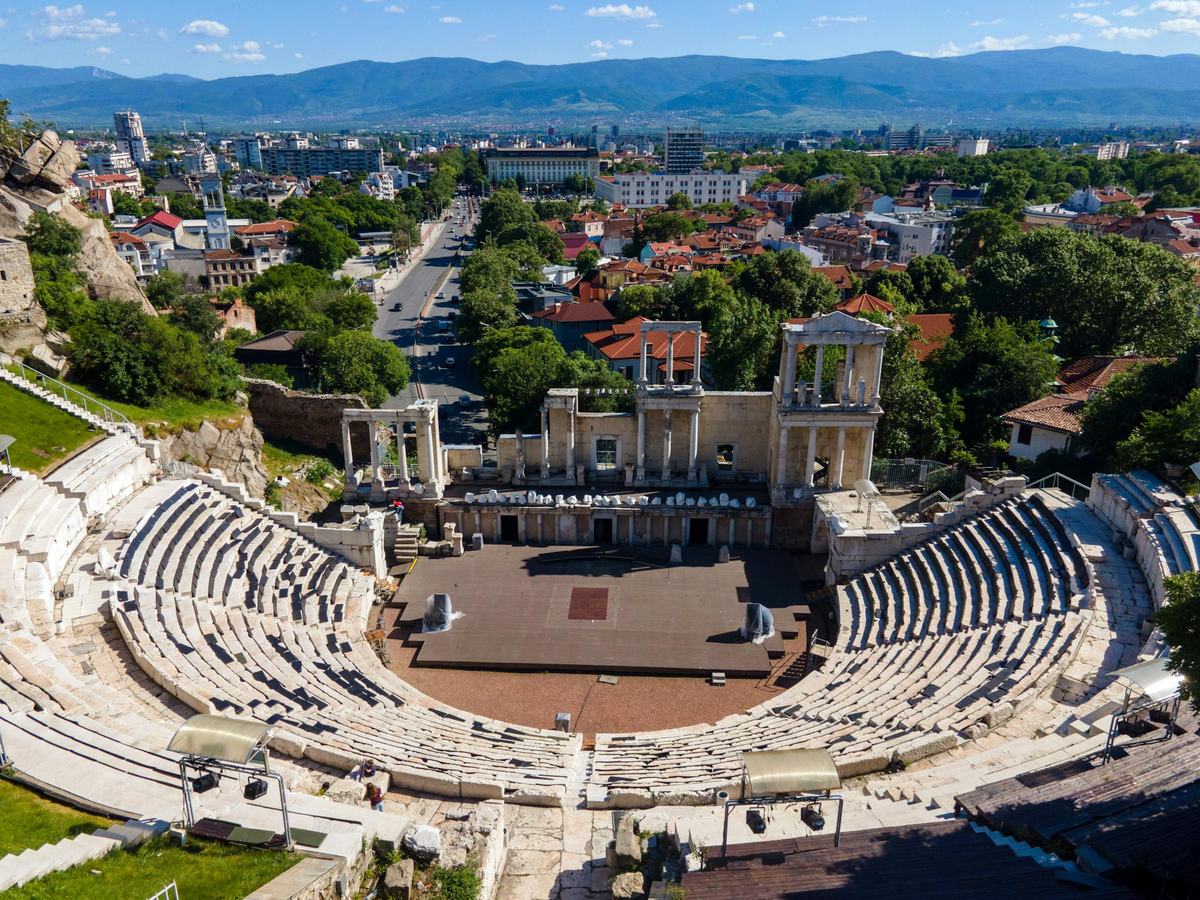
The Greeks and then the Romans came next, leaving cities like Plovdiv with a Roman amphitheater that still hosts concerts. Plovdiv, by the way, is one of the oldest continuously inhabited cities in Europe, with settlement layers going back roughly 8,000 years. Then in the 7th century, a Bulgar khan named Asparuh crossed the Danube, made a deal and a war with Byzantium, and founded the First Bulgarian Empire in 681 CE. Three foundations. One country. The geography just happened to be too good to leave.
Yogurt, Nodding, and Other Quiet Things
Bulgarians shake their heads for yes and nod for no. Not as a joke, not regionally, the whole country. I had to look this up twice. The first time I learned it I assumed it was one of those tourist-trap factoids that fall apart on contact with reality. It doesn't. It's still common, especially with older folks and outside the big cities, and it has caused more than one diplomatic incident.
The country is also where Lactobacillus bulgaricus was first identified, the bacterium that turns milk into yogurt. A Bulgarian researcher named Stamen Grigorov isolated it in 1905 while studying with the Pasteur school in Geneva. Bulgarians have been eating yogurt, called kiselo mlyako here, for centuries, and they will tell you it's part of why their grandparents lived past 90. The science on that is fuzzier than the marketing, but the yogurt itself is real, and it's better than what we get back home.
Then there's the music. Bulgarian women's choirs sing in close, dissonant intervals that sound like nothing in Western choral tradition. NASA included a track of Bulgarian folk singer Valya Balkanska on the Voyager Golden Record, the gold-plated phonograph sent into deep space in 1977 to introduce humanity to anyone out there listening. Of all the Earth songs they could have picked, one came from a Bulgarian shepherd's wife. That feels right.
Frequently Asked Questions
What is Bulgaria most famous for?
Bulgaria is most famous for inventing the Cyrillic alphabet, producing the majority of the world's rose oil, and being home to the oldest worked gold ever discovered, dating to around 4,600 BCE. It's also known for its yogurt, ancient Thracian tombs, and Black Sea coast resorts.
Is Bulgaria part of the European Union?
Yes. Bulgaria joined the European Union on January 1, 2007. It uses the Bulgarian lev as its currency, pegged to the euro at a fixed rate, and joined the Schengen Area for air and sea travel in March 2024 with full land borders following later.
What language do they speak in Bulgaria?
The official language is Bulgarian, a South Slavic language written in the Cyrillic alphabet. Around 85 percent of the population speaks it as a first language. English is increasingly common in cities and tourist areas, while older generations often speak Russian or German.
Is Bulgaria safe to visit?
Yes, Bulgaria is generally considered a safe country for travelers. Violent crime rates are low, and tourist areas like Sofia, Plovdiv, and the Black Sea coast are well patrolled. Standard precautions against pickpocketing in crowded places and tourist hubs are sensible.
Why is Bulgaria's population shrinking?
Bulgaria has one of the fastest population declines in the world due to a low birth rate and significant emigration, especially among younger workers moving to Western Europe after EU accession. The population has dropped from roughly 9 million in 1989 to around 6.4 million today.
Sources
- Sofia City Profile - UNESCO
- Bulgaria Population - World Bank
- Cyrillic Script and the Preslav Literary School - Britannica
- Bulgarian Lev and Euro Peg - Bulgarian National Bank
- Bulgarian Rose Oil Production - FAO
- Varna Gold Necropolis - Smithsonian Magazine
- Thracian Tomb of Kazanlak - UNESCO World Heritage Centre