- Capital: Gitega, the political capital since 2019, with Bujumbura still serving as the economic capital on Lake Tanganyika [1]
- Population: roughly 13 million, packed into one of the most densely populated countries in mainland Africa [2]
- Area: 27,834 square kilometers, smaller than the state of Maryland
- Official languages: Kirundi, French, and English, with Swahili widely spoken in trade and along the lake [3]
- Currency: Burundian franc (BIF)
- Distinguishing claim: one of the contested sources of the Nile, the world's longest river, rises from a hillside spring in southern Burundi [4]
I grew up thinking the Nile started in Egypt. Then I learned it ended there. The actual source, or one of them, is a quiet hillside in a small country I could not have placed on a map at twelve years old. Burundi sits in the middle of the African continent, shaped a little like a heart if you squint, and it holds more in its 27,000 square kilometers than countries ten times its size. A great lake, a great river, sacred drums, a coffee crop that connoisseurs whisper about, and a history that nobody outside the region talks about enough.
A Source of the Nile
In the south of the country, near a place called Rutovu, a stone pyramid marks what German explorers in 1934 declared to be the southernmost source of the Nile. The water comes up from the ground, runs into the Kasumo River, joins the Ruvyironza, becomes the Kagera, flows into Lake Victoria, and eventually pours out the other end as the White Nile. The whole journey is something like 4,100 miles. Standing at that pyramid, you are standing at the start of one of the most consequential rivers in human history. Egypt's pharaohs, the Sudanese kingdoms, the cotton fields of the colonial era, all of it begins here, in a country most people have never thought about.
There is a competing claim from the Nyungwe Forest in Rwanda, and the geography of "true source" gets murky once you start measuring tributary lengths. But Burundi's claim is older and was the standard for most of the twentieth century. Either way, the Nile begins in countries that almost nobody associates with it.
Lake Tanganyika and the Edge of the Rift
The country's western border is Lake Tanganyika, the second-deepest lake in the world after Baikal in Siberia. It plunges nearly 4,800 feet, holds about 16 percent of the world's available fresh surface water, and stretches over 400 miles south into Tanzania and Zambia [5]. Bujumbura sits on its northern shore, palm trees and beaches and the kind of sunsets that make you forget what continent you are on.
The lake is a slice of the East African Rift, where the African continent is slowly tearing itself in two. Geologists figure that in maybe ten million years, what is now Burundi's western edge will be a coastline on a brand new ocean. Which, if you think about it, makes a lakefront house in Bujumbura the longest possible long-term real estate play.
The Royal Drums
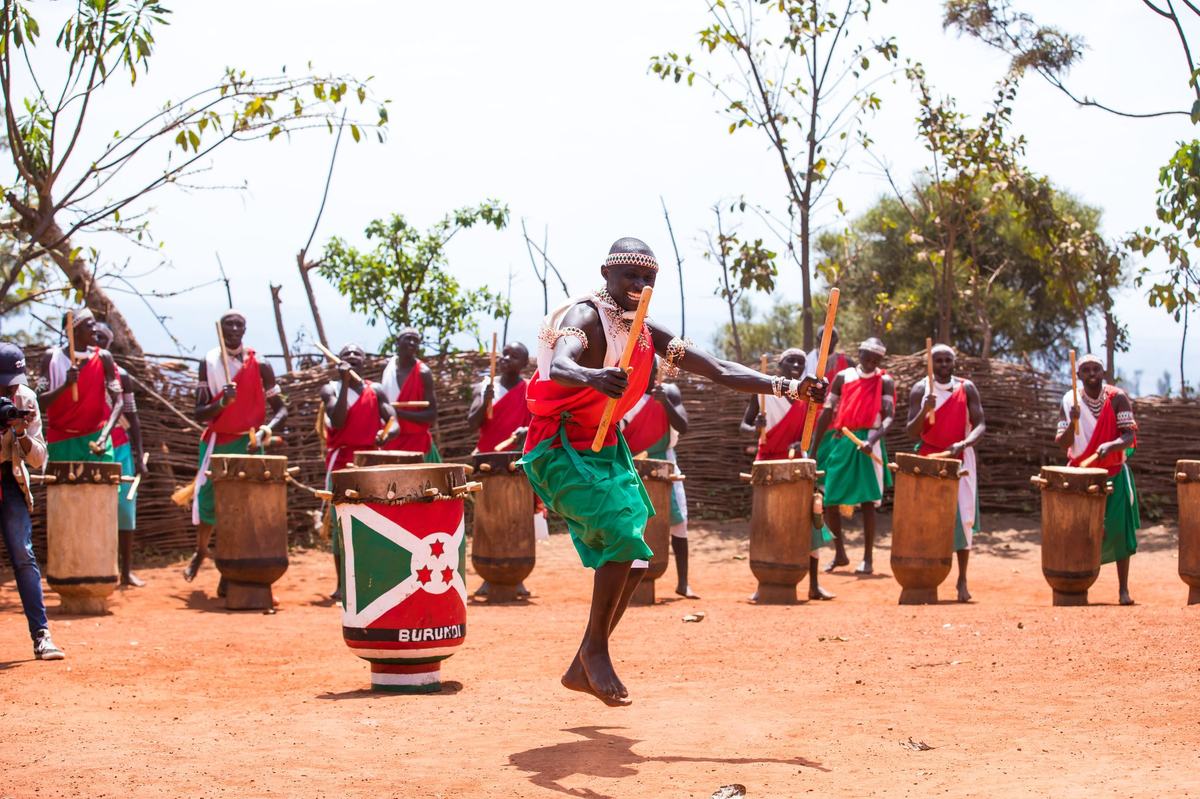
For centuries, the kingdom of Burundi was held together by a tradition called the Karyenda, the sacred royal drums. These were not just instruments. They were the heart of the kingdom's authority, played at coronations, at agricultural ceremonies, at funerals. The drummers, all men from specific lineages, trained their whole lives. UNESCO inscribed the ritual dance of the royal drum on the list of Intangible Cultural Heritage in 2014 [6].
If you have seen a video of Burundian drummers, you remember it. Twenty men in red and white robes, carrying enormous wooden drums on their heads, then setting them down in a half-circle and pounding out polyrhythms with such physical force that the ground shakes. They sing and dance between sets, leaping over their drums. It is one of the most powerful live performances on earth, and it almost never happens outside the country.
The Coffee Nobody Knows
Burundi grows some of the best coffee in Africa, mostly Bourbon variety arabica, on small hillside farms tended by hundreds of thousands of families. The combination of high altitude, volcanic soil, and a long dry season produces beans with bright acidity and notes of black currant and citrus that specialty roasters in Portland and Brooklyn have been quietly celebrating for years [7].
Most of the country's coffee leaves before anyone in Burundi gets to drink it. The domestic market is tiny, infrastructure is thin, and the farmers who grow it earn very little. There is a slow, ongoing effort to change that, with cooperatives building washing stations and selling directly to roasters abroad. Turns out the country in the middle of Africa is responsible for something on your kitchen counter, and the people who grew it have probably never tasted what it becomes.
Frequently Asked Questions
Where is Burundi located?
Burundi is a small landlocked country in East Africa, bordered by Rwanda to the north, Tanzania to the east and south, and the Democratic Republic of the Congo to the west across Lake Tanganyika. It sits roughly in the geographic center of the African continent.
What is the capital of Burundi?
The political capital of Burundi is Gitega, designated in January 2019. Bujumbura, the former capital and the country's largest city, remains the economic and commercial center. Gitega is located in the central highlands, while Bujumbura sits on the shore of Lake Tanganyika.
What languages do people speak in Burundi?
The official languages of Burundi are Kirundi, French, and English. Kirundi is spoken by nearly the entire population as a first language. French remains common in government and education, English was added as an official language in 2014, and Swahili is widely used in commerce.
Is Burundi safe to visit?
Burundi has stabilized considerably since the political crisis of 2015 and earlier civil war, but Western governments still advise caution due to occasional unrest and limited tourism infrastructure. Most visitors travel to Bujumbura, Lake Tanganyika, or organized cultural sites and follow local guidance.
What is Burundi famous for?
Burundi is best known for its sacred royal drummers, recognized by UNESCO, and for being one of the contested sources of the Nile River. It is also celebrated among coffee specialists for high-quality Bourbon arabica beans grown on small hillside farms.