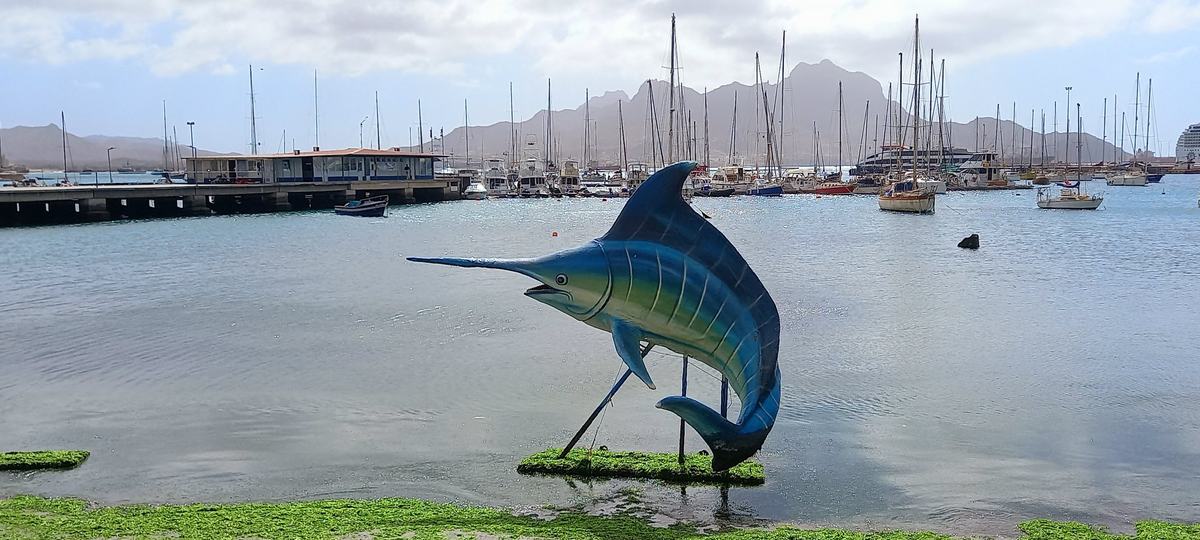
- Capital: Praia, on the island of Santiago, the largest city and political center of the archipelago [1]
- Population: roughly 600,000 people across ten islands, with a diaspora abroad that is actually larger than the population at home [2]
- Area: 4,033 square kilometers spread across the Atlantic, smaller than the state of Rhode Island
- Official language: Portuguese, with Cape Verdean Creole (Kriolu) spoken as the everyday tongue by nearly everyone [3]
- Currency: Cape Verdean escudo (CVE)
- Distinguishing claim: home to one of the most active volcanoes in the Atlantic, Pico do Fogo, which last erupted in 2014 and 2015 [4]
I had to look this up twice. There is a country off the coast of West Africa that nobody at my high school in Montana could have placed on a map, and yet the music coming out of it has filled jazz clubs in Paris and Lisbon for decades. Cabo Verde is ten islands stacked into a rough horseshoe shape about 350 miles west of Senegal, born from volcanoes punching up through the Atlantic, settled by accident, and shaped by every ship that ever needed water and salt cod on the long voyage between Europe, Africa, and the Americas. The whole country could fit inside a Montana county. The story it carries is bigger than most continents.
Ten Islands, Two Names
The country was called Cape Verde in English for centuries. In 2013, the government formally requested that the world use the Portuguese name, Cabo Verde, in all languages. The United Nations agreed, and most international bodies followed. The name comes from Cap-Vert, the green peninsula on the coast of Senegal, which is what Portuguese sailors were aiming for when they bumped into the islands in 1456.
The archipelago splits into two groups, the Barlavento (windward) islands in the north and the Sotavento (leeward) islands in the south. Each island has its own personality. Santiago is the largest and most African in feel, with the capital and the most people. Sal and Boa Vista are flat, sandy, and tourist-heavy. Santo Antao is mountainous and green, the kind of place where you hike through a cloud forest at breakfast and a desert by lunch. Brava and Fogo sit out on their own, smaller, quieter, and harder to reach.
A Volcano You Can Climb
Pico do Fogo rises 2,829 meters out of the island of Fogo, and it is the highest point in the country and one of the most active volcanoes in the Atlantic. Inside the crater is a settlement called Cha das Caldeiras, where a few hundred people live, grow grapes for a famous local wine, and have rebuilt their homes more than once after eruptions. The 2014 to 2015 eruption buried two villages and forced an evacuation, but the community came back, planted new vines in volcanic ash, and went right on making manecom and pontche. The wine is rough and good, and the coffee grown on those slopes is some of the best in West Africa.
You can climb the mountain in a long morning if you are reasonably fit, scrambling up loose scree until the wind on the rim hits you full in the face. Standing up there, with the Atlantic in every direction and the crater below your boots, you understand why people keep coming back even after the lava takes their houses.
Creole Culture, Forged at a Crossroads
Cabo Verde was uninhabited when the Portuguese arrived. There were no indigenous people, no preexisting culture to layer on top of. Everyone there now is descended from the people who came afterwards, mostly Portuguese settlers and Africans brought as slaves from the mainland. Out of that collision, a new culture grew, with its own language, its own food, its own music, and its own stubborn sense of identity.
Kriolu, the Creole language, is the heart of it. Every Cape Verdean speaks it, no matter how educated or what island they grew up on. Portuguese is for school and government. Kriolu is for home, for fights, for love songs, for jokes that do not quite translate. There are slightly different versions on different islands, and people argue cheerfully about which one is the real one.
The food tells the same story. Cachupa, the national dish, is a slow stew of corn, beans, and whatever meat or fish is around. It is the kind of meal that takes all day, gets better the second day, and shows up at every Cape Verdean table from Praia to Boston.
Morna and the Voice of Cesaria Evora
Morna is the country's signature music, slow and mournful, sung in Kriolu, played on guitar and cavaquinho and violin. It is the sound of saudade, the Portuguese word for a kind of longing that is not quite homesickness and not quite grief but lives somewhere between them. UNESCO added morna to the list of Intangible Cultural Heritage in 2019 [5].
The woman who carried morna out of the islands and into the world was Cesaria Evora, the Barefoot Diva, who started singing in bars in Mindelo as a teenager and became one of the most beloved voices in world music before she died in 2011. She refused to wear shoes on stage, smoked through her sets, and sang like every song was the last one anyone would ever sing. Her version of "Sodade" is on every list of essential recordings of the twentieth century, and it sounds exactly like an island that knows half its people are always leaving.
A Country of Departures
More Cape Verdeans live abroad than at home. The diaspora is concentrated in Portugal, the United States (especially southeastern Massachusetts and Rhode Island), France, the Netherlands, and Senegal. For generations, the islands have been too dry and too small to support everyone born there, and people have left, sent money home, and come back to retire. Remittances are a major part of the economy, and the connection between, say, New Bedford and the island of Brava is so strong that you can hear the same Kriolu in both places [6].
Which, if you think about it, is what shapes the music. Morna is a song about the boat that left this morning, and the village that woke up smaller, and the letter that took six months to come back.
Frequently Asked Questions
Where is Cabo Verde located?
Cabo Verde is an island country in the central Atlantic Ocean, about 570 kilometers off the coast of West Africa. It sits west of Senegal and Mauritania and consists of ten volcanic islands divided into a windward and a leeward group.
What language do people speak in Cabo Verde?
The official language is Portuguese, used in government, schools, and formal media. The everyday language is Cape Verdean Creole, known as Kriolu, spoken by virtually the entire population. English and French are also widely understood, especially in tourist areas.
Is Cabo Verde safe to visit?
Cabo Verde is generally considered one of the safer countries in West Africa, with stable democratic government and a well-developed tourism sector on islands like Sal and Boa Vista. Petty theft can occur in cities, so standard travel precautions are advised.
What is Cabo Verde famous for?
Cabo Verde is best known for its volcanic landscapes, beaches on Sal and Boa Vista, and its music traditions, especially morna and the late singer Cesaria Evora. It is also recognized for a vibrant Creole culture and an active volcano on the island of Fogo.
Why was the country renamed from Cape Verde?
In 2013, the government formally asked international bodies and other countries to use the Portuguese name Cabo Verde in all languages. The change was meant to standardize the name and reflect how the country refers to itself, and the United Nations and most governments accepted the request.
Sources
- Cabo Verde Country Profile - BBC News
- Cabo Verde Country Data - World Bank
- Languages of Cabo Verde - Ethnologue
- Pico do Fogo Volcano - Smithsonian Global Volcanism Program
- Morna, Musical Practice of Cabo Verde - UNESCO Intangible Heritage
- Cabo Verde Migration Profile - International Organization for Migration