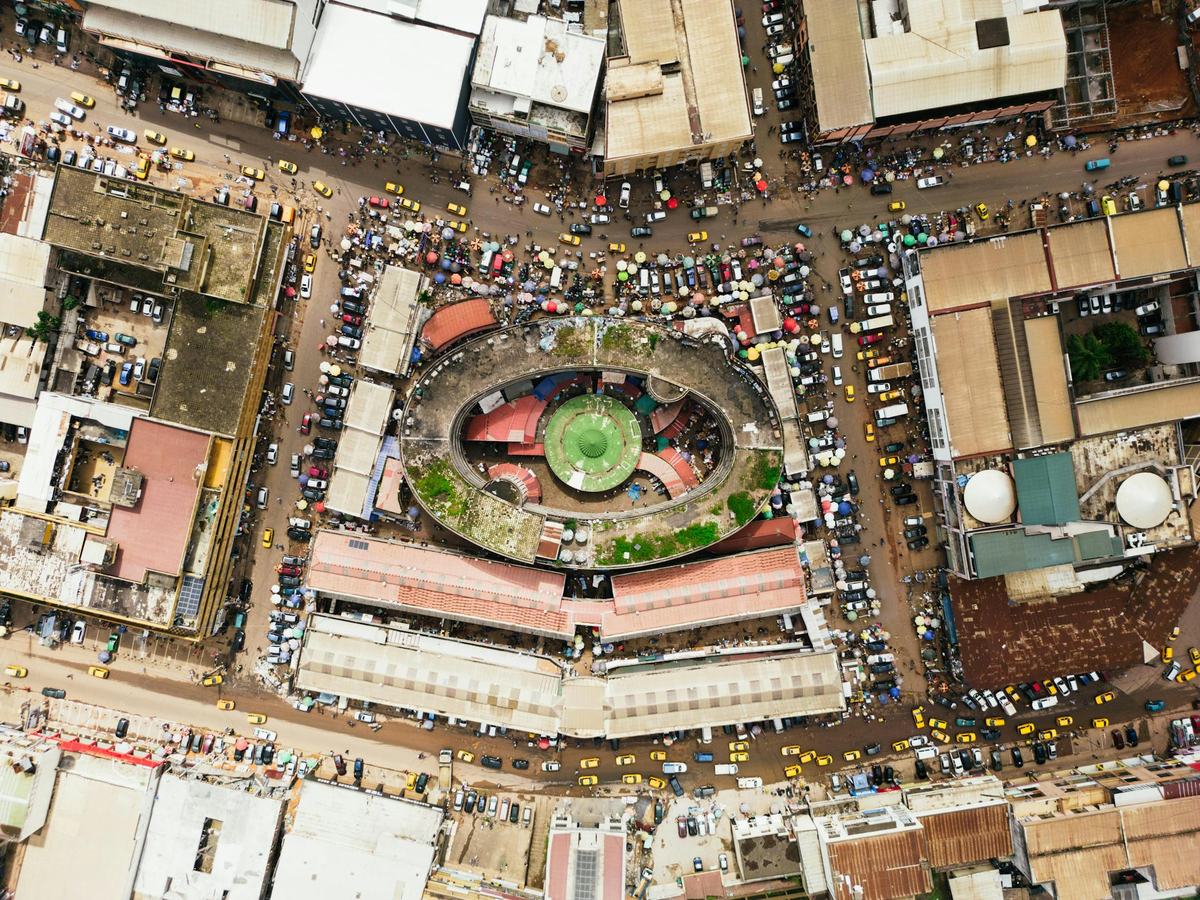
- Capital: Yaoundé [1]
- Population: about 29 million [1]
- Area: 475,442 square kilometers [1]
- Official languages: French and English [1]
- Currency: Central African CFA franc (XAF) [2]
- Distinguishing claim: nicknamed "Africa in miniature" for packing the continent's major climate zones into one country [3]
I grew up thinking of Africa as a place you had to pick a slice of. You went to the savanna or the rainforest or the desert. Then I read about Cameroon and had to look it up twice. The country has all of it. Sahel scrub in the north, dense equatorial rainforest in the south, mountains and volcanic highlands down the middle, and a coast on the Gulf of Guinea. Geographers call it "Africa in miniature" for a reason [3]. You can drive across one country and watch the continent change underneath you.
Two Official Languages, and It's Not Just Paperwork
Cameroon is one of the few countries on earth that runs on two former colonial languages at once. French and English are both official, a holdover from the period after World War I when the German colony of Kamerun was split between France and Britain under League of Nations mandates [3]. When the country reunified in 1961, both languages came along.
About 80 percent of Cameroonians live in the French-speaking regions, and roughly 20 percent in the two English-speaking regions in the northwest and southwest [3]. That smaller English-speaking population has been at the center of a long political dispute over marginalization, which boiled over into the ongoing Anglophone Crisis that started in 2016 and has displaced hundreds of thousands of people [4]. The two languages aren't decorative. They've shaped law, schools, courts, and the army. And the friction between them is part of what the country is still working out.
Mount Cameroon, the Coast Volcano That Actually Erupts
Most West African countries do not have an active volcano. Cameroon has Mount Cameroon, which the locals call Mongo ma Ndemi, "Mountain of Greatness". It rises 4,040 meters straight off the coast near the city of Buea, making it one of the highest peaks in West and Central Africa, and one of the few volcanoes in the world where you can stand on a beach and look up at the crater rim [5].
It is also genuinely active. Mount Cameroon erupted seven times during the 20th century, with the most recent eruption in 2000, and lava flows have come close to the coastal road on multiple occasions [5]. There is an annual race up the mountain, the Mount Cameroon Race of Hope, where runners cover roughly 38 kilometers up and back down through rainforest, grassland, and volcanic rock. Turns out the fastest finishers do it in under five hours, which is an absurd statement to type.
Lake Nyos and a Disaster Almost No One Has Heard Of
Here's the thing about volcanic geography. It is not always the eruptions that get you. On August 21, 1986, Lake Nyos, a deep crater lake in the volcanic highlands of northwestern Cameroon, released a massive cloud of carbon dioxide that had been slowly building up in its lower waters [6]. The dense gas flowed downhill into the surrounding valleys at night and suffocated about 1,746 people and thousands of livestock in nearby villages.
The event is one of only a handful of recorded "limnic eruptions" in human history. Engineers have since installed degassing pipes that vent the lake's deep waters, lowering the risk to manageable levels [6]. I had not heard of any of this before researching this article, and that is a strange thing to say about something that killed nearly 1,800 people in a single night. It deserves to be more widely known than it is.
The Indomitable Lions and the Most Famous Football Run in African History
Cameroon's national football team, the Indomitable Lions, gave African football one of its biggest moments at the 1990 FIFA World Cup in Italy. They beat the defending champions Argentina in the opening match, made it to the quarterfinals, and lost in extra time to England, becoming the first African team ever to reach the World Cup quarterfinals [7]. Roger Milla, then 38 years old and technically retired, came off the bench to score four goals across that tournament and dance at the corner flag after each one. That run forced FIFA to expand the number of African slots at future World Cups.
Cameroon has won the Africa Cup of Nations five times, hosted the tournament most recently in 2021–22, and remains one of the strongest football nations on the continent [7]. Football here is not just a sport. It is the closest thing the country has to a unifying national language, French, English, and 200-plus indigenous tongues notwithstanding.
Around 250 Languages Spoken in One Country
Cameroon has somewhere between 240 and 280 living indigenous languages, depending on how linguists count, in addition to French and English [3]. That is one of the highest linguistic densities of any country in Africa. Major language families represented include Bantu, Bantoid, Adamawa, Chadic, and Nilo-Saharan, basically a snapshot of the deep linguistic history of central Africa.
Most Cameroonians grow up speaking at least one local language at home, then add French or English at school, and many people in the markets of cities like Douala or Bamenda also use Cameroonian Pidgin English, an English-based creole that works as a regional bridge language [3]. Back home in Montana, most people I knew spoke one language and called it a day. The everyday multilingualism in Cameroon is just the normal cost of getting through your week.
Food Worth Crossing the Map For
Cameroonian cuisine is built around starches like cassava, plantain, and corn, paired with rich, spicy stews. Ndolé, the unofficial national dish, is made from bitterleaf greens cooked with ground peanuts, smoked fish or beef, and crayfish [8]. It is dense, earthy, and not really like anything else I've eaten. Other staples include poulet DG ("director general's chicken", chicken with sautéed plantains and vegetables), eru, and koki beans steamed in banana leaves.
Cameroon is also one of the world's significant producers of cocoa and Robusta coffee, and the country has a real café culture, especially in the cities of the south and west [9]. Most of the cocoa goes overseas, which is a familiar story across West and Central Africa. The chocolate you ate today might well have started in a Cameroonian rainforest you've never heard of.
Frequently Asked Questions
What is Cameroon best known for?
Cameroon is best known as "Africa in miniature" because it contains nearly every major African landscape, from rainforest to savanna to mountains to coast, in a single country. It is also known for its national football team, the Indomitable Lions, and for being officially bilingual in French and English.
What languages are spoken in Cameroon?
Cameroon's two official languages are French and English, with French dominant in eight of the country's ten regions. About 240 to 280 indigenous languages are also spoken, and Cameroonian Pidgin English is widely used as a common second language in markets, churches, and informal settings across the country.
What currency is used in Cameroon?
Cameroon uses the Central African CFA franc (XAF), a regional currency shared with five other Central African countries and historically pegged to the euro. Both coins and banknotes are issued by the Bank of Central African States. US dollars and euros can be exchanged easily in major cities.
Is Cameroon safe to visit?
Most of Cameroon is generally safe for tourism, particularly the south, the capital Yaoundé, and the economic hub Douala. However, the two Anglophone regions in the northwest and southwest, the Far North bordering Lake Chad, and some eastern border areas have ongoing security issues. Travelers should always check current government advisories before going.
What is the climate like in Cameroon?
Cameroon's climate ranges from hot and humid equatorial rainforest in the south to a hot and dry Sahel climate in the far north. Most of the country has two seasons, a wet season and a dry season, with the timing varying by region. The southwest coast around Mount Cameroon is one of the wettest places on Earth.
Sources
- The World Factbook: Cameroon
- Bank of Central African States: CFA Franc
- Encyclopaedia Britannica: Cameroon
- UN Office for the Coordination of Humanitarian Affairs: Cameroon
- Smithsonian Institution Global Volcanism Program: Cameroon
- United States Geological Survey: The Lake Nyos Disaster
- Confederation of African Football: Cameroon
- Encyclopaedia Britannica: Cuisine of Cameroon
- International Cocoa Organization: Cameroon Production Statistics