- Capital: Bangui [1]
- Population: about 5.5 million [1]
- Area: 622,984 square kilometers [1]
- Official languages: French and Sango [1]
- Currency: Central African CFA franc (XAF) [2]
- Distinguishing claim: home to the Sangha Trinational, a UNESCO World Heritage rainforest shared with Cameroon and the Republic of the Congo [3]
Most countries don't tell you where they are in their name. The Central African Republic does, and it is not exaggerating. Pull up a map of Africa, find the geographic middle, and you'll land somewhere inside its borders. The country sits roughly equidistant from the Atlantic, the Indian Ocean, the Mediterranean, and the Cape. It has no coastline, no real neighbors with a port to speak of, and almost no railways. Getting goods in and out is slow and expensive, and that single fact has shaped just about everything else here.
A Capital on a River, Across from Another Country
Bangui sits on the north bank of the Ubangi River, which forms the southern border with the Democratic Republic of the Congo [1]. From the Bangui waterfront you can look straight across the river at the town of Zongo on the Congolese side. The Ubangi flows into the Congo River, which gives the country its only real outlet to the sea, more than a thousand kilometers downstream through another country's territory. That is what landlocked actually feels like in practice.
The capital was founded by the French in 1889 as a colonial outpost called Bangui, named for the rapids that block river traffic just upstream [4]. Today it is by far the largest city in the country, home to roughly a fifth of the entire population, and the economic center of a nation where most people still live in small rural villages.
Sango, a Language Almost Everyone Actually Uses
Here's the thing about official languages in Africa - the European one is usually for paperwork and elite schools, and people speak something else at home. The Central African Republic does this differently. Sango, a Ngbandi-based creole that grew up along the Ubangi River as a trade language, is co-official with French and is spoken by the vast majority of the population as either a first or second language [5]. It is one of the few national African languages that genuinely functions as a lingua franca for an entire country.
The government uses Sango on the radio, in church, in markets, and in everyday political life. French still dominates in courts and higher education, a holdover from the colonial period that ended in 1960. But if you walked through a market in Bangui or a village in the south, you would hear Sango first, French second.
The Sangha Trinational and the World's Forest Elephants
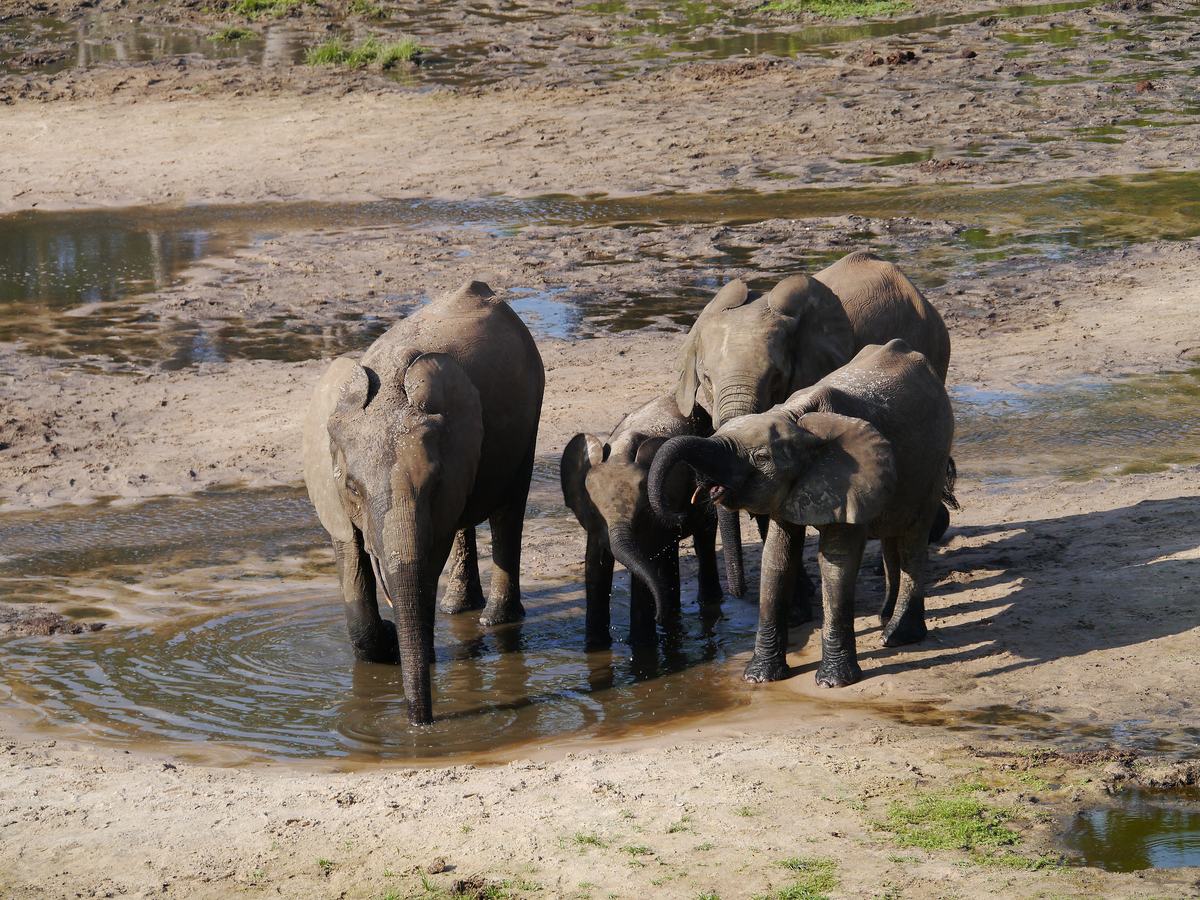
The southwestern corner of the country sits inside one of the largest blocks of intact tropical rainforest left on Earth, the Congo Basin. The Sangha Trinational, a UNESCO World Heritage Site shared with Cameroon and the Republic of the Congo, protects a massive stretch of this forest [3]. On the Central African side, Dzanga-Sangha Reserve is famous among biologists for one specific reason. It contains the Dzanga Bai, a large clearing in the forest where dozens, sometimes more than a hundred, African forest elephants gather at once to drink mineral-rich water from the ground [6].
Forest elephants are a different species from the savanna elephants most people picture. They are smaller, with straighter tusks, and they live deep in the rainforest where you almost never see them. Dzanga Bai is one of the only places on the planet where you can sit on a viewing platform and watch them in numbers, behaving normally. Poaching has been brutal across the region, and the Central African forest elephant population is a fraction of what it once was, but the bai is still there, and the elephants still come.
Diamonds, Gold, and an Economy Built on What Comes Out of the Ground
The Central African Republic is rich in resources and poor in almost every standard development metric. Diamonds and gold are mined across much of the country, mostly by artisanal miners working small claims by hand [7]. Diamonds alone have historically accounted for a large share of export earnings. Uranium, oil, and timber sit underneath or across the landscape too, but the lack of infrastructure and decades of political instability have made large-scale extraction difficult.
The country has been through repeated coups and a civil war that began in 2012 and has displaced more than a million people at various points [8]. UN peacekeepers have been on the ground continuously since 2014. None of this is in the brochure version of "interesting facts", but it is the context every other fact sits inside, and the country deserves to be understood honestly rather than skipped over.
Frequently Asked Questions
What is the Central African Republic best known for?
The Central African Republic is best known as one of the most geographically central countries on the African continent and for its protected rainforests in the Congo Basin, particularly the Sangha Trinational UNESCO World Heritage Site. It is also known for its diamond mining and for the widely spoken national language, Sango.
What languages are spoken in the Central African Republic?
The two official languages are French and Sango. Sango, a creole based on the Ngbandi language, is spoken by most of the population as a first or second language and serves as the country's everyday lingua franca. Several dozen other indigenous languages are also spoken in different regions.
What currency is used in the Central African Republic?
The country uses the Central African CFA franc (XAF), a regional currency shared with five other Central African countries and issued by the Bank of Central African States. Banknotes and coins are accepted across all six member states, and the currency has historically been pegged to the euro.
Is the Central African Republic safe to visit?
Travel to the Central African Republic carries significant risks due to ongoing armed conflict, banditry, and unstable security in much of the country outside Bangui. Most Western governments advise against non-essential travel. Anyone considering a visit should check current government advisories carefully and arrange in-country support in advance.
What is the climate like in the Central African Republic?
The climate ranges from tropical rainforest in the south, with high rainfall most of the year, to a tropical savanna with distinct wet and dry seasons in the north. Average temperatures stay warm year-round across the country, generally between 21 and 32 degrees Celsius depending on altitude and season.
Sources
- The World Factbook: Central African Republic
- Bank of Central African States
- UNESCO World Heritage Centre: Sangha Trinational
- Encyclopaedia Britannica: Central African Republic
- Encyclopaedia Britannica: Sango Language
- World Wildlife Fund: Dzanga-Sangha Protected Areas
- Kimberley Process: Central African Republic Diamond Sector
- UN Office for the Coordination of Humanitarian Affairs: Central African Republic