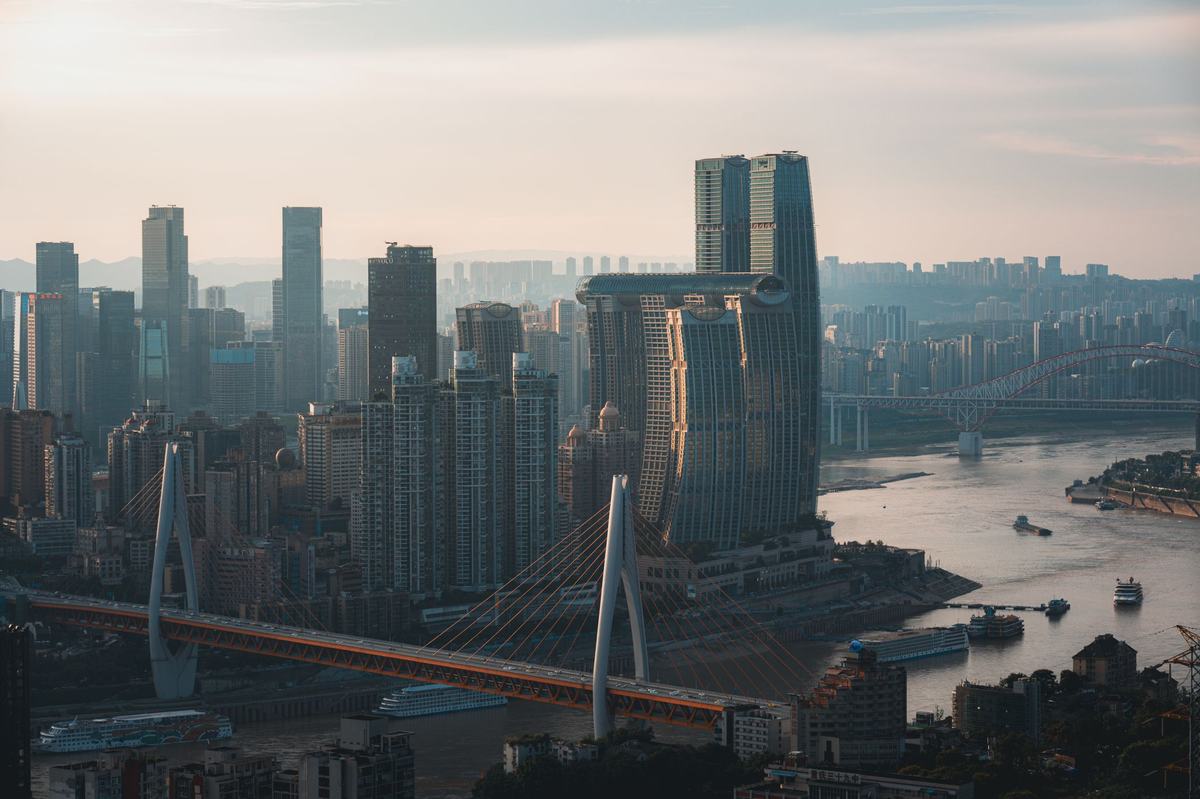
- Capital: Beijing [1]
- Population: about 1.41 billion (2024 estimate) [2]
- Area: 9.6 million square kilometers, roughly the size of the United States [1]
- Official language: Standard Mandarin (Putonghua), with hundreds of regional varieties spoken alongside it [3]
- Currency: Renminbi (yuan), symbol ¥ [2]
- One distinguishing claim: the only major civilization with a continuous written record stretching back more than 3,000 years [4]
I grew up thinking "old country" meant something like Italy or Greece. Then a teacher at my school in Montana put up a timeline that lined up Chinese dynasties next to American history, and I remember staring at it for a long time. The Shang dynasty was already five hundred years old when the pyramids at Giza were going up. The Tang dynasty was running a city of a million people while London was a swampy trading post. China is not just old. It's the only place on the planet where the same civilization has been continuously writing its own story for that long.
That fact does something to the rest of the country's facts. They start to make a different kind of sense.
One Country, One Time Zone (Whether It Fits or Not)
Here's something that'll ruin the next geography quiz you take: China spans five geographic time zones, but the entire country runs on one. Beijing time. From the eastern coast all the way out to the western edge of Xinjiang, every clock reads the same number.
Which, if you think about it, is kind of wild. In far western Xinjiang, the sun doesn't rise until about 10 a.m. in winter, because the actual local solar time is hours behind Beijing. Schools shift their schedules. Restaurants open later. People in the region informally use what they call "Xinjiang time" - two hours behind official time - just to make daily life work [5]. The official policy is the policy. But the sky doesn't care about policy.
For comparison, the U.S. has six time zones across roughly the same east-west distance. China decided in 1949 to unify everything to Beijing, and they've stuck with it. It's a small thing that says a lot about how the country thinks about itself.
A High-Speed Rail Network That Dwarfs the Rest of the World
I had to look this up twice. China has more high-speed rail track than every other country on Earth combined. As of 2024, the network runs over 45,000 kilometers (around 28,000 miles), and it's still growing [6]. You can get from Beijing to Shanghai - a distance roughly equivalent to New York to Atlanta - in about 4 hours and 18 minutes on the fastest trains. The whole network was essentially built from scratch starting in 2008.
For context: the United States, which once led the world in railroads, has zero true high-speed lines in regular operation. China built its system in less time than it took to argue about the California high-speed line.
The trains hit 350 km/h (217 mph) in regular service. The stations look like airports. And tickets often cost less than a tank of gas back home in Montana.
The Great Wall Is Not What You Think It Is
Most people picture the Great Wall as a single, continuous line snaking across mountains. The reality is messier and more interesting. The "Great Wall" is actually a network of walls, fortifications, watchtowers, and natural barriers built and rebuilt over more than two millennia by different dynasties, each with its own engineering style [7].
The total length, including all branches and overlapping sections, comes out to roughly 21,196 kilometers (about 13,170 miles). That's longer than the diameter of the Earth.
And here's the thing - most of it is in ruins. The polished stone sections tourists walk on near Beijing? Those were built by the Ming dynasty in the 1300s to 1600s and restored in the 20th century. The older parts, the Han and Qin walls out in the deserts, are crumbling earthen berms that look like nothing until you realize what they are. I've seen old fence lines on Montana ranches that have aged better. But those Han walls are over 2,000 years old. Different timeline entirely.
A Cuisine That Refuses to Be One Cuisine
Saying "Chinese food" is like saying "European food". It's technically true and almost completely useless. China has eight major regional culinary traditions, often called the Eight Great Cuisines, and the differences between them can be enormous [8].
Sichuan cooking, from the southwest, leans on chili peppers and the famous numbing málà sensation that comes from Sichuan peppercorns. Cantonese cooking, from the south, is built around fresh seafood, light steaming, and the dim sum tradition. Shandong cuisine in the north favors wheat noodles, braised dishes, and seafood from the Yellow Sea. Hunan brings even more heat than Sichuan. Jiangsu is delicate and sweet.
The dish most Americans grew up calling "Chinese food" - chop suey, General Tso's chicken, fortune cookies - was largely invented in the United States, mostly by Cantonese immigrants adapting to American tastes in the 1800s and 1900s. Real regional Chinese cooking is a much bigger universe.
Inventions That Quietly Run the Modern World
Paper. Printing. Gunpowder. The compass. These are the four classical great inventions, and every one of them changed the course of world history [9]. But the list goes deeper. Mechanical clocks, paper money, the iron plow, the seismograph, suspension bridges, deep drilling for natural gas - all of them have origins in pre-modern China, often centuries before they appeared in Europe.
Movable type printing was developed by Bi Sheng around 1040 CE, about 400 years before Gutenberg. Paper money was in regular use during the Song dynasty (960 to 1279) when most of Europe was still moving around bags of coins. The compass was being used for navigation by the 11th century.
And nobody talks about this, but the modern world's quiet dependence on Chinese manufacturing isn't a new pattern. It's the latest chapter in a very long story.
The Living Languages and the Single Script
Standard Mandarin, called Putonghua ("common speech"), is the official spoken language and what most non-Chinese people learn. But China is home to hundreds of regional Chinese varieties - Cantonese, Shanghainese, Hokkien, Hakka, and many others - that are often as different from each other as Spanish is from Italian [3]. Speakers of one frequently can't understand speakers of another.
What holds it all together is the writing system. Chinese characters represent meaning, not pronunciation, so the same written sentence can be read aloud completely differently in Beijing, Hong Kong, and Taipei, but everyone reads the same meaning. It's one of the great unifying technologies in human history, and it's been doing this job, in some form, for about 3,300 years.
A Geography That Contains Almost Everything
China stretches from the steamy tropical south of Hainan Island to the Siberian-cold winters of Heilongjiang in the northeast. From the Tibetan Plateau, the highest in the world, down to the Turpan Depression in Xinjiang, which sits 154 meters below sea level. From the Gobi and Taklamakan deserts in the north and west to subtropical rice paddies in the south.
The country shares land borders with 14 other nations - tied with Russia for the most in the world - and contains the world's third-tallest mountain (K2, on the border with Pakistan), some of the longest rivers (the Yangtze and Yellow), and biodiversity hotspots that include the wild range of the giant panda. The pandas only live in a few mountain provinces in central China and basically eat one thing: bamboo, for about 14 hours a day. They didn't evolve to be efficient. They evolved to live exactly where they live.
Frequently Asked Questions
What is China's population in 2024?
China's population is roughly 1.41 billion as of 2024. India overtook China as the world's most populous country in 2023, but China remains the second-most populous nation, with a population now slowly declining due to low birth rates and an aging society.
Why does China have only one time zone?
China unified its time zones to Beijing time in 1949 for political and administrative reasons. The country geographically spans five zones, so the policy creates large mismatches with solar time in the far west, where many residents informally use a local "Xinjiang time" two hours earlier.
Is the Great Wall of China visible from space?
No, the Great Wall is not generally visible from space with the naked eye. The claim is a popular myth. Astronauts, including Chinese astronaut Yang Liwei, have confirmed they could not see it from low Earth orbit. The wall is long but very narrow.
How many languages are spoken in China?
China officially recognizes Standard Mandarin as the national spoken language, but hundreds of regional Chinese varieties and dozens of minority languages are spoken across the country. The government recognizes 55 ethnic minority groups, many with their own languages and writing systems.
What is China's currency called?
China's currency is the renminbi (RMB), which means "people's currency". The basic unit is the yuan, often written with the symbol ¥. The terms renminbi and yuan are both used, with renminbi being the formal name and yuan being the unit you actually count.
Sources
- The World Factbook: China
- World Bank: China Country Profile
- Britannica: Languages of China
- UNESCO: Chinese Writing System and Continuous Civilization
- BBC News: The country with one time zone
- International Union of Railways: High Speed Rail Statistics
- UNESCO World Heritage: The Great Wall
- Britannica: Chinese Cuisine and Regional Traditions
- Needham Research Institute: Science and Civilisation in China