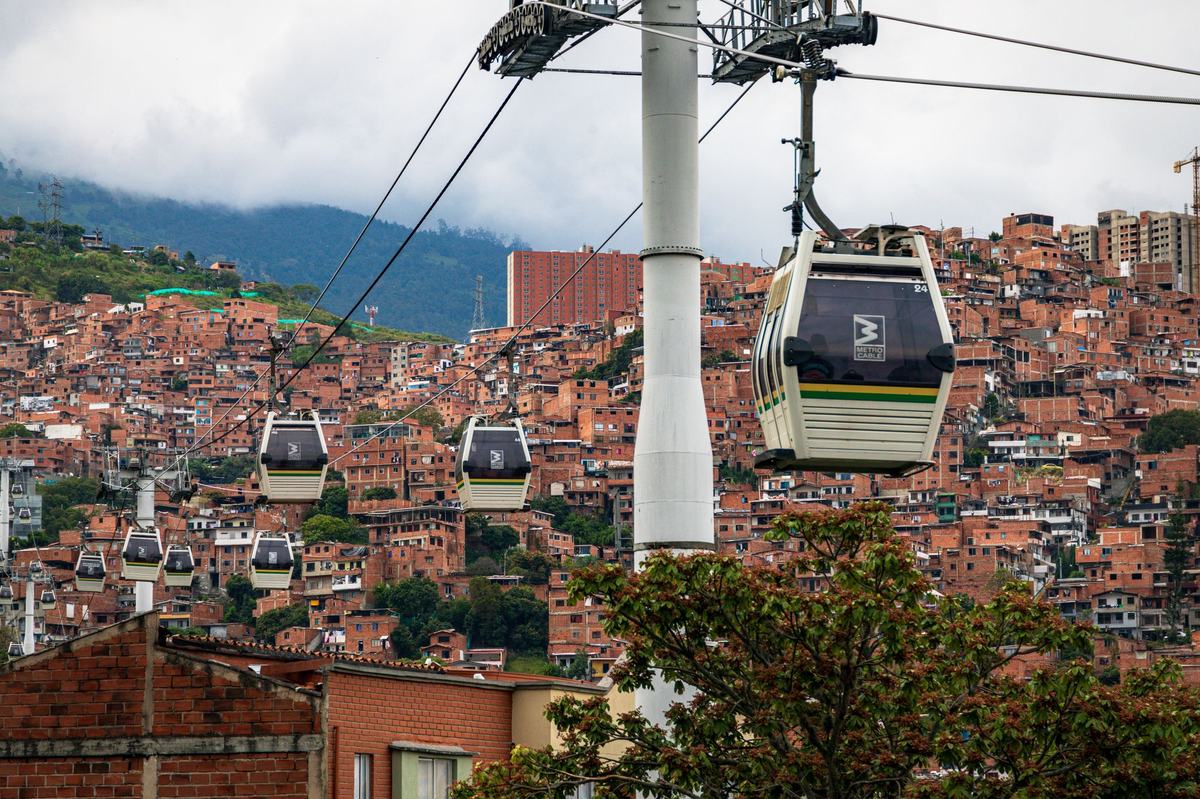
- Capital: Bogotá, sitting at about 2,640 meters above sea level [1]
- Population: about 52 million (2024 estimate) [2]
- Area: roughly 1.14 million square kilometers, slightly larger than Texas and California combined [1]
- Official language: Spanish, with 65 recognized indigenous languages also spoken [3]
- Currency: Colombian peso (COP)
- One distinguishing claim: the only South American country with coastlines on both the Pacific Ocean and the Caribbean Sea [1]
I grew up looking at maps of South America thinking the continent had a clear shape. A long Pacific edge on one side, an Atlantic edge on the other, and a green Amazon middle. Colombia broke that picture for me. It sits in the top-left corner of the continent like a country that didn't get the memo about which ocean to face. It has Caribbean beaches in the north, Pacific rainforest on the west, the Andes running down the middle in three separate ridges, and a slice of the Amazon basin in the south. One country, four worlds.
Most of the conversation about Colombia outside Colombia is still stuck in the 1990s. The actual country has moved on. What's left, when you look past the old headlines, is one of the most geographically and culturally rich places on the planet.
Three Andes Ranges, Not One
Most people think of the Andes as a single mountain chain. In Colombia they split into three. The Cordillera Occidental, Cordillera Central, and Cordillera Oriental fan out from the south like three fingers, separated by the long, deep valleys of the Cauca and Magdalena rivers [1]. The country's biggest cities sit in different fingers. Bogotá is high up in the eastern range. Medellín is tucked into a valley in the central range. Cali sits between the central and western ones.
What this does to the country is unusual. Drive a few hours and you cross from coffee-belt foothills to alpine paramo grasslands at 4,000 meters, then back down to dry tropical forest. Climates stack on top of each other instead of stretching across the map. Colombians joke that you can pick your weather by picking your altitude, and they are not exaggerating.
The Most Biodiverse Square Meter in the World
Here's something that'll ruin the next geography quiz you take: Colombia is the second-most biodiverse country on Earth, behind only Brazil, despite being about one-eighth the size [4]. It has more bird species than any other country on the planet, around 1,950 of them, which is roughly 20 percent of all bird species in the world [5]. Brazil and Peru are not even close.
The reason is that geography again. Two coasts, three mountain ranges, the Amazon, the Orinoco plains, the Chocó rainforest. Each one is its own ecosystem. The Chocó region on the Pacific coast gets up to 13 meters of rain a year in some spots, making it one of the wettest places on Earth, and it's still largely unexplored by biologists [4]. New species turn up there on a regular basis.
The orchid is the national flower for a reason. Colombia has more than 4,000 orchid species. Back home in Montana, I grew up thinking a wildflower meadow with twenty species in it was something special. Colombia has single mountainsides that hit numbers like that before lunch.
Coffee, but Not the Way You Think
Coffee in Colombia is not just a crop. It's a region, a culture, and a UNESCO World Heritage Site. The Coffee Cultural Landscape, covering parts of Caldas, Quindío, Risaralda, and northern Valle del Cauca, was inscribed in 2011 for the way more than a century of small-farm coffee growing shaped the land and the communities living on it [6].
Most Colombian coffee is grown on tiny family farms, not industrial plantations. The country produces almost exclusively arabica beans, and almost all of it is washed-process - meaning the cherries are pulped, fermented, and washed before drying, which gives Colombian coffee that clean, bright cup most people recognize. Colombia is the third-largest coffee producer in the world after Brazil and Vietnam, and the largest producer of washed arabica.
I had to look this up twice, but the famous Juan Valdez character with his mule, Conchita, was created in 1959 by an American ad agency. The character stuck. Colombian coffee growers leaned in, and now Juan Valdez is a real coffee company owned by the federation of Colombian coffee farmers themselves.
The Lost City Older Than Machu Picchu
Everyone knows Machu Picchu. Almost nobody outside Colombia knows about Ciudad Perdida. The Lost City, called Teyuna by the indigenous communities who consider it sacred, sits high in the Sierra Nevada de Santa Marta on the Caribbean coast. It was built by the Tairona civilization around 800 CE, roughly 650 years before Machu Picchu was constructed in Peru [7].
The site is a series of stone terraces, plazas, and stairways carved into a steep mountainside, abandoned during the Spanish conquest and rediscovered by treasure hunters in 1972. Today it's only reachable by a four-day hike through the jungle. There's no road, no cable car, no visitor center. The Kogi, Wiwa, Arhuaco, and Kankuamo peoples - direct descendants of the Tairona - still live in the surrounding mountains and consider the Sierra Nevada the heart of the world. Out of respect, the trek closes for a few weeks each year so the communities can perform ceremonies on the site.
A Country with Yellow, Blue, and Red Reasons to Celebrate
Colombian culture is loud in the best way. The flag itself tells the story: yellow for the gold of the land, blue for the two oceans, red for the blood spilled in the wars of independence. The country celebrates more than 18 public holidays a year, one of the highest counts in the world.
Music is everywhere. Cumbia, born on the Caribbean coast from a fusion of indigenous, African, and Spanish traditions, became one of the foundational rhythms of Latin American popular music. Vallenato, played on accordion, drum, and a ridged percussion stick called a guacharaca, was added to UNESCO's intangible cultural heritage list in 2015 [8]. And then there's reggaeton and Latin pop, where Colombian artists like Shakira, J Balvin, Karol G, and Maluma have spent the last two decades reshaping global music.
Carnival in Barranquilla, held every February, is the second-largest carnival in the world after Rio's. It draws over a million people, runs for four days, and has its own UNESCO recognition [8].
The Emerald Capital of the World
Colombia produces some of the highest-quality emeralds in the world, particularly from mines in Boyacá, north of Bogotá. The deep green stones from Muzo and Chivor have been mined for over 500 years and are considered the gold standard among gem dealers [9]. Most of the world's finest emeralds, including those in royal collections in Europe and the Middle East, originally came out of Colombian mountains.
The Spanish stumbled onto these mines almost as soon as they arrived. The indigenous Muzo people had been mining and trading the stones long before that. Today most of the trade still passes through a few blocks in central Bogotá, where men in suits stand on sidewalks examining loose stones in folded paper packets, the way people in other cities buy fruit.
Frequently Asked Questions
What is the capital of Colombia?
The capital of Colombia is Bogotá, located in the eastern Andes mountains at about 2,640 meters above sea level. It is the largest city in the country, with a metropolitan population of around 11 million, and serves as the political, financial, and cultural center of Colombia.
Is Colombia safe to visit?
Most major cities and tourist regions in Colombia are considered safe for visitors today, including Bogotá, Medellín, Cartagena, and the Coffee Region. Conditions have improved significantly since the 1990s, though remote rural areas can still pose risks. Travelers should follow current government advisories before visiting.
What language is spoken in Colombia?
Spanish is the official and most widely spoken language in Colombia. The Colombian dialect, especially in Bogotá, is often praised as one of the clearest forms of Spanish in Latin America. The country also recognizes 65 indigenous languages and creoles, including Wayuu, Palenquero, and San Andrés Creole.
What is Colombia famous for?
Colombia is famous for its coffee, emeralds, biodiversity, and Caribbean and Pacific coastlines. It is the only South American country bordering both the Pacific Ocean and the Caribbean Sea. It is also internationally known for cumbia and vallenato music, the writer Gabriel García Márquez, and the lost Tairona city of Ciudad Perdida.
What currency does Colombia use?
Colombia uses the Colombian peso, abbreviated COP. Banknotes commonly come in denominations of 2,000, 5,000, 10,000, 20,000, 50,000, and 100,000 pesos. U.S. dollars are not generally accepted in everyday transactions, though they can be exchanged at banks and authorized currency offices in major cities.
Sources
- The World Factbook: Colombia
- World Bank: Colombia Country Profile
- Ethnologue: Languages of Colombia
- Convention on Biological Diversity: Colombia Country Profile
- BirdLife International: Colombia Bird Diversity
- UNESCO World Heritage: Coffee Cultural Landscape of Colombia
- Smithsonian Magazine: Ciudad Perdida and the Tairona
- UNESCO Intangible Cultural Heritage: Carnival of Barranquilla and Vallenato Music
- Gemological Institute of America: Colombian Emeralds