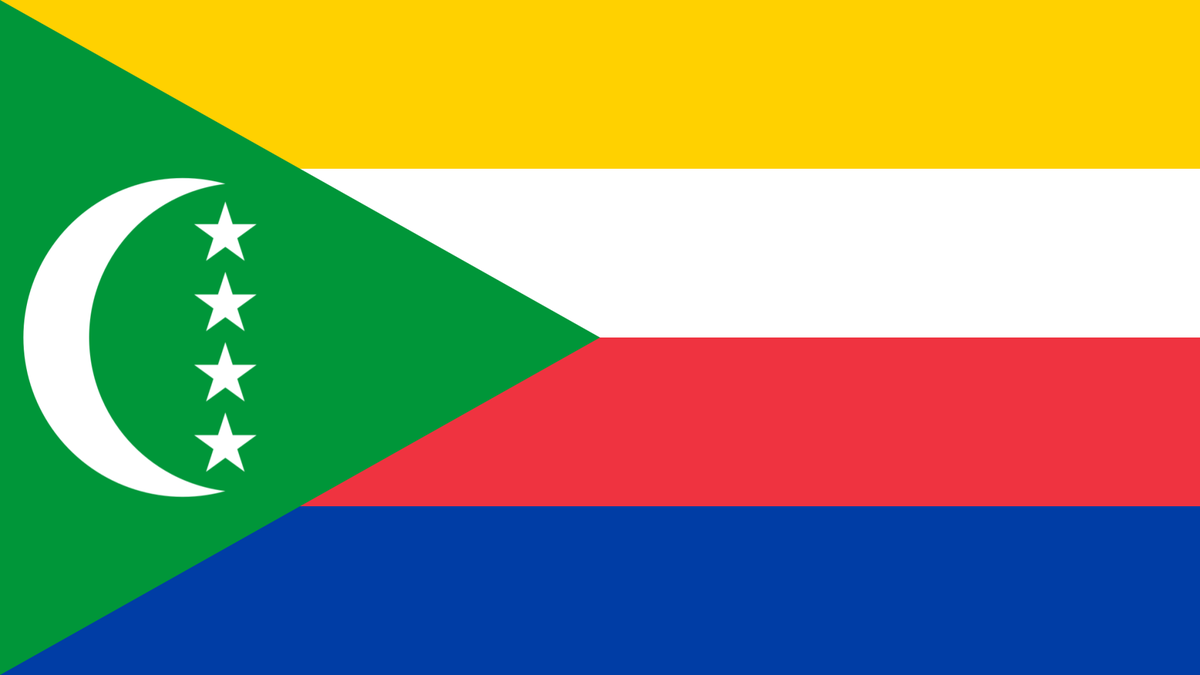
- Capital: Moroni, on the island of Grande Comore [1]
- Population: roughly 870,000 [2]
- Area: 1,861 square kilometers, smaller than Rhode Island [1]
- Official languages: Comorian, Arabic, and French [1]
- Currency: Comorian franc (KMF), pegged to the euro [3]
- Distinguishing claim: produces around 80 percent of the world's ylang-ylang essential oil, the floral note in Chanel No. 5 [4]
I had to look this up twice. There's a country off the east coast of Africa, scattered across three small volcanic islands, that quietly supplies most of the perfume industry's most famous ingredient. It has its own flag, its own seat at the United Nations, and a name almost nobody can place on a map. That country is Comoros, and once you start reading about it, you wonder how it stayed so far off the radar.
Where Comoros Actually Is
Pull up a map of the Indian Ocean. Find Madagascar. Now slide your eye northwest, into the Mozambique Channel, and look for a small cluster of islands tucked between Madagascar and the African mainland. That's Comoros. The country is made up of three main islands - Grande Comore (Ngazidja), Anjouan (Nzwani), and Mohéli (Mwali) - plus the disputed island of Mayotte, which voted to remain with France in 1974 and is still administered by Paris [1]. Comoros has never accepted that arrangement and continues to claim Mayotte as its fourth island.
The whole archipelago sits on a volcanic ridge, which means the islands are mountainous, green, and geologically restless. Mount Karthala on Grande Comore is one of the largest active volcanoes in the world, with a summit caldera over three kilometers wide [5]. It erupted as recently as 2007. Locals have learned to live with it the way people back home in Montana live with grizzly country - aware, prepared, but not paralyzed.
A Country Built on Perfume
Here's the thing about ylang-ylang. The flower is small, yellow, and droopy, and most Americans have never seen one. But if you've ever opened a bottle of Chanel No. 5 - or a hundred other classic perfumes - you've smelled what Comoros sends out into the world. The country produces roughly 80 percent of global supply, distilled in small village stills that have barely changed in a hundred years [4].
Vanilla and cloves matter too. Comoros is one of the largest clove producers on the planet, and the trade in spices and essences has shaped the economy for generations [6]. It's also why the islands are sometimes called the Perfumed Islands. You read that and assume it's a tourism slogan. Turns out the nickname is older than tourism, and the air around the distilleries genuinely does smell like a department store counter.
A History Stitched Together From Three Continents
Comoros sits at a crossroads, and its culture shows it. Bantu farmers from East Africa, Arab traders, Persian merchants, Malay sailors, and later French colonizers all left fingerprints. The result is a Sunni Muslim majority population speaking Comorian, a Bantu language written in both Arabic and Latin scripts and laced with Arabic loanwords [1]. French is the language of administration. Arabic is the language of religion. Comorian is the language of home.
The country gained independence from France in 1975 - or rather, three of the four islands did, with Mayotte breaking off [1]. What happened next is the part nobody talks about. Comoros has had more than twenty attempted or successful coups since independence, earning the grim nickname Cloud Coup Coup Land among foreign correspondents. A French mercenary named Bob Denard was involved in four of them, including one in which he assassinated the sitting president [7]. That is not the kind of detail you expect to read about a sleepy island chain best known for flowers.
Daily Life and Culture
Step away from the politics and Comoros is, by most accounts, a quiet place. Fishing canoes line the volcanic beaches. Markets sell breadfruit, cassava, and dried fish. Weddings are enormous - the Grand Marriage, or anda, is a traditional rite of passage that can take years to save for and involves feasting an entire village. A man who completes the Grand Marriage gains a whole new social standing and can wear distinctive ceremonial clothing in public [8].
The architecture mixes Swahili coastal style with Arab influence: carved wooden doors, narrow alleys, and stone houses that have stood for centuries. The old medina of Moroni feels less like the capital of a country and more like a quiet provincial town in Oman that floated south.
The Economy in One Sentence
Comoros is one of the poorest countries in the world, and its biggest export by value is not perfume oil or cloves but the money sent home by Comorians living abroad, mostly in France [3]. Remittances make up around a quarter of the entire economy. Fishing, subsistence agriculture, and the slow growth of tourism fill in most of the rest.
Frequently Asked Questions
Where is Comoros located?
Comoros is an archipelago in the Indian Ocean, off the southeast coast of Africa, between Mozambique and Madagascar. It is made up of three main islands and claims a fourth, Mayotte, which is administered by France.
What language do they speak in Comoros?
Comoros has three official languages: Comorian, Arabic, and French. Comorian, a Bantu language with Arabic influence, is what most people speak at home. Arabic is used in religious settings and French in government and business.
Is Comoros safe to visit?
Comoros is generally safe for travelers, though infrastructure is limited and political tensions occasionally flare. Most visitors come for diving, hiking Mount Karthala, or exploring the old stone towns. Standard travel precautions apply.
What is Comoros famous for?
Comoros is famous for producing about 80 percent of the world's ylang-ylang essential oil, a key ingredient in many luxury perfumes including Chanel No. 5. It is also known for cloves, vanilla, and Mount Karthala, one of the largest active volcanoes on Earth.