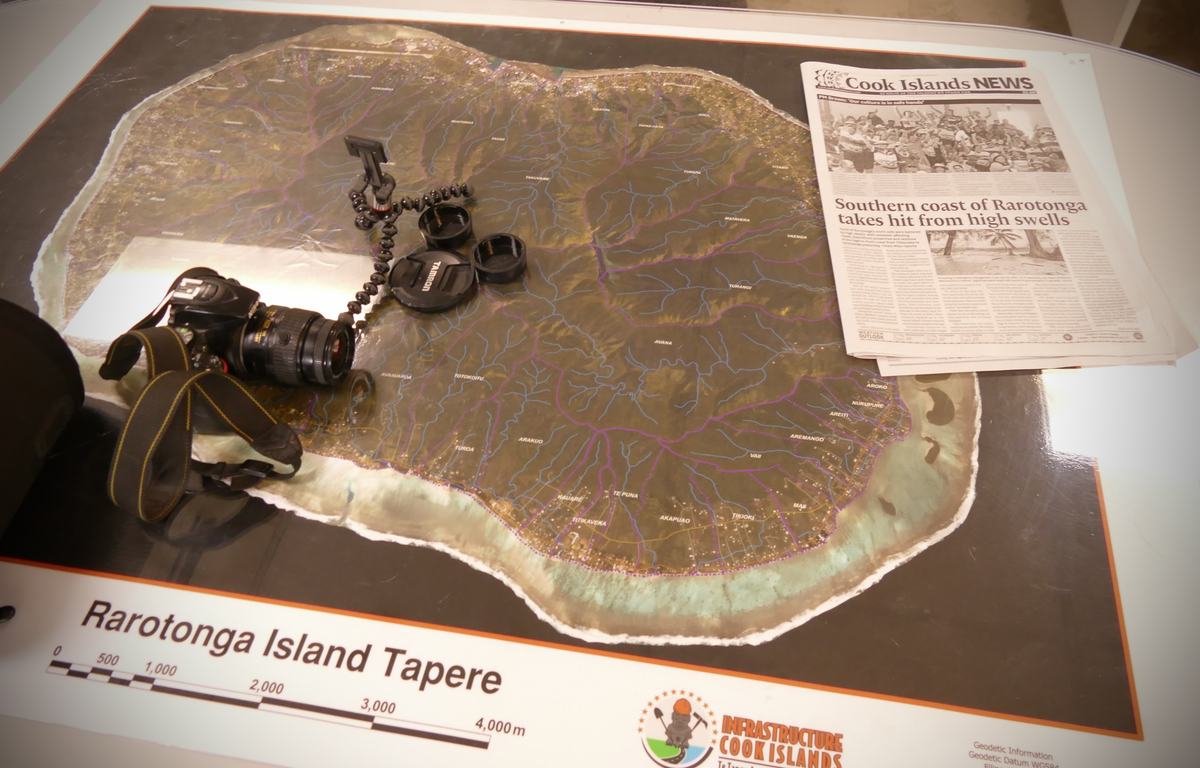
- Capital: Avarua, on the island of Rarotonga [1]
- Population: about 15,040 residents (2021 census) [2]
- Land area: 236.7 square kilometers, scattered across roughly 2 million sq km of ocean [1]
- Official languages: English and Cook Islands Maori (Rarotongan) [1]
- Currency: New Zealand dollar, plus a unique local Cook Islands dollar that includes a triangular $2 coin [3]
- Status: A self-governing nation in free association with New Zealand since 1965 [4]
I grew up thinking of the Pacific as one giant blue space on the map. Then I started reading about the Cook Islands and realized that blue space is full of countries, and some of them barely have more residents than my old high school had students. Fifteen islands. About fifteen thousand people. A coastline that, if you stretched it out, would still be smaller than the city limits of Portland. Yet this place runs its own government, prints its own coins, and has a culture that's been stitched together from a thousand years of open-ocean voyaging.
A Country That Isn't Quite a Country
The Cook Islands have one of the strangest political arrangements in the world. They're fully self-governing, with their own prime minister, parliament, and laws. They sign their own treaties. They've joined the World Health Organization on their own terms. But they also share citizenship with New Zealand, which means every Cook Islander is automatically a New Zealand citizen and can live, work, or vote there [4]. Turns out this setup, called "free association", was negotiated in 1965 and has held up remarkably well, even though more Cook Islanders now live in New Zealand and Australia than in the islands themselves.
Fifteen Islands, Two Million Square Kilometers
Here's the thing about the Cook Islands that takes a minute to absorb. The total land area is about 92 square miles, smaller than the city of Sacramento. But the country's exclusive economic zone, the ocean it controls, covers roughly 1.96 million square kilometers [1]. That's larger than the combined area of Texas, California, Montana, and New Mexico. The islands split into two groups: the Southern Cooks, where most people live and where Rarotonga sits, and the Northern Cooks, low-lying coral atolls so remote that some of them only see a supply ship every few months.
The Black Pearl Capital
Most people couldn't tell you where Pukapuka or Manihiki is on a map. That's probably exactly how the pearl farmers there like it. The lagoons of Manihiki and Penrhyn produce some of the world's finest black pearls, grown inside the black-lipped oyster Pinctada margaritifera. Pearl farming is one of the country's biggest exports after tourism, and the colors range from deep peacock green to silver to that rich charcoal black the islands are famous for. The industry took a beating from a cyclone in the late 1990s and has rebuilt slowly. Visit a pearl farm in Manihiki and the operation feels less like industry and more like patience: years of waiting on a single oyster.
Maori Roots and the Voyaging Past
The Cook Islanders are Polynesian, and their language, Cook Islands Maori, is closely related to the Maori spoken in New Zealand and the language of French Polynesia. Oral histories trace the great voyaging canoes that left Rarotonga around the 13th century carrying settlers south to Aotearoa, what we now call New Zealand [5]. Seven of those canoes are remembered by name in Maori tradition, and on Rarotonga there's a stone called Taputapuatea, near a road, that's said to mark where some of those canoes departed. I had to look this up twice. A small road on a small island, marking the start of a journey that helped populate one of the largest islands in the South Pacific.
Where the Money Has Triangles
The Cook Islands use the New Zealand dollar for most transactions, but they also issue their own local currency that circulates alongside it. The Cook Islands dollar is famous among coin collectors for one reason: the $2 coin is shaped like a triangle. Not rounded edges trying to look triangular. An actual triangle. There's also a $5 note that features a topless Polynesian woman in traditional dress, which is one of the few banknotes in the world depicting that imagery [3]. The local currency only works inside the country, so any cash you have left over at the airport gets traded back or kept as a souvenir. Most travelers keep it.
A Climate Country on the Front Line
Climate change isn't an abstract topic in the Cook Islands. The Northern Group atolls sit just a few feet above sea level, and rising oceans, stronger cyclones, and coral bleaching all show up in everyday life. The country has pushed hard on renewable energy, aiming to power the entire archipelago with renewable sources, mostly solar, in the coming years. Several outer islands have already hit close to 100% solar generation during daylight hours. For a country of fifteen thousand people, the engineering effort is real, and it's part of a broader Pacific push to lead by example on a problem the small island nations didn't create.
Frequently Asked Questions
Are the Cook Islands part of New Zealand?
Not exactly. The Cook Islands are a self-governing nation in free association with New Zealand. They run their own government, parliament, and foreign affairs, but Cook Islanders are also New Zealand citizens and use the New Zealand dollar alongside their own local currency. The arrangement has been in place since 1965.
What language do they speak in the Cook Islands?
The two official languages are English and Cook Islands Maori, sometimes called Rarotongan. Cook Islands Maori is closely related to the Maori spoken in New Zealand and to other Polynesian languages. English is used in government and schools, while Maori is widely spoken at home and in churches.
How do you get to the Cook Islands?
Most visitors fly into Rarotonga International Airport, which has direct flights from Auckland, Sydney, Los Angeles, and a few other Pacific hubs. Rarotonga is the only international gateway. From there, smaller domestic flights and supply ships connect to the outer islands, including Aitutaki, the second most visited island in the country.
What currency is used in the Cook Islands?
The Cook Islands use the New Zealand dollar as legal tender, alongside their own Cook Islands dollar, which is pegged to the New Zealand dollar at par. Local coins include a famous triangular $2 piece. The Cook Islands currency only circulates within the country and cannot be exchanged abroad.