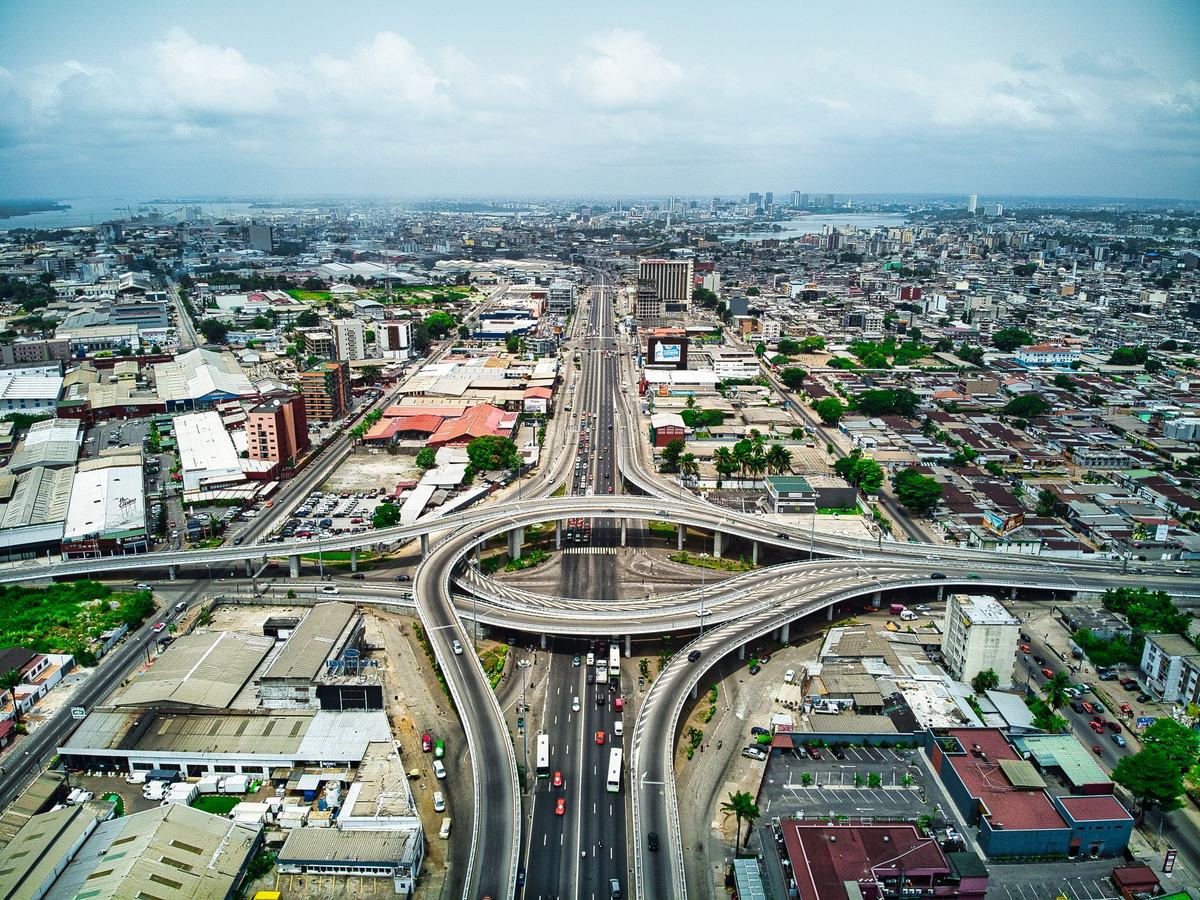
- Capital: Yamoussoukro is the official political capital, Abidjan is the economic capital and largest city [1]
- Population: about 31 million [2]
- Area: 322,463 square kilometers (about 124,504 square miles), roughly the size of New Mexico [1]
- Official language: French [1]
- Currency: West African CFA franc (XOF) [3]
- Distinguishing claim: The world's largest producer of cocoa beans, supplying over 40% of global output [3]
Every time you eat a chocolate bar, there's about a 40% chance the cocoa came from a single country in West Africa. I learned that one afternoon flipping through a coffee table book on global agriculture, and it stopped me cold. Cote d'Ivoire. A place I could not have placed on a map at twelve years old, quietly powering most of the world's chocolate aisle. The deeper you look into this country, the more it works like that. One small story turns out to be enormous, and nobody talks about it.
The Cocoa Capital of the World
Cote d'Ivoire produces roughly 2 million tons of cocoa beans every year, which works out to more than 40% of the global supply [3]. Together with neighboring Ghana, the two countries account for about two thirds of all the cocoa traded on Earth. If you are eating chocolate right now, mathematically, the odds favor an Ivorian cocoa farmer. The crop only arrived from South America in the late 1800s, and the country built an entire economy around it within a few decades.
Here's the thing about all that cocoa. The farmers themselves see a tiny fraction of what a finished chocolate bar sells for. Most of the value gets added in Europe and North America, where the beans are roasted, ground, sweetened, and packaged. In recent years, the Ivorian government has worked with Ghana to set a minimum price for cocoa beans, trying to capture more of the value at the source. The work is slow, and global commodity markets do what they want, but the effort is real.
A Capital Most People Have Never Heard Of
Most maps still show Abidjan as the capital of Cote d'Ivoire. It is the country's economic engine, its biggest city, the place every embassy actually operates from. But the official political capital, on paper since 1983, is Yamoussoukro - a much smaller city about 240 kilometers inland. The reason is personal. Yamoussoukro was the home village of Felix Houphouet-Boigny, the country's first president, who decided to elevate his birthplace into the seat of government [4].
The result is a strange split. Abidjan has the skyline, the lagoon, the markets, the traffic, and the energy of a major African metropolis with around 5 million people. Yamoussoukro has wide boulevards, a presidential palace surrounded by a moat full of crocodiles, and a cathedral so big it shows up on every list of architectural superlatives. Which brings us to the next thing.
The Largest Church on Earth
In a town of fewer than 300,000 people, Houphouet-Boigny built the Basilica of Our Lady of Peace of Yamoussoukro. Consecrated by Pope John Paul II in 1990, it holds the Guinness World Record as the largest church in the world by area, larger than St. Peter's in Rome [5]. The dome rises about 158 meters. The interior holds 7,000 worshippers seated, with another 11,000 standing in the plaza outside.
I had to look this up twice. A basilica that rivals the Vatican, sitting in the middle of West Africa, in a country that is mostly Muslim and traditional religions. The cost was estimated at around 300 million dollars in the 1980s, paid largely from the president's personal fortune, and the controversy at the time was loud. Today it functions as a working Catholic cathedral and a stop on a lot of unusual itineraries.
French, Plus Sixty Other Languages
French is the official language, a holdover from colonial rule that ended in 1960. It is the language of school, government, and business. But step into any market in Bouake or San-Pedro, and you will hear something else. Cote d'Ivoire has more than 60 indigenous languages spoken across its borders, grouped into four major families: Akan, Mande, Gur, and Kru [1]. Dyula functions as a common trade language across much of the north and west.
Most Ivorians grow up multilingual without making a big deal of it. A vendor might switch from French to Dyula to Baoule to Bete in the span of a single conversation, depending on who walks up to the stall. Back home in Montana, knowing one extra language past English felt like a special skill. In Abidjan it is just Tuesday.
Football, Coffee, and the Ivorian Economy
Beyond cocoa, Cote d'Ivoire is one of the world's top producers of cashews and a major exporter of coffee, palm oil, rubber, and cotton [3]. The country has a more diversified agricultural economy than many of its neighbors, and Abidjan serves as the main commercial port for several landlocked nations to the north.
Football, though, might be where Cote d'Ivoire is best known internationally. The Elephants, as the national team is called, won the Africa Cup of Nations in 1992, 2015, and 2024. Ivorian players like Didier Drogba, Yaya Toure, and Kolo Toure became global stars in European leagues. Drogba in particular is a national hero - he is widely credited with helping pause the country's civil war in 2005 by appealing for peace on live television after the team qualified for the World Cup. A footballer talking, and the fighting actually slowed. That happened.
Lagoons, Forests, and Mont Nimba
Geographically, Cote d'Ivoire packs a lot into one country. The southern coast is a string of lagoons and beaches along the Gulf of Guinea, with Abidjan built around the Ebrie Lagoon. Move inland and you pass through dense rainforest, then savanna, then the highlands of the west. Mont Nimba sits on the border with Guinea and Liberia and is a UNESCO World Heritage Site for its unique mountain ecosystem [5].
Tai National Park, also a World Heritage Site, protects one of the last large blocks of primary rainforest in West Africa. It shelters chimpanzees, pygmy hippopotamuses, and forest elephants, all of them rare elsewhere in the region. Conservation work in Cote d'Ivoire is hard - logging and cocoa farming have eaten into the forests for decades - but Tai still stands as proof of what was once everywhere.
Frequently Asked Questions
What language do they speak in Cote d'Ivoire?
French is the official language and is used in government, schools, and business. Most Ivorians also speak one or more of about 60 indigenous languages, including Dyula, Baoule, Bete, and Senufo. Dyula is widely used as a common trade language, especially in the north and in markets.
What is the capital of Cote d'Ivoire?
Yamoussoukro has been the official political capital since 1983, but Abidjan remains the largest city, the economic hub, and where most embassies and government activity actually take place. The capital was moved to honor President Felix Houphouet-Boigny's home village.
Why is Cote d'Ivoire famous for cocoa?
Cote d'Ivoire is the world's largest producer of cocoa beans, supplying more than 40% of global output. Cocoa was introduced from South America in the late 1800s and became the backbone of the country's agricultural economy. Most of the world's chocolate begins as beans grown on Ivorian smallholder farms.
Is Cote d'Ivoire safe to visit?
Cote d'Ivoire is generally safer today than during the political crises of the 2000s, with Abidjan functioning as a modern, business-oriented city. Petty crime is the most common concern, and travelers should avoid border regions in the north near the Sahel. Most embassies maintain updated travel advisories worth checking before a trip.
What is the religion in Cote d'Ivoire?
Cote d'Ivoire is religiously diverse, with roughly 42% of the population Muslim, 39% Christian, and the remainder following traditional African religions or no religion [1]. Religious coexistence is a long-standing feature of Ivorian society, and major holidays from both Islam and Christianity are observed nationally.