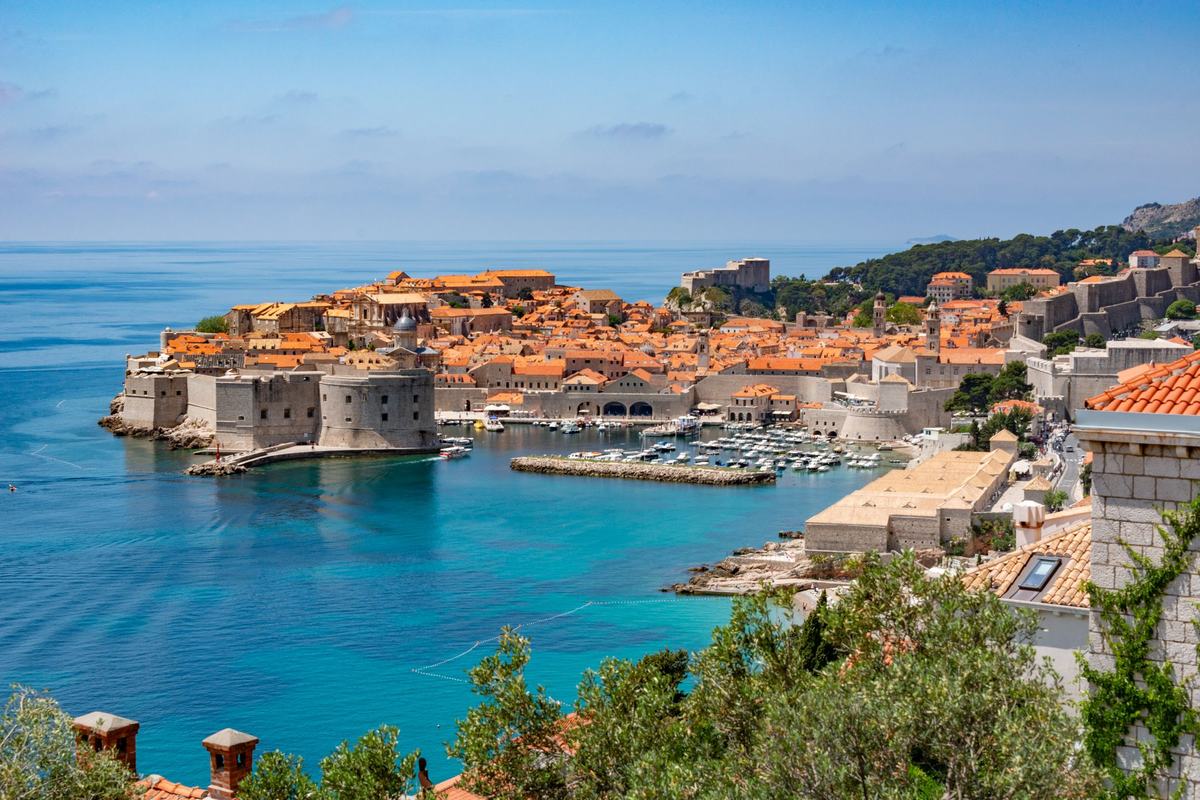
- Capital: Zagreb [1]
- Population: about 3.85 million (2021 census) [2]
- Area: 56,594 square kilometers [1]
- Official language: Croatian [1]
- Currency: Euro (adopted January 1, 2023) [3]
- Coastline: roughly 1,777 km of mainland coast plus over 4,000 km of island coastline along 1,246 islands, islets, and reefs [4]
I had to look this up twice. Croatia, a country smaller than West Virginia, has more than 1,200 islands. Most of them sit empty. You can hire a small boat in Split, point the bow at the horizon, and find a cove where the only sound is your engine cutting out. Back home in Montana we measure space in miles of nothing. Croatia measures it in water.
That ratio of land to sea shapes everything here. The food, the holidays, the way people talk about summer like a person they're waiting on. And the history. Because once you start pulling on the thread of how a small country ended up with this many islands, this much coastline, and this many empires arguing over it, you don't really stop.
A Roman Emperor's Retirement Home Is Now a City Center
In the city of Split, a Roman emperor built a palace to retire to in the year 305 AD. His name was Diocletian, and he liked the spot because it had clean water, defensible walls, and a view. The palace covered about 38,000 square meters, roughly the footprint of a small American college campus.
Here's the thing - people never stopped living in it. After Rome fell, locals moved into the walls and stayed. They built houses inside the old corridors, shops in the gates, churches in the mausoleum. Today around 3,000 people still live inside Diocletian's Palace. Their kids walk to school past columns from the 4th century. There are bars in rooms where Roman soldiers slept. UNESCO put the whole thing on the World Heritage list in 1979 [5].
I keep trying to picture an equivalent and I can't. It's like if someone built a CVS inside the Lincoln Memorial and nobody minded because their family had been running it for forty generations.
Croatia Invented the Necktie
You can blame Croatia for every miserable man pulling at his collar before a wedding. The necktie, that strip of cloth Western men have worn for almost four hundred years, started with Croatian soldiers.
In the 1630s, Croatian mercenaries serving in France wore knotted scarves around their necks as part of their uniform. The French nobility thought this looked sharp. King Louis XIV picked it up. The French called the style "à la croate" - in the Croatian way. That phrase eventually got mangled into "cravate", which is still the French word for necktie [6].
So when you put on a tie for a job interview, you're wearing a 17th-century Croatian military uniform with the volume turned way down. Croatia knows this and leans into it. October 18 is Cravat Day in Zagreb, and they once tied a giant orange necktie around the Roman amphitheater in Pula for the occasion.
Eight National Parks in a Country You Can Drive Across in a Day
Croatia has eight national parks, and they cover about eight percent of the country. The most famous is Plitvice Lakes - sixteen terraced lakes connected by waterfalls, the water turning that impossible turquoise that looks Photoshopped in person. Plitvice has been a UNESCO World Heritage site since 1979 [7].
What surprised me is how different the parks are from each other. Plitvice is freshwater forest. Krka is more open, with travertine cascades you can sometimes swim near. Kornati is a maze of bare limestone islands sticking out of the Adriatic like a dropped puzzle. Paklenica is a vertical canyon for climbers. Brijuni is where Marshal Tito kept his private zoo, complete with elephants other world leaders gave him as gifts.
Drive from Zagreb to Dubrovnik and you cross half the country, but you also cross several different ecosystems and a stretch of Bosnia in between. Croatia is shaped like a boomerang or a crescent depending on who you ask, and that weird geography means a small country contains a lot of different versions of itself.
A Language with Three Genders, Seven Cases, and a Reasonable Alphabet
Croatian is a Slavic language. It has seven grammatical cases, three genders, and verbs that change form depending on whether the action is finished or ongoing. Tourists who try to learn a few phrases on the plane usually surrender by the time they land.
But here's the trade-off. The Croatian alphabet is almost perfectly phonetic. Every letter makes one sound, every time. The letter č is always "ch". The letter š is always "sh". Once you learn the 30 letters, you can pronounce any Croatian word, even ones you've never seen. American English, by comparison, has the same five vowels doing twenty different jobs and a "gh" that sounds like "f" sometimes for no reason at all.
Croatian also gave the world some words you might not expect. "Dalmatian", the spotted dog, is named after the Dalmatian coast. "Vampire" came into English from Slavic folklore that includes Croatian sources. "Kuna", the old Croatian currency until 2023, is the word for marten, an animal whose fur was used as currency in the medieval Balkans.
The Sea Has 11 Different Officially Recognized Shades of Blue
Okay, I'm exaggerating slightly. There isn't a government list. But Croatian fishermen and sailors have a vocabulary for the Adriatic that English doesn't really have an equivalent for. The water changes color based on depth, time of day, the limestone bottom, and how much wind has stirred the bottom up.
The Adriatic along the Croatian coast is one of the cleanest seas in Europe. The European Environment Agency consistently rates Croatia at or near the top for bathing water quality, with around 99 percent of monitored sites meeting the highest "excellent" standard [8]. That's part of why the islands matter so much. Each one is essentially a tiny self-contained ecosystem with its own beach, its own family-run konoba serving grilled fish, and its own local olive oil that someone will tell you is the best in the country.
The longest sea route between two inhabited Croatian islands runs through the Pelješac Peninsula and the islands of Korčula, Mljet, and Lastovo. Lastovo is so far out that for decades during the Yugoslav era it was closed to foreigners because the military used it as a strategic outpost. Now you can rent a house there for the summer, and the night sky is dark enough that the Milky Way looks painted on.
A History of Being Owned by Other People
Croatia became an independent country in 1991, but the land has been governed by somebody else for most of recorded history. Romans, Byzantines, Venetians, Habsburgs, Ottomans on the edges, the Kingdom of Yugoslavia, then socialist Yugoslavia under Tito. Independence came at the cost of a brutal four-year war that ended in 1995.
You see the layers everywhere if you know where to look. Venetian lions carved over doorways in Dalmatian towns. Habsburg yellow on the apartment buildings in Zagreb. Ottoman-influenced sweets in Slavonia. The Italian and German you'll hear from older Croats in Istria. A bilingual sign in Pula switching between Croatian and Italian without comment.
Which, if you think about it, is part of why the country feels older than its 1991 founding date. The state is young. The place is ancient.
Frequently Asked Questions
What is Croatia famous for?
Croatia is best known for its Adriatic coastline, more than 1,200 islands, and well-preserved Roman ruins like Diocletian's Palace in Split. It also gave the world the necktie and is home to eight national parks, including Plitvice Lakes.
Is Croatia part of the European Union?
Yes. Croatia joined the European Union on July 1, 2013, becoming the bloc's 28th member state. It also joined the Schengen Area and adopted the euro on January 1, 2023, replacing the Croatian kuna as the official currency.
What language do they speak in Croatia?
Croatian is the official language and is spoken by the vast majority of the population. It uses the Latin alphabet with 30 letters and is closely related to Serbian, Bosnian, and Montenegrin. English is widely spoken in tourist areas, especially among younger Croatians.
When is the best time to visit Croatia?
May, June, and September are typically considered the best months to visit Croatia. The weather is warm, the sea is swimmable, and the crowds are thinner than in July and August, when coastal towns and national parks reach their busiest point.
Is Croatia a safe country?
Croatia is one of the safer countries in Europe for both residents and travelers, with low rates of violent crime according to international indices. Petty theft can occur in tourist hotspots in summer, but overall safety levels are comparable to those in Western European destinations.
Sources
- The World Factbook: Croatia (CIA)
- Croatian Bureau of Statistics: 2021 Census Results
- European Central Bank: Croatia and the euro
- Croatian Ministry of Tourism: Islands of Croatia
- UNESCO World Heritage: Historical Complex of Split with the Palace of Diocletian
- Academia Cravatica: History of the Cravat
- UNESCO World Heritage: Plitvice Lakes National Park
- European Environment Agency: European bathing water quality report