- Capital: Nicosia (the last divided capital city in the world) [1]
- Population: about 1.26 million [2]
- Area: 9,251 square kilometers, the third largest island in the Mediterranean [1]
- Official languages: Greek and Turkish [1]
- Currency: Euro (since 2008 in the south); Turkish lira in the north [3]
- One claim to fame: birthplace of the goddess Aphrodite according to Greek mythology [4]
Most people think of Cyprus as a beach holiday with cheap flights from London. That is part of the story, sure, but it leaves out the parts that actually stick with you. This is an island where you can stand on a UN-patrolled buffer zone in the middle of a capital city, eat a cheese that squeaks when you bite it, and visit a rock where a goddess is said to have walked out of the sea. All in one afternoon. I had to look this up twice when I first read it, but Cyprus has been continuously inhabited for about 10,000 years, which means people were making things and trading things on this island before the wheel was a common technology. Here's what makes Cyprus more than a flight deal.
A Capital Cut in Half
Nicosia is the only capital in the world still split between two countries by a wall. Walk down Ledra Street in the Greek-speaking south and you can cross a checkpoint, show your passport, and step into the Turkish-speaking north a minute later [1]. The dividing line is called the Green Line. It was drawn in 1964 by a British general using a green chinagraph pencil on a map, which is how it got its name.
The division goes back to 1974, when Turkey invaded the northern third of the island following a Greek-backed coup attempt. The United Nations established a buffer zone that runs roughly 180 kilometers across the entire island [5]. In some places it is a few meters wide. In Nicosia it cuts through neighborhoods, leaving abandoned houses and rusting cars frozen in the summer of 1974. The Republic of Cyprus, recognized internationally, controls the south. The north is governed by the Turkish Republic of Northern Cyprus, which only Turkey recognizes.
Cypriots on both sides have lived with this for fifty years. There have been talks. There have been near-deals. The 2004 Annan Plan referendum failed, and the line is still there. But you can cross it now, which was not always true.
The Birthplace of Aphrodite
Drive west from Limassol along the southern coast and you will come to a stretch of pebbly beach where a single jagged rock rises out of the sea. This is Petra tou Romiou. Greek mythology says Aphrodite, the goddess of love, was born from the sea foam right here [4]. Pilgrims came for centuries to bathe in the water and ask for beauty or fertility.
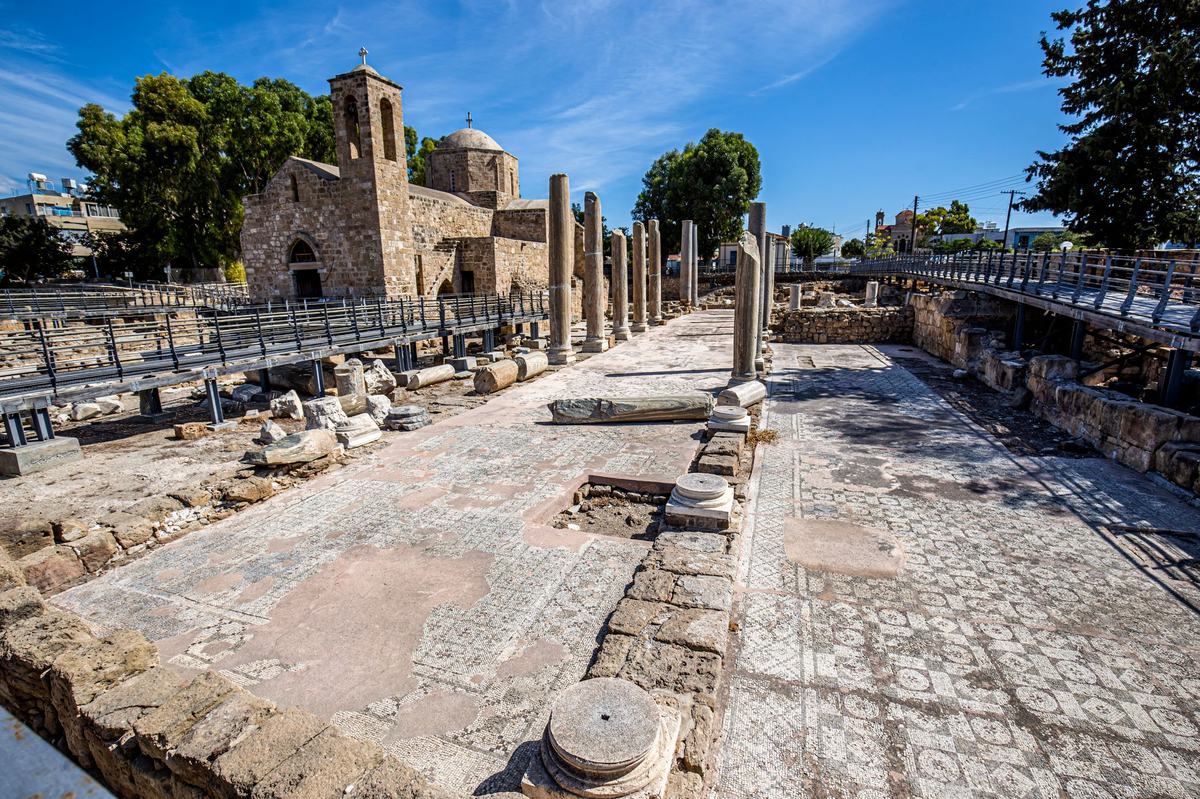
The cult of Aphrodite was a real thing on Cyprus for a very long time. The ruins of her main temple at Palaipafos were a major pilgrimage site for over 1,500 years, from around 1200 BCE into the late Roman period [6]. The site is now part of a UNESCO World Heritage listing along with Kato Pafos, where you can see Roman mosaics that are some of the best preserved in the eastern Mediterranean.
Cyprus also gave the world the word "copper". The Latin word "cuprum" comes from "aes Cyprium", meaning "metal of Cyprus", because the island was the ancient world's main copper supplier. Mining went on here for over 4,000 years. There is a town in the north still called Skouriotissa, where copper was extracted into the twentieth century.
Halloumi and the Cheese That Squeaks
If you have eaten halloumi at a restaurant anywhere in the last decade, you have eaten something with strong opinions attached to it. Halloumi is a semi-hard, brined cheese traditionally made from a mix of sheep and goat milk, sometimes with a little cow milk added. It has a high melting point, which is why you can grill it without it collapsing into a puddle. Bite into it warm and it squeaks against your teeth.
The European Union granted halloumi Protected Designation of Origin status in 2021, meaning only cheese made in Cyprus to the traditional recipe can legally be called halloumi within the EU [7]. This was a big deal. Halloumi is one of Cyprus's largest export products, and the recipe is genuinely old. References to a Cypriot cheese matching its description go back to the medieval period.
The cheese is folded into a half-moon shape with a sprig of mint tucked inside before brining. That mint is not optional in the traditional version, though commercial producers often skip it. In village kitchens, women still make halloumi at home in big copper pots over wood fires. The whey left over from cheese-making becomes anari, a soft fresh cheese eaten with honey for breakfast. Nothing wasted.
A Mountain Range with Painted Churches
The Troodos Mountains in the center of the island climb to Mount Olympus at 1,952 meters. In winter, you can ski here. By summer the same slopes are covered in pine forest and apple orchards. The mountains keep the cooler villages alive in the heat, which is why most Cypriots have a relative with a stone house in some hill village they retreat to in August.
What pulled me into this part of Cyprus was the churches. Tucked into the Troodos villages are ten small Byzantine churches collectively listed as a UNESCO World Heritage Site [6]. From the outside, several of them look like simple wooden barns with steep tile roofs. Step inside and the entire interior is painted with frescoes from the eleventh through the seventeenth centuries. The colors are still vivid. The faces of saints look back at you from walls that have been there longer than most countries.
These mountain villages also produce the wine. Cyprus has been making wine for at least 5,000 years, which makes it one of the oldest wine-producing places in the world [8]. The signature wine is Commandaria, a sweet dessert wine made from sun-dried grapes. It was a favorite of Crusader knights and is sometimes called the oldest named wine in continuous production.
A Climate That Bends Time
Cyprus has roughly 340 days of sunshine a year, one of the highest counts in Europe [9]. Summers are hot and dry, often hitting 40 Celsius inland, while winters along the coast stay mild enough that the cafés never really close their patios. This climate has shaped almost everything about how Cypriots live.
It also means harvest is staggered. Citrus comes in winter, almonds in spring, grapes and olives in fall. There is rarely a month with nothing being picked. The Akamas peninsula in the northwest is wild scrubland and one of the last nesting grounds in the Mediterranean for green and loggerhead sea turtles. Volunteers patrol the beaches at night during nesting season to protect the eggs.
Back home in Montana, the seasons hit hard and clean. Cyprus has its own pattern, slower and more layered, where summer drags on into October and the first rain of the year is something everyone notices.
Frequently Asked Questions
Is Cyprus part of Europe?
Cyprus has been a member of the European Union since 2004. Geographically it sits in the eastern Mediterranean, closer to Syria and Turkey than to mainland Europe, but politically and culturally it identifies with Europe and uses the euro in the south.
What language do they speak in Cyprus?
The two official languages are Greek and Turkish. Greek is spoken in the south by the majority of Cypriots, while Turkish is spoken in the north. English is widely understood thanks to the British colonial period and the strong tourism industry.
Can you cross between North and South Cyprus?
Yes. Since 2003, several checkpoints across the buffer zone allow tourists and Cypriots to cross with a passport or ID card. The crossings in central Nicosia are the most popular for day visits.
What is Cyprus famous for?
Cyprus is famous for halloumi cheese, ancient archaeological sites linked to the goddess Aphrodite, the painted Byzantine churches of Troodos, Commandaria wine, and the divided capital of Nicosia. It is also a popular Mediterranean beach destination.
How big is Cyprus?
Cyprus covers 9,251 square kilometers, making it the third largest island in the Mediterranean after Sicily and Sardinia. It is slightly smaller than the US state of Connecticut.
Sources
- CIA World Factbook: Cyprus
- World Bank: Cyprus Country Data
- European Central Bank: Cyprus and the Euro
- Encyclopaedia Britannica: Aphrodite
- United Nations Peacekeeping: UNFICYP Mandate
- UNESCO World Heritage: Cyprus Sites
- European Commission: Halloumi PDO Registration
- Wines of Cyprus: Cypriot Wine History
- Cyprus Department of Meteorology: Climate of Cyprus