- Capital: Pyongyang (population about 3.04 million) [1]
- Total population: roughly 25.7 million [1]
- Area: 120,538 square kilometers (a little smaller than Mississippi) [1]
- Official language: Korean
- Currency: North Korean won (KPW)
- Official calendar: Juche, which counts years from the 1912 birth of Kim Il Sung [2]
I had to look this up twice. In North Korea, the year is not what your phone says it is. The official Juche calendar starts in 1912, the year national founder Kim Il Sung was born, so on government documents and newspapers, the year you are reading this is Juche 115. The Gregorian year still appears beside it, but the Juche year is the one that matters domestically [2]. It is the kind of detail that tells you everything about how the country sees itself. Most nations measure themselves against the world. North Korea measures the world against itself.
A Closed Country in a Connected World
The Democratic People's Republic of Korea, the formal name on the UN roster, sits on the northern half of the Korean peninsula and shares a border with China, Russia, and South Korea. Of those three borders, only the Chinese one sees real human traffic. The 38th parallel, the line dividing North and South, is the most heavily fortified border on the planet, with about two million land mines, watchtowers every few hundred yards, and a four-kilometer-wide demilitarized zone that is, despite the name, anything but [3].
What makes the country unusual is not just the border. It is the information seal. Ordinary North Koreans cannot access the global internet. They have a domestic intranet called Kwangmyong, which contains a few thousand approved sites and no outside connection [4]. Foreign radio is jammed. Foreign films circulate on smuggled USB sticks at real personal risk. For a country in the middle of the 21st century, the information environment looks more like the Cold War than anything else on Earth.
The World's Largest Stadium
Here is something that'll ruin the next geography quiz you take. The largest stadium in the world by capacity is not in Texas, not in Brazil, not at a Premier League ground in England. It is Rungrado May Day Stadium in Pyongyang, with a listed capacity of 114,000 [5]. It opened in 1989 to host the World Festival of Youth and Students, which the country threw partly as a response to the 1988 Seoul Olympics in the South.
The stadium is best known for the Mass Games, also called Arirang, a synchronized performance involving up to 100,000 participants on the field and in the stands. The stand sections form a giant living mosaic, where each person flips colored cards on cue. From the field it looks like a screen the size of a city block, and the image changes every few seconds. It is one of those things that makes you sit down for a minute when you realize the scale.
The Empty Hotel That Defines a Skyline
Pyongyang's skyline is dominated by a 105-story pyramid called the Ryugyong Hotel. It started construction in 1987, was supposed to open in 1989, and has never operated as a hotel [6]. The frame went up, the country ran out of money during the 1990s famine, and for years it stood as a bare concrete shell. In 2011, contractors finally clad the exterior in glass and LED panels, and at night it now lights up the city. The interior, by most accounts, remains largely unfinished. It is the tallest unoccupied building in the world.
A Famine That Shaped a Generation
The mid-1990s were catastrophic. A combination of failed harvests, the collapse of Soviet aid, and rigid central planning produced a famine that killed somewhere between 600,000 and 2.5 million people, depending on whose estimate you trust [7]. Inside the country, it is referred to as the Arduous March. Defectors from that generation are noticeably shorter than their South Korean counterparts of the same age. South Korean researchers studying refugees have measured height gaps of several inches between adults born in the North and those born in the South in the same years [7]. Same DNA. Different countries. Different food.
A Family That Owns a State
Three generations of one family have ruled the country since its founding in 1948. Kim Il Sung, the founder, is officially the Eternal President of the Republic, even though he died in 1994 [2]. His son Kim Jong Il ran the country until his own death in 2011. His grandson Kim Jong Un has run it since. No other modern state has built a hereditary leadership structure quite like this, and the constitution is written to keep it that way.
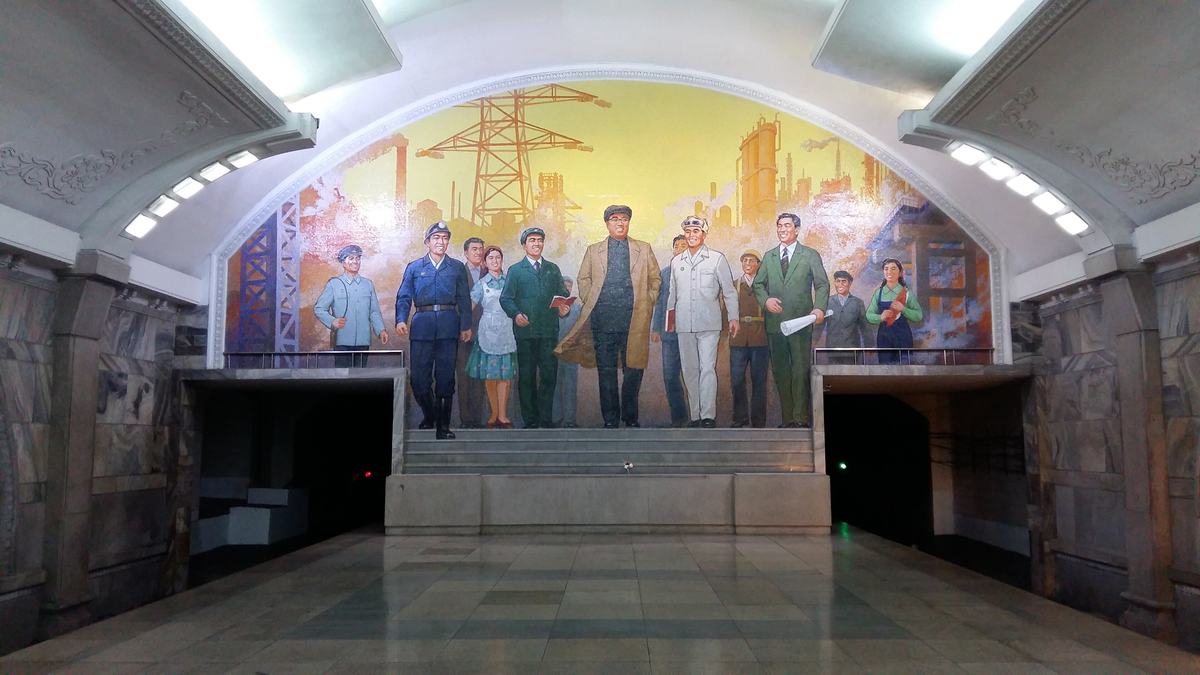
Pyongyang has more than 35,000 statues, monuments, and murals dedicated to the family, by some scholarly counts [8]. The two largest, the bronze statues of Kim Il Sung and Kim Jong Il at Mansudae, are roughly 70 feet tall. Citizens bow on holidays. Foreign visitors are expected to as well.
A Different Kind of Tourism
A few thousand foreign tourists visit each year, almost all on guided tours that route them through Pyongyang and a small handful of approved sites. You cannot wander. You cannot photograph the wrong building. Your phone is not on a foreign network because there is no foreign roaming agreement. There is a domestic mobile network called Koryolink, used by a couple of million North Koreans, but it cannot call out of the country [4]. American passport holders have not been allowed in since 2017, after the death of Otto Warmbier following his detention.
The strange thing tourists who have been there always mention is the silence in Pyongyang. A capital of three million people, and the streets are quiet because there are very few private cars. Bicycles, trolleys, the occasional government vehicle. It is what an American downtown might have sounded like in 1955.
Frequently Asked Questions
What is North Korea's official name?
The official name is the Democratic People's Republic of Korea, often abbreviated as DPRK. The country was founded on September 9, 1948, and the name reflects its self-description as a democratic socialist republic. South Korea, by contrast, is officially the Republic of Korea.
How many people live in North Korea?
About 25.7 million people live in North Korea, according to United Nations population estimates. Roughly 3 million live in the capital, Pyongyang. The country is far less populous than South Korea, which has about 51 million people in a similar land area.
Can tourists visit North Korea?
Foreign tourists from most countries can visit North Korea on guided tours, almost always run through Beijing-based agencies. United States passport holders have been barred from entering since September 2017. Independent travel is not permitted, and visitors are accompanied by government-assigned guides at all times.
What language is spoken in North Korea?
Korean is the sole official language. The Northern dialect has diverged from Southern Korean over seventy years of separation and uses fewer English loanwords. The two versions remain mutually intelligible, but vocabulary, accent, and even some grammar have drifted apart enough that defectors often need a few months to adjust.
What is the Juche calendar?
The Juche calendar is North Korea's official calendar, which counts years from 1912, the birth year of national founder Kim Il Sung. So 1912 is Juche 1, 2012 is Juche 101, and so on. It appears on government documents and newspapers alongside the Gregorian year, which is still in use for international purposes.
Sources
- United Nations Statistics Division: DPRK Country Profile
- Britannica: North Korea
- BBC News: The Korean Demilitarized Zone
- Reuters: Inside North Korea's Closed Internet
- World Atlas: Largest Stadiums in the World
- CNN: The Ryugyong Hotel
- Human Rights Watch: North Korea Famine Report
- The Guardian: North Korea's Cult of Personality