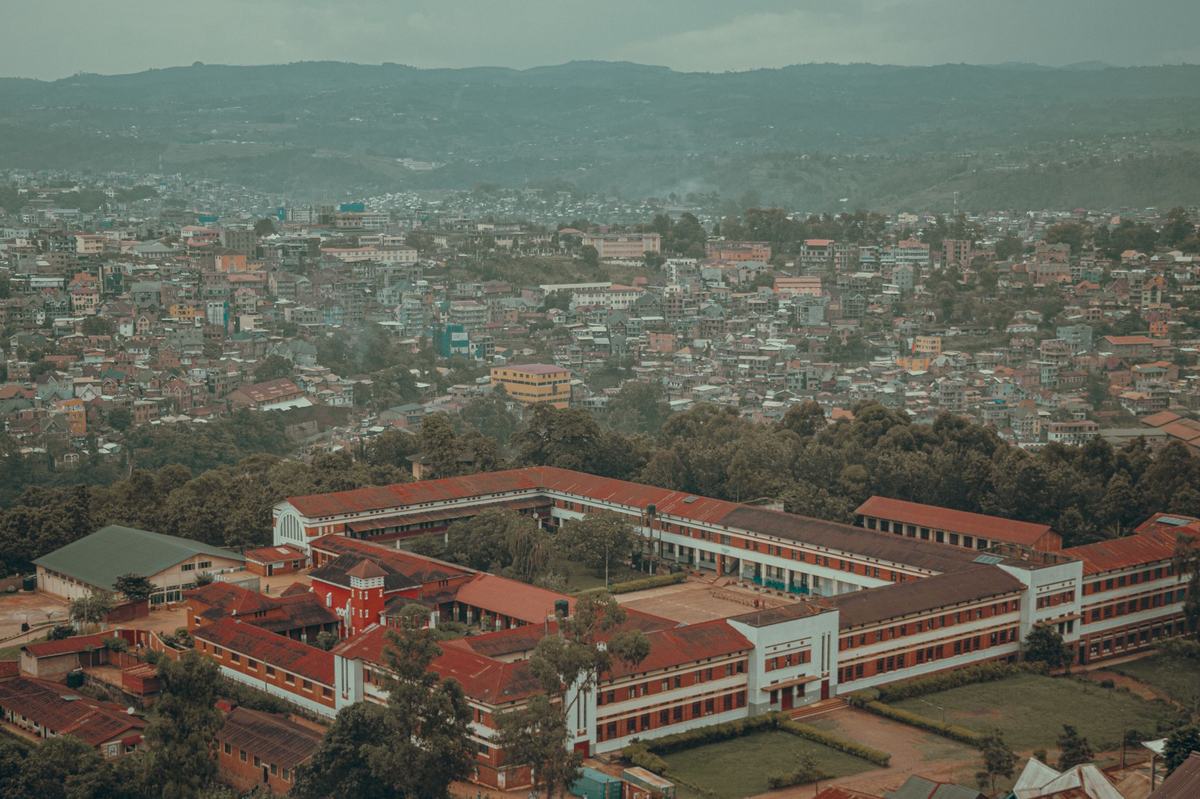
- Capital: Kinshasa (population roughly 17 million in the metro area, the largest French-speaking city on Earth) [1]
- Total population: about 109 million, making it the fourth most populous country in Africa [1]
- Area: 2,344,858 square kilometers, the second largest country in Africa [1]
- Official language: French, with four national languages (Lingala, Kikongo, Swahili, Tshiluba)
- Currency: Congolese franc (CDF)
- Holds an estimated 70 percent of global cobalt reserves [2]
I had to look this up twice. The Democratic Republic of the Congo is so big you could fit Texas inside it three times and still have room left over for a couple of Midwestern states. It sits in the dead center of the African continent, straddles the equator, and contains the second largest rainforest on the planet after the Amazon. And yet most Americans I know could not point to it on a map. Here is the thing. The cobalt in the lithium-ion battery of the phone in your hand right now almost certainly came from a hole in the ground in southern Congo. The country is invisible to most of us, and at the same time, it is in our pockets every minute of every day.
A Land the Size of Western Europe
The DRC, sometimes shortened to DR Congo or Congo-Kinshasa to distinguish it from its smaller neighbor across the river, covers 2.34 million square kilometers [1]. That is bigger than France, Germany, Spain, Sweden, and Norway combined. It shares borders with nine countries, the most of any African nation, and runs from the Atlantic coast in the west to the Great Rift Valley in the east. The Congo River, the second longest in Africa and the deepest in the world, drops about 220 meters at its mouth and pushes a freshwater plume far out into the Atlantic [3].
The river is also the country's spine. There are still parts of central Congo where the river is the only practical way to move people and goods, because the road network never recovered from the colonial period and decades of conflict. A barge trip from Kinshasa to Kisangani, around 1,700 kilometers upriver, can take two to three weeks.
The Second Largest Rainforest on Earth
The Congo Basin holds about 1.5 million square kilometers of rainforest inside the DRC, which is more than the country's neighbors combined [4]. After the Amazon, it is the second largest tropical rainforest in the world, and it absorbs roughly 1.5 billion tons of carbon dioxide a year. The basin is home to the bonobo, a great ape that lives nowhere else on Earth, and to the okapi, a striped relative of the giraffe that was unknown to Western science until 1901.
Salonga National Park, set entirely inside this rainforest, is the largest tropical rainforest reserve in Africa and a UNESCO World Heritage Site [5]. To put the scale in plain terms, Salonga alone is bigger than Belgium. Back home in Montana, our biggest national park is Glacier, at about 4,100 square kilometers. Salonga is roughly nine times that size, and it is just one piece of one country's protected land.
The Cobalt in Your Phone
About 70 percent of the world's cobalt reserves sit in the southern Congolese provinces of Lualaba and Haut-Katanga [2]. Cobalt is what keeps lithium-ion batteries from overheating, which makes it essential for smartphones, laptops, and electric vehicles. The DRC also produces a huge share of global tantalum (used in capacitors), copper, and industrial diamonds.
Which, if you think about it, means the global energy transition runs through Congolese rock. The country produced an estimated 220,000 metric tons of cobalt in 2024, more than ten times the next biggest producer [2]. A meaningful share of that comes from artisanal mining, where individual miners dig with hand tools, often in dangerous conditions, and sell to traders who feed into the global supply chain. There is no clean way to talk about this. Your battery and someone else's labor are connected by a chain of trade most consumers never see.
A Country of Many Languages
French is the official language, a holdover from the Belgian colonial period, but it is mostly the language of government, schools, and big cities. In daily life, most Congolese speak one of four national languages: Lingala in the capital and along the river, Swahili in the east, Kikongo in the southwest, and Tshiluba in the central south [6]. There are around 200 additional ethnic languages spoken across the country.
Lingala, in particular, has spread well beyond the country's borders. Congolese rumba, a music style that grew out of Kinshasa and Brazzaville in the 1940s and 1950s, was sung in Lingala and became one of the most popular musical genres on the African continent. UNESCO added Congolese rumba to its list of intangible cultural heritage in 2021.
A Capital That Will Soon Be the Largest City in Africa
Kinshasa already has a metro population of about 17 million people [1]. UN projections suggest it will pass 26 million by 2030 and could be one of the largest cities in the world by mid-century. It sits on the south bank of the Congo River, directly across from Brazzaville, the capital of the Republic of Congo. Those two are the closest pair of capital cities in the world, separated only by the river itself, around 1.5 kilometers wide at that point.
Kinshasa is also a music city. Beyond rumba, it is the heart of soukous, ndombolo, and a hip-hop and gospel scene that exports across the continent. The city has a youthful energy you feel before you read a single statistic about it.
Frequently Asked Questions
Is the Democratic Republic of the Congo the same as the Republic of the Congo?
No. They are two separate countries. The Democratic Republic of the Congo, with its capital Kinshasa, is the larger one and sits east of the Congo River. The Republic of the Congo, with its capital Brazzaville, is the smaller country to the west. The two capitals face each other across the river.
What is the DRC famous for?
The DRC is best known for the Congo River, the Congo Basin rainforest (the second largest on Earth), its rich mineral deposits (especially cobalt and copper), and Congolese rumba music, which UNESCO recognized as intangible cultural heritage in 2021.
What languages do people speak in the DRC?
French is the official language, used in government and schools. The four national languages are Lingala, Swahili, Kikongo, and Tshiluba. About 200 other ethnic languages are spoken across the country, making it one of the most linguistically diverse nations in Africa.
How big is the DRC compared to other countries?
The DRC is the second largest country in Africa, after Algeria, and the eleventh largest in the world. Its 2.34 million square kilometers is roughly the size of Western Europe and about a quarter the size of the United States.