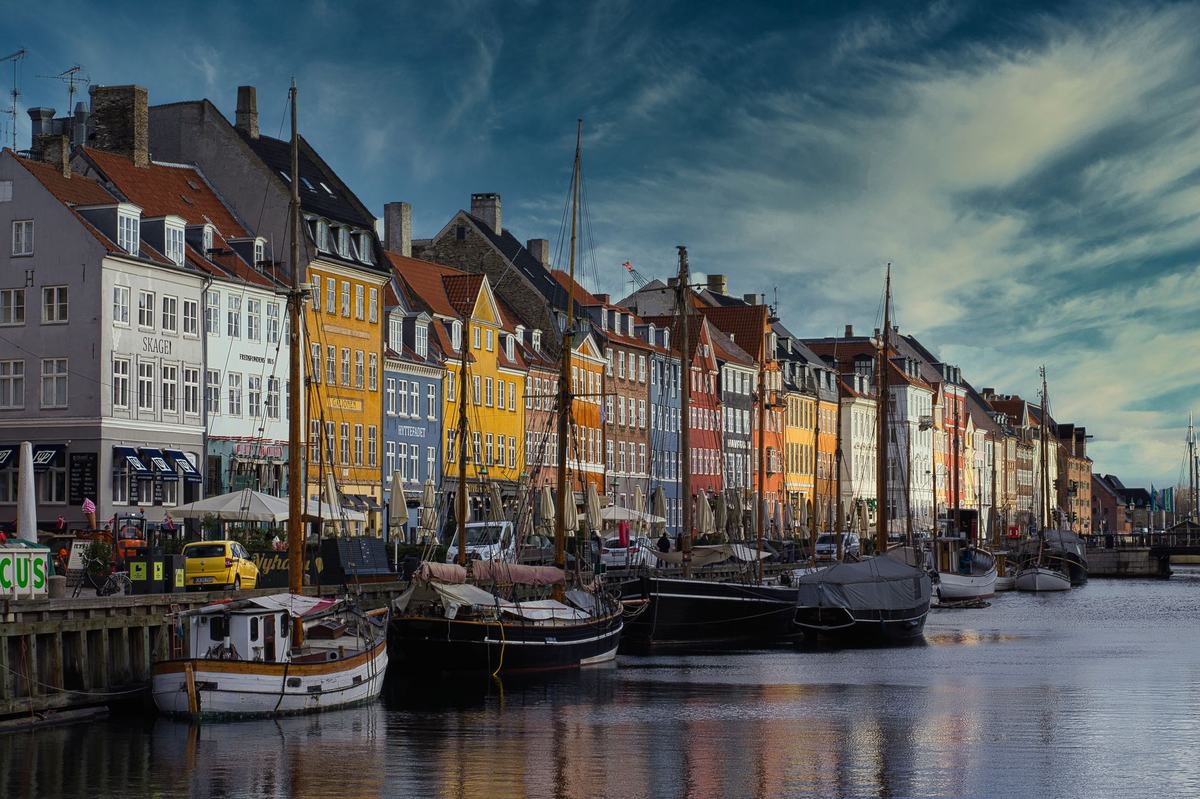
- Capital: Copenhagen (population about 1.4 million in the metro area) [1]
- Total population: roughly 5.97 million [1]
- Area: 42,933 square kilometers (a little smaller than West Virginia) [1]
- Official language: Danish
- Currency: Danish krone (DKK)
- Monarchy: the oldest continuous monarchy in Europe, dating back over 1,100 years to King Gorm the Old [2]
I grew up thinking Denmark was the country with the little mermaid statue and the cookies in the blue tin. Then I started reading and could not stop. This is a country smaller than my home state of Montana that runs the oldest monarchy on the continent, invented Lego, gave us the word for happy coziness that everyone is suddenly trying to import, and somehow keeps showing up at the top of every world happiness ranking like it is no big deal. Denmark is one of those places that quietly outperforms its size in almost every category that matters.
The Oldest Monarchy in Europe
The Danish royal line stretches back to King Gorm the Old in the 10th century, which makes it the oldest continuous monarchy in Europe and one of the oldest in the world [2]. Queen Margrethe II reigned for 52 years before stepping down in January 2024 and handing the crown to her son, King Frederik X. That kind of voluntary abdication is unusual for Danish monarchs. Most of them stay until the end.
The royal family is treated less like distant celebrities and more like extremely well-known neighbors. The Queen used to walk her dog around Copenhagen. The current king grew up in regular schools, served in the Danish navy frogman corps, and married an Australian advertising executive he met at a pub during the 2000 Sydney Olympics. Mary, the Australian, is now Queen of Denmark. Turns out the path to a throne can run through a Sydney bar.
A Flag That Reportedly Fell From the Sky
The Danish flag, the Dannebrog, is the oldest national flag still in use anywhere in the world [3]. The legend says it fell from the sky during a battle in Estonia on June 15, 1219, when King Valdemar II was losing badly. A red banner with a white cross drifted down out of nowhere, the Danes rallied, and they won the day. June 15 is still celebrated in Denmark as Valdemar's Day.
You can argue with the legend, and historians do. What you cannot argue with is the design itself, which has been in continuous use since at least the 14th century. Every Scandinavian country eventually adopted a version of the off-center Nordic cross. Denmark started it.
Copenhagen Bikes More Than It Drives
Here's something that'll ruin the next geography quiz you take. There are more bikes than cars in Copenhagen, and on any given weekday, more than 49 percent of all trips to work or school in the city are made by bicycle [4]. The city has built nearly 400 kilometers of dedicated cycle tracks, separated from the road by a curb, with their own traffic lights and their own snow plows in winter.
This is not a hobby. It is infrastructure. People in suits ride to meetings. Parents pull two kids in front-loading cargo bikes called Christianias. Old people pedal to the grocery store with a baguette in the basket. The city even built a bicycle bridge across the harbor, the Cykelslangen, the Bicycle Snake, that curves through the air like an orange ribbon. It exists because cars were getting in the way of bikes, not the other way around.
Hygge Is Not a Mood, It Is Policy
Every couple of years an English-language lifestyle magazine rediscovers hygge and tries to sell it back to you in the form of candles and chunky throws. Which, if you think about it, kind of misses the point. Hygge, pronounced roughly "hoo-ga", is the Danish word for the cozy contentment of a small, warm gathering. Soft light, good food, people you actually like, no phones. It is the deliberate building of a small pocket of comfort in a country that has long, dark winters.
What is interesting is how seriously it shapes Danish life. Workplaces close early in winter so people can get home before dark. Friday-bar culture in offices is a normal part of the week. The Danish furniture and lighting design tradition, which produced names like Arne Jacobsen and Poul Henningsen, was built around making indoor spaces feel humane during four months of gray. Hygge is not a marketing trend in Denmark. It is closer to a building code.
The Birthplace of Lego
Lego comes from Billund, a small town in Jutland, where a carpenter named Ole Kirk Christiansen started making wooden toys during the Great Depression [5]. He combined two Danish words, "leg godt", meaning "play well", and got Lego. The plastic interlocking brick we know today launched in 1958, and the patent has barely changed since. A brick made in 1958 still snaps perfectly onto one made yesterday.
The numbers are hard to picture. Lego produces around 100 billion bricks a year. There are roughly 80 Lego pieces for every person on Earth. The original Legoland in Billund opened in 1968 and now draws nearly two million visitors a year, more than the population of Copenhagen. Not bad for a town that most maps only label because the airport sits next to the factory.
Always Near the Top of the Happiness Rankings
Denmark has finished in the top three of the World Happiness Report nearly every year since the report began in 2012, and it has been number one multiple times [6]. People always want to know why, and the answer is less about Danes being naturally cheerful and more about systems. Universal healthcare. Free university tuition with student stipends. Strong unions. Generous parental leave shared between both parents. High taxes, but also high trust that the taxes will come back to you in services.
Danes will tell you they are not particularly happy in the sunny, smiling sense. The Danish word for it is closer to satisfaction or contentment. The country does not promise you a great life. It promises you a stable one, with a thick safety net underneath.
Greenland and the Faroe Islands Are Technically Denmark
This one trips up a lot of Americans. Denmark proper is small, but the Kingdom of Denmark also includes Greenland, the largest island in the world, and the Faroe Islands, an archipelago in the North Atlantic. Both are self-governing but sit under the Danish crown for foreign policy and defense [7]. That technically makes Denmark the twelfth largest country in the world by total area, even though the part you can drive across in five hours is one of the smallest in Europe.
Frequently Asked Questions
What is Denmark famous for?
Denmark is famous for the oldest continuous monarchy in Europe, the concept of hygge, Lego, world-class design, and consistently ranking among the world's happiest countries. It is also known for its bicycle culture, especially in Copenhagen, where bikes outnumber cars.
What is the capital of Denmark?
Copenhagen is the capital and largest city of Denmark, with a metropolitan population of about 1.4 million. The city is known for its harbor, royal palaces, the Little Mermaid statue, and one of the most extensive cycling infrastructures in the world.
What language do they speak in Denmark?
Danish is the official language of Denmark, spoken by nearly all residents. English is widely understood, with around 86 percent of Danes speaking it as a second language, making travel in Denmark straightforward for English speakers.
Is Denmark part of the European Union?
Yes, Denmark joined the European Union in 1973. However, it has not adopted the euro and continues to use the Danish krone, with a fixed exchange rate to the euro. Denmark also maintains opt-outs on certain EU policies.
How big is Denmark?
Denmark proper covers about 42,933 square kilometers, slightly smaller than West Virginia. Including Greenland and the Faroe Islands, the Kingdom of Denmark covers more than 2.2 million square kilometers, making it one of the largest sovereign territories in the world.
Sources
- Statistics Denmark - Population and Area
- Royal House of Denmark - History of the Monarchy
- National Museum of Denmark - The Dannebrog
- City of Copenhagen - Bicycle Account
- The LEGO Group - Company History
- World Happiness Report - Country Rankings
- Ministry of Foreign Affairs of Denmark - The Kingdom of Denmark