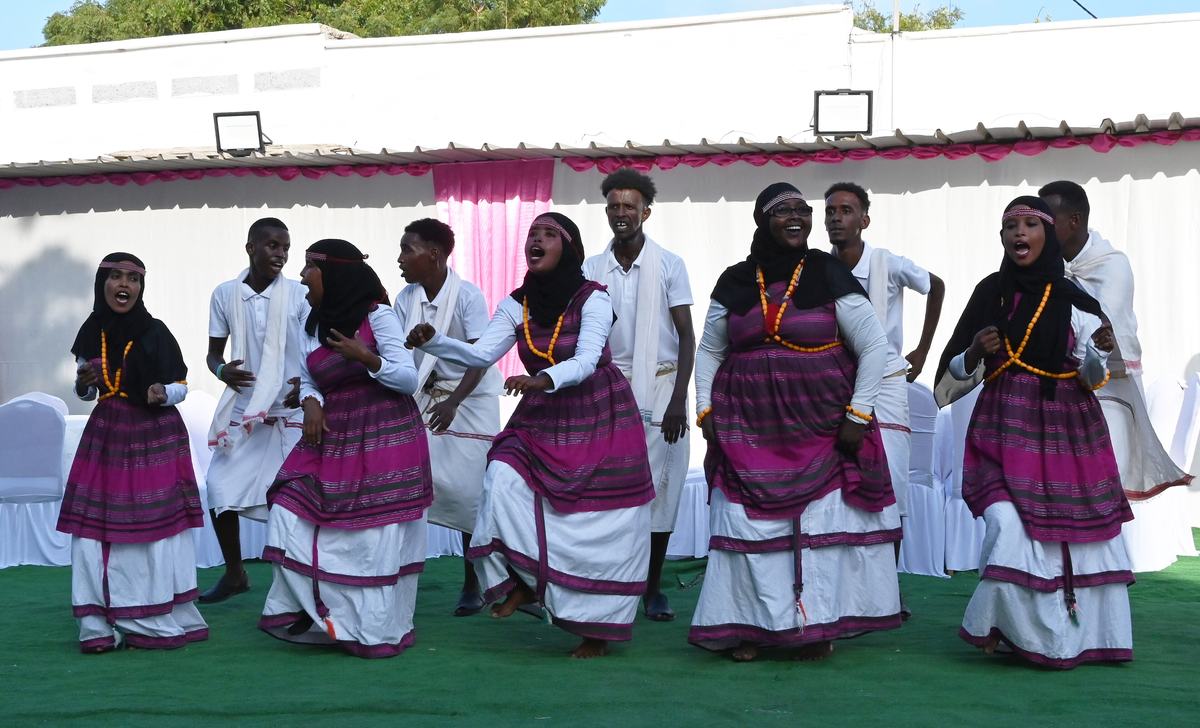
- Capital: Djibouti City (home to about 70 percent of the country's population) [1]
- Total population: roughly 1.1 million [1]
- Area: 23,200 square kilometers (about the size of New Hampshire) [1]
- Official languages: French and Arabic
- Currency: Djiboutian franc (DJF)
- Strategic note: sits on the Bab el-Mandeb strait, where roughly 30 percent of global shipping container traffic passes through [2]
Most people couldn't find Djibouti on a map. That's a shame, because almost everything you wear, eat, or drive past has probably brushed up against this country at some point. It sits at the pinch point between the Red Sea and the Gulf of Aden, where Africa nearly touches the Arabian Peninsula, and that little stretch of water carries a slice of nearly everything the world ships. Djibouti is small, hot, and easy to overlook on a globe, but it has built its entire identity around a piece of geography that the rest of the planet cannot afford to ignore.
A Country Built on a Strait
The Bab el-Mandeb is only about 20 miles wide at its narrowest point, and Djibouti sits right on it. That single fact explains most of the country's modern history. Roughly 30 percent of the world's container shipping and a huge share of the oil moving from the Persian Gulf to Europe squeeze through this strait every year [2]. Cut it off, and global supply chains start to wobble within days.
This is why a country with about 1.1 million people somehow hosts foreign military bases from the United States, France, Japan, Italy, and China, often within a few miles of each other. The American base, Camp Lemonnier, is the only permanent US military base on the African continent. China opened its first overseas military base here in 2017. France has been here since independence. Japan, which has not maintained an overseas base since World War II, made an exception for Djibouti. Turns out you can rent your geography out, and Djibouti has built a real economy around doing exactly that.
Lake Assal Is Lower Than Death Valley
I had to look this up twice. Lake Assal, in the middle of Djibouti, sits 155 meters below sea level. That makes it the lowest point in Africa and the third lowest land surface anywhere on Earth [3]. Death Valley, which I always thought of as the dramatic American answer to "how low can you go", only drops to about 86 meters below sea level. Lake Assal goes nearly twice as deep.
It is also one of the saltiest bodies of water in the world, more salty than the Dead Sea. The shoreline is crusted in white salt that looks like dirty snow from a distance. Caravans of camels still walk in to load up salt slabs the same way traders did centuries ago. The whole place feels like another planet, which is partly why a few science fiction films have used it as a stand-in for one.
One of the Hottest Inhabited Places on Earth
Djibouti's summer is not a metaphor. Temperatures regularly push past 110 degrees Fahrenheit, and in the inland Danakil region, on the border with Eritrea and Ethiopia, the heat can hit 120 degrees with humidity that makes it physically harder to breathe [4]. Average annual temperatures in Djibouti City hover around 86 degrees, which means even the cool months would feel like a Montana heatwave back home.
The country sits at the meeting point of three tectonic plates that are slowly pulling apart, which is why the land is dotted with volcanoes, lava fields, and superheated geothermal vents. Geologists love this place. They come here to study what continental break-up looks like in real time. The Afar Triangle, which Djibouti shares with Ethiopia and Eritrea, is one of the only places on Earth where you can stand on a rift that will, in a few million years, become a new ocean.
A French and Arab and African Country All at Once
Djibouti was a French colony until 1977, which makes it one of the youngest countries in Africa. French is still an official language, the legal system has French roots, and croissants are surprisingly easy to find. But Arabic is also official, the country is a member of the Arab League, and the call to prayer is part of the daily soundtrack in the capital. Most of the population belongs to two ethnic groups, the Somali Issa and the Afar, both with their own languages and long histories that predate any colonial map.
The result is a place where French bakeries sit next to Yemeni fish markets and Somali tea stalls. Lunch might be a baguette with goat stew. Khat, the mild stimulant leaf chewed across the Horn of Africa and southern Arabia, is a daily ritual for a big chunk of the adult population. Khat arrives by truck from Ethiopia every afternoon, and the country effectively pauses for an hour while everyone gets their bundle.
The Port That Lets Ethiopia Reach the Sea
Ethiopia is one of the most populous landlocked countries in the world, with around 130 million people and no coast of its own. About 95 percent of Ethiopia's international trade moves through Djibouti's ports [5]. That single fact has shaped the country's economy more than almost anything else.
A new electrified railway, finished in 2018, runs from Addis Ababa straight to Djibouti's coast. Container ships dock, goods get loaded onto trains, and a few days later they are sitting in warehouses in the Ethiopian highlands. Djibouti also runs one of the most modern free-trade zones in Africa, much of it built with Chinese financing. The whole country is, in a real sense, a port with a nation attached.
Frequently Asked Questions
Where is Djibouti located?
Djibouti is in the Horn of Africa, on the Bab el-Mandeb strait that connects the Red Sea to the Gulf of Aden. It borders Eritrea to the north, Ethiopia to the west and south, and Somalia to the southeast, with Yemen across the water.
What is Djibouti famous for?
Djibouti is famous for hosting foreign military bases from the United States, France, China, Japan, and Italy, and for sitting on one of the world's busiest shipping lanes. It is also known for Lake Assal, the lowest point in Africa.
What languages do they speak in Djibouti?
The official languages of Djibouti are French and Arabic. Most of the population also speaks Somali or Afar at home, and English is increasingly used in business and at the ports. French is still common in government and education.
Is Djibouti a safe country to visit?
Djibouti is generally considered one of the more stable countries in the Horn of Africa, with a functioning government and a strong international military presence. Visitors should still check current travel advisories, as conditions in nearby Somalia and Yemen can affect border regions.
What currency is used in Djibouti?
Djibouti uses the Djiboutian franc, which has been pegged to the US dollar at a fixed rate since 1949. US dollars are widely accepted at hotels, ports, and many businesses, making the country one of the easier places in the region for American travelers to pay for things.