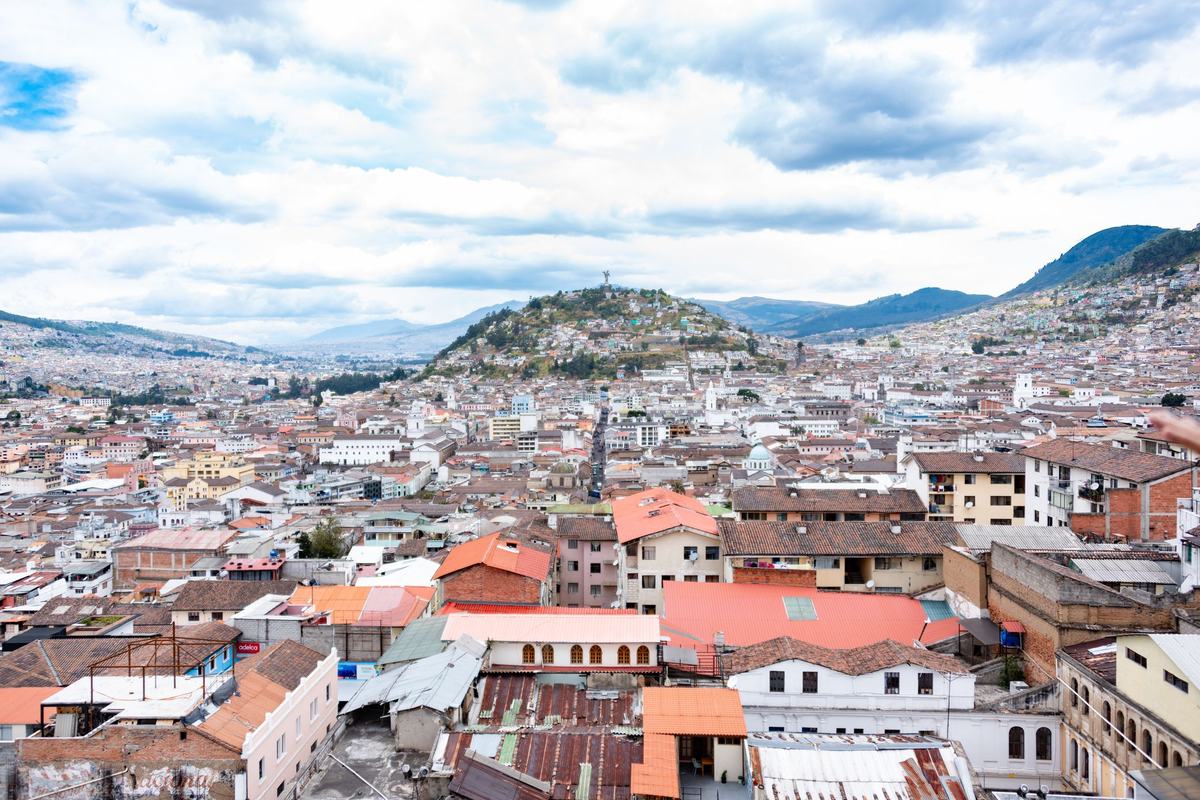
- Capital: Quito, sitting at 9,350 feet above sea level [1]
- Population: about 17.7 million [2]
- Area: 109,484 square miles, roughly the size of Nevada [1]
- Official languages: Spanish, plus Kichwa and Shuar recognized in the constitution [3]
- Currency: US dollar, adopted in 2000 [4]
- The only country in the world named after a geographic line, the equator, that runs straight through it [1]
I grew up thinking the equator was just a dotted line on classroom globes. Then I read about Ecuador and realized there's a whole country down there that built its identity around standing on it. Most countries are named after a tribe, a king, a river, or a saint. Ecuador looked at an imaginary line on a map and said, that's us. There's something both literal and poetic about it, and the more you dig into the place, the more it fits.
A Country Built on a Line
The Spanish word "ecuador" means "equator", and the name was made official in 1830 when the country split from Gran Colombia. Just north of Quito, there's a yellow line painted on the ground at a place called Mitad del Mundo, which means "Middle of the World", where tourists straddle the line for photos. Here's the thing - GPS readings show the actual equator runs about 240 meters north of that monument, in a small site called Intinan. So Ecuador has two equators, one historical and one accurate, and somehow that feels right for a country this layered.
The equator does something practical too. Day and night stay roughly twelve hours each, year round. Sunrise lands around 6 a.m. and sunset around 6 p.m. in every season. Back home in Montana, June nights stretch until almost ten and December swallows the sun by 4:30. In Ecuador, that doesn't happen. The seasons exist, but they're horizontal instead of vertical - you change climates by changing altitude, not by waiting for months to pass.
Four Worlds in One Country
Ecuador packs four distinct ecosystems into a country smaller than the state of Nevada. The Pacific coast in the west, the Andes mountains running through the middle, the Amazon rainforest in the east, and the Galapagos Islands about 600 miles offshore. Ecuadorians call these the Costa, the Sierra, the Oriente, and the Insular regions. You can have breakfast on a humid beach, lunch in a chilly mountain town at 9,000 feet, and dinner where howler monkeys are louder than the rain on the roof, all in one day.
The Andes section is where things get vertical. Cotopaxi, one of the highest active volcanoes in the world at 19,347 feet, sits inside a national park you can drive into. Chimborazo, an extinct volcano further south, has a peculiar claim - because Earth bulges at the equator, the summit of Chimborazo is the farthest point on the planet's surface from the center of the Earth. Higher than Everest in that specific sense. I had to look this up twice. Mount Everest is taller measured from sea level, but Chimborazo wins the geocentric contest by about 1.4 miles.
The Galapagos Changed Everything
In 1835, a 26-year-old Charles Darwin spent five weeks on the Galapagos Islands and noticed that the finches and tortoises looked subtly different from one island to the next. That observation seeded the theory of evolution by natural selection, which he published 24 years later in "On the Origin of Species". The islands belong to Ecuador and sit on the equator in the eastern Pacific, formed by volcanic activity over millions of years.
What's wild about the Galapagos is how the animals act. Sea lions sprawl across park benches in the town of Puerto Ayora. Marine iguanas, the only lizards on Earth that swim and feed in the ocean, sneeze salt out of their nostrils after a dive. Giant tortoises live over 150 years and weigh as much as a small car. None of these animals evolved with humans as a threat, so they don't run. You can sit ten feet from a blue-footed booby doing its mating dance and the bird honestly does not care that you're there. UNESCO named the Galapagos the very first World Heritage Site in 1978, before any other place on Earth got that designation.
Quito and the World's Highest Capital
Quito was the first city ever named a UNESCO World Heritage Site, also in 1978, sharing that opening list with Krakow's old town. The historic center is the largest and best-preserved in the Americas, built on top of an Incan settlement that was burned to keep it from falling into Spanish hands in 1534. The Spanish then built their colonial city right on the ashes, layering one civilization on top of another, with cobblestones and gilded churches and plazas that haven't moved in five centuries.
La Compania de Jesus, a Jesuit church in the old town, contains around seven tons of gold leaf inside it. Walls, ceilings, altars, all of it gilded. It took 160 years to finish. Quito sits at 9,350 feet, making it the second-highest official capital city in the world after La Paz, Bolivia. First-time visitors usually feel the altitude on day one, walking up a small hill and wondering why their lungs are betraying them. Locals drink coca-leaf tea, called mate de coca, which helps with the soroche - the local word for altitude sickness.
The Currency and the Pacific Boundary
In 2000, after a banking collapse and runaway inflation, Ecuador did something unusual - it abandoned its national currency, the sucre, and adopted the US dollar as legal tender. Old sucre coins still circulate as collectibles, but every price tag and bus fare is now in dollars and cents. Which, if you think about it, makes Ecuador one of the few countries where Americans can travel without converting a single dime.
Ecuador also has territorial waters that extend 200 nautical miles from its coast and from the Galapagos, which together cover a chunk of the Pacific bigger than the country's land area. Those waters host humpback whales that migrate north from Antarctica every year between June and September, hammerhead sharks that school in the hundreds, and the largest fish in the ocean, the whale shark. Tourism pamphlets call Ecuador "four worlds in one". That's marketing, but it's also accurate.
Frequently Asked Questions
What is Ecuador best known for?
Ecuador is best known for the Galapagos Islands, where Charles Darwin developed his theory of evolution, and for being the only country named after the equator. It also contains a slice of the Amazon, the high-altitude capital of Quito, and Andean volcanoes including Cotopaxi and Chimborazo.
What language do they speak in Ecuador?
Spanish is the official language and the most widely spoken. Ecuador's constitution also recognizes Kichwa and Shuar as official languages of intercultural relations, and around 14 indigenous languages are used in different regions, especially in the Amazon basin and the highlands.
Is Ecuador safe to visit?
Most tourist areas in Ecuador, including Quito's old town, the Galapagos, Cuenca, and Banos, are considered safe for visitors who take normal precautions. Petty theft happens in crowded places, and certain border regions with Colombia are advised against. Travelers should check current government advisories before booking.
Why does Ecuador use the US dollar?
Ecuador adopted the US dollar in 2000 after a severe banking crisis caused its currency, the sucre, to collapse. Dollarization stabilized prices and restored confidence in the financial system. The country has kept the dollar ever since, which simplifies travel and trade for American visitors and investors.
What is the highest mountain in Ecuador?
Chimborazo is the highest mountain in Ecuador at 20,549 feet. Because of the equatorial bulge of the Earth, its summit is the farthest point from the planet's center, beating Mount Everest by that specific measure. Cotopaxi, at 19,347 feet, is the country's tallest active volcano.