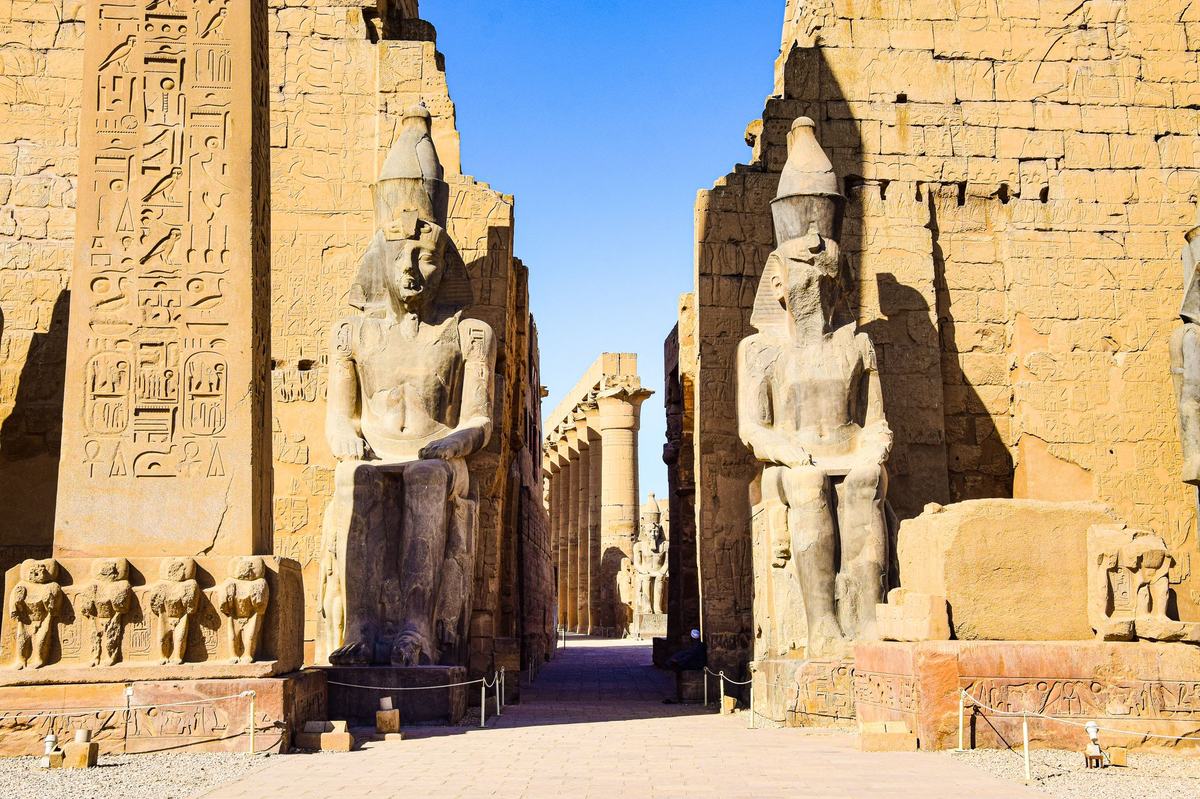
- Capital: Cairo, the largest city in the Arab world with about 22 million people in its metro area [1]
- Population: Roughly 109 million, making Egypt the third most populous country in Africa [2]
- Area: 1,001,450 square kilometers, but about 95% of Egyptians live on the 4% of land along the Nile [3]
- Official language: Arabic, with Egyptian Arabic being the most widely understood dialect across the Arab world thanks to Cairo's film industry
- Currency: Egyptian pound (EGP)
- Distinguishing claim: Egypt has one of the longest continuous national identities on Earth - the name "Misr" has been in use for over 4,000 years [4]
Here's something that messes with your head when you read it the first time: the pyramids at Giza are older to Cleopatra than Cleopatra is to us. She lived closer in time to the moon landing than to the building of the Great Pyramid. I had to look this up twice. The Egypt we picture as one ancient thing is actually a stack of ancient things, each one looking back at the ones before it the same way we look at black-and-white photos of our grandparents.
That's what I want to get into here. Not the tourist-brochure version of Egypt, but the country as it actually exists - a place where a 5,000-year-old story is still being written, where the world's longest river still does the same job it did before writing was invented, and where modern people are dealing with very modern problems while living next door to monuments older than most languages.
The Nile Is the Country
You can stop reading right now if you take only one thing from this article: Egypt is the Nile. Not "Egypt has a river". Egypt IS the river, plus a thin strip of green on either side, and then 96% emptiness.
Look at a satellite photo. You'll see what looks like a long, skinny tree growing up from the south, with its branches spreading into a fan at the Mediterranean. That tree is the Nile and the delta. Outside of that shape, Egypt is the Sahara. Sand, rock, and not much else.
About 95% of the population lives on 4% of the land [3]. Think about that. The entire country crowds into a sliver, and the rest is empty desert. Back in Montana, my hometown had 800 people spread across 50 square miles. Egypt's Nile valley has the opposite problem - over 100 million people packed into a space about the size of the Netherlands.
The river runs 6,650 kilometers, which makes it the longest in the world by most measurements, though the Amazon has its defenders [5]. The ancient Egyptians figured out something the rest of the world wouldn't catch onto for thousands of years: a river that floods on a predictable schedule is a printing press for civilization. The Nile flooded every summer, dropping black silt across the floodplain. That silt grew wheat. That wheat fed cities. Those cities built pyramids.
The Aswan High Dam, finished in 1970, ended the annual flood. The silt now collects behind the dam instead of fertilizing the fields, which sounds like a loss and in some ways is, but the dam also gives Egypt year-round irrigation, hydroelectric power, and protection from droughts and floods that used to kill people regularly.
Pharaohs, Pyramids, and Time Itself
The Great Pyramid of Giza was the tallest human-made structure on Earth for 3,800 years [6]. Read that again. From around 2560 BCE until the spire of Lincoln Cathedral was finished in England in 1311, nothing humans built reached higher. Roman roads, the Great Wall of China, the cathedrals of medieval Europe - none of them topped it for almost four millennia.
It's made of about 2.3 million limestone blocks. Each block weighs somewhere between 2.5 and 15 tons. The construction took roughly 20 years and a workforce that, contrary to what you may have heard, was not made up of slaves. The workers were paid laborers, fed beer and bread and meat, and many of them are buried in tombs near the site with inscriptions naming their work crews [7]. We know one crew called itself "Friends of Khufu", which honestly sounds like a band name.
The pyramids weren't built in a vacuum, either. Egypt had thirty dynasties of pharaohs over roughly 3,000 years before Cleopatra. Cleopatra herself wasn't even ethnically Egyptian. She was Greek, from the Ptolemaic dynasty that took over after Alexander the Great. She was the first ruler in her family in 300 years to actually learn to speak Egyptian. The Egypt she ruled was already so ancient that her contemporaries thought of it the way we think of the Romans.
Which, if you think about it, is the strangest part of Egyptian history. It's not just old. It's old upon old upon old.
Modern Egypt Is Not Ancient Egypt
The Egypt of today is a young country in an old land. The median age is about 24. Cairo is loud, fast, vertical, and getting more crowded by the day. The Egypt you see on the news is dealing with the same things every big country deals with - water shortages, housing pressure, an economy trying to find its feet, a young population looking for jobs.
Egyptian Arabic is the most-understood dialect in the Arab world, and that's almost entirely because of Cairo's film and television industry. For most of the 20th century, if you grew up anywhere from Morocco to Iraq watching movies, you watched Egyptian movies. The accent and slang of Cairo became the lingua franca of Arabic-speaking pop culture. The country has been called the Hollywood of the Arab world, and that's not a small thing - it's a soft power most countries would kill for.
The food is its own argument for visiting. Ful medames, a slow-cooked fava bean dish, is breakfast for tens of millions of people every morning. Koshari, the unofficial national dish, is rice, lentils, chickpeas, pasta, fried onions, and tomato sauce all mashed together. It's the kind of meal that sounds like it shouldn't work and absolutely does. It's also, not coincidentally, dirt cheap to make and feeds you for hours.
The Sphinx, the Sahara, and Other Things You Think You Know
The Sphinx has no nose. You probably knew that. What you may not know is that we don't actually know who broke it. The popular story blames Napoleon's soldiers for using it as target practice, but drawings from 1737 - decades before Napoleon - already show the nose missing. The most likely culprit is a 14th-century Sufi cleric who got upset about people leaving offerings at the statue and had its face vandalized. The story doesn't make a good action movie, but it's probably true.
The Sahara, Egypt's western backdrop, isn't just sand. About 30% of it is the kind of rolling dunes you see in movies. The rest is rocky plateaus, gravel plains, dry mountains, and the occasional oasis. Some of the most beautiful landscapes in Egypt are inland - the White Desert north of Farafra Oasis has chalk formations carved by wind into shapes that look like they belong on another planet.
And the Red Sea coast, on the country's eastern edge, has some of the best diving in the world. The coral reefs at places like Sharm El Sheikh and Dahab are healthier than most reefs in the Caribbean, partly because the Red Sea's high salinity makes it inhospitable to certain coral diseases. Turns out the ancient Egyptians had a thriving Red Sea trade route running down to modern Eritrea and Somalia thousands of years ago, importing frankincense, gold, and exotic animals.
Egyptian Culture Without the Cliches
Hospitality in Egypt isn't a marketing slogan. It's a structural feature of daily life. Refuse food once, you're being polite. Refuse food three times, you might actually be allowed to refuse. The Arabic phrase "ahlan wa sahlan" - welcome - is said constantly, to strangers, to neighbors, to people who walked into the wrong shop. Tea is offered everywhere. Strong, sweet, and constant.
Soccer is the national obsession, and the rivalry between Cairo's two biggest clubs - Al Ahly and Zamalek - is one of the most intense in world football. Matches between them have been played behind closed doors at neutral stadiums when authorities were worried about safety. The atmosphere is something else. I haven't been, but a friend who has describes it as a religious experience held inside a thunderstorm.
Family is the center of everything. Multi-generational households are normal. Wedding parties spill onto streets and shut down traffic. Funerals draw whole neighborhoods. The Egyptian sociologist Galal Amin wrote that the country's identity is held together by a handful of things that won't quit - the Nile, the language, family loyalty, and a sense of being part of something older than anyone alive. He's probably right.
Frequently Asked Questions
What language do Egyptians speak?
Egyptians speak Arabic, with Egyptian Arabic being the everyday spoken dialect. Modern Standard Arabic is used in writing, news, and formal contexts. English is widely taught in schools and common in tourist areas and business. French and German are also spoken in some educated and tourism-related circles.
How old are the pyramids of Egypt?
The Great Pyramid of Giza was built around 2560 BCE during the reign of Pharaoh Khufu, making it about 4,500 years old. Other pyramids range from this period to roughly 1700 BCE. The pyramids predate the Roman Empire by more than 2,000 years and the writing of the Old Testament by over a thousand.
Is Egypt safe to visit?
Egypt's main tourist regions, including Cairo, Luxor, Aswan, and the Red Sea resorts, are generally considered safe for visitors and are heavily policed. Travel advisories typically recommend avoiding the North Sinai region and remote desert border areas. Check your government's current advisory before traveling, as conditions change.
What is the capital of Egypt?
The capital of Egypt is Cairo, located on the Nile River in the north of the country. With around 22 million people in its metropolitan area, it is the largest city in Africa and the Arab world. A new administrative capital, currently called the New Administrative Capital, is being built east of Cairo.
What currency is used in Egypt?
Egypt uses the Egyptian pound, abbreviated as EGP or sometimes shown with the symbol "LE" (from the French livre egyptienne). Banknotes come in denominations from 5 to 200 pounds. US dollars and euros are widely accepted in tourist areas, but you'll get better value paying in local currency.
Sources
- United Nations Department of Economic and Social Affairs - World Urbanization Prospects
- World Bank - Egypt Population Data
- CIA World Factbook - Egypt
- UNESCO World Heritage Centre - Memphis and its Necropolis
- Encyclopedia Britannica - Nile River
- Britannica - Pyramids of Giza
- Smithsonian Magazine - Who Built the Pyramids