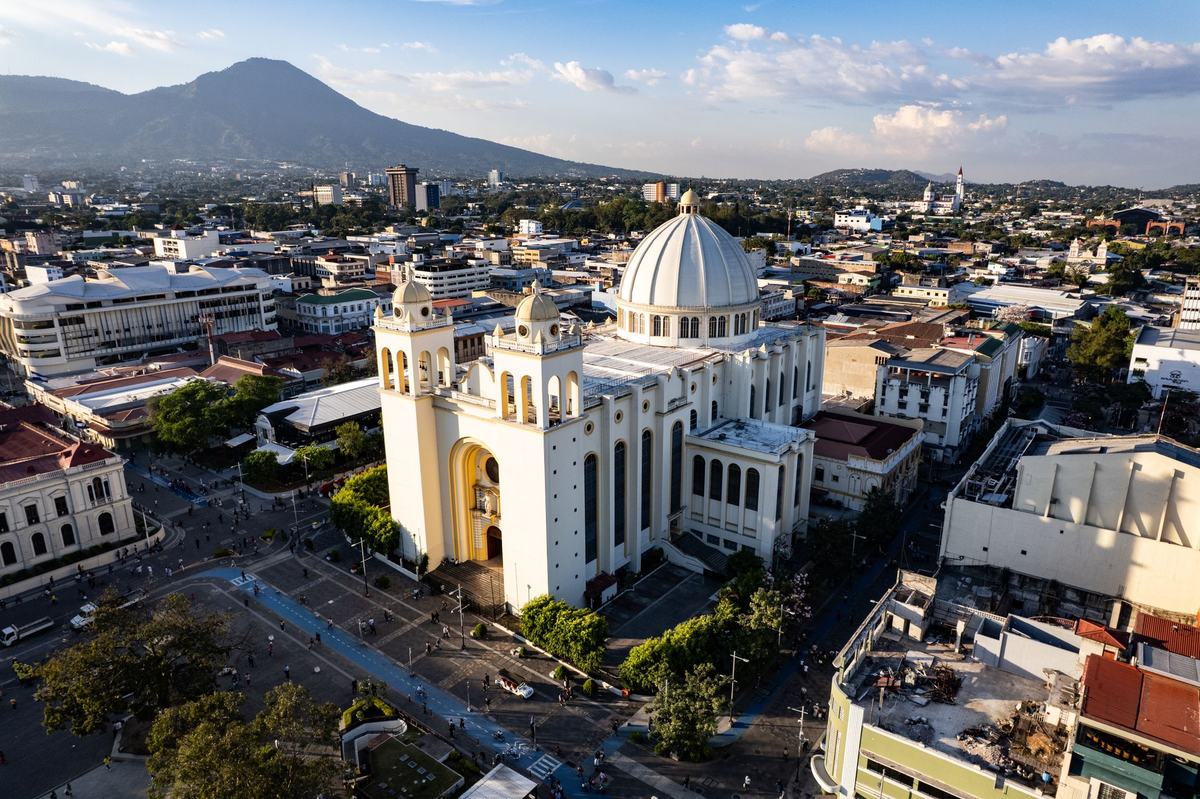
- Capital: San Salvador, founded in 1525 and rebuilt repeatedly after earthquakes [1]
- Population: Roughly 6.3 million, making it the most densely populated country on the mainland of the Americas [2]
- Area: 21,041 square kilometers, about the size of New Jersey [3]
- Official language: Spanish, with the Nawat language preserved by a small community of speakers
- Currency: US dollar (since 2001) and Bitcoin (legal tender since 2021) [4]
- Distinguishing claim: El Salvador is the only country in the Americas without a Caribbean coastline, and the only one in the world to adopt Bitcoin as official currency [4]
Most people couldn't find El Salvador on a map. That's probably exactly what the country wants to fix. The smallest country in Central America has spent the last decade trying to get the world's attention, and depending on the year, it has done it through coffee, surfing, gang policy, or cryptocurrency. The result is a place that feels much bigger in the news than it is on the ground.
Here's the thing about El Salvador: it's tiny. You can drive across the whole country in about four hours. The Pacific coast on one side, the Honduran highlands on the other, and a string of green, smoking volcanoes running right down the middle. The whole country fits into Lake Michigan with room to spare. And yet it's home to over six million people, which makes the density wild. Imagine New Jersey's land area with the population of Tennessee. That's roughly what it feels like.
A Country Built on Volcanoes
El Salvador sits on top of about twenty volcanoes, and roughly half of them are still considered active. The country is part of the Pacific Ring of Fire, so earthquakes and eruptions are part of the deal. San Salvador, the capital, has been knocked down by earthquakes so many times that the city's older buildings are mostly the ones that were lucky enough to be between disasters.
The most famous volcano is Izalco, which spent most of the 19th and 20th centuries erupting so reliably that sailors out in the Pacific used it for navigation. They called it the Lighthouse of the Pacific. Then in 1957, after building a hotel nearby specifically so tourists could watch it erupt at night, Izalco went quiet. It hasn't put on a real show since. That hotel, by the way, is still there, sitting on a ridge with a perfect view of nothing.
The volcanic soil is the reason El Salvador grows some of the best coffee in the world. The country is small, but it has stretches of high-altitude volcanic land that are ideal for arabica beans. For most of the 20th century, coffee was basically the entire economy. The country still produces some of the most prized specialty coffees you can find, especially from the Apaneca-Ilamatepec mountain range out west. If you've ever paid too much for a pour-over and been told it had "notes of chocolate and citrus", there's a decent chance the beans came from a hillside in El Salvador.
The Pupusa Is a National Religion
If you walk into any pupuseria, you'll see women slapping balls of corn dough between their palms, stuffing them with cheese, beans, or chicharron, and grilling them on a hot comal. The pupusa is the national dish, and asking a Salvadoran which pupuseria makes the best one is like asking a New Yorker about pizza. People have opinions, and they will share them.
Pupusas predate the arrival of the Spanish by centuries. The indigenous Pipil people were making versions of them long before Cortes's nephews showed up looking for gold. Today there's even a National Pupusa Day, the second Sunday of November, when the country eats absurd quantities and breaks its own world records for the largest pupusa ever assembled.
Beyond pupusas, the food leans on corn, beans, cream, plantains, and queso fresco. Yuca frita with chicharron is everywhere. Horchata, the rice and seed drink, is made with morro seeds in El Salvador and tastes nothing like the cinnamon-rice version you get in Mexican restaurants. Turns out the Salvadoran version is older, and arguably better.
A Pacific Coast the World Is Finally Noticing
For decades, the surf community has whispered about a tiny Pacific village called El Tunco. The wave there is a long, perfect right-hand point break that runs over a cobblestone bottom. It's the kind of wave that surfers travel across continents to ride. Until about ten years ago, hardly anyone outside of Central America knew it existed.
Now El Tunco and the rest of the surf coast - El Zonte, Punta Roca, Las Flores - are showing up in surf magazines and on highlight reels. El Salvador has even hosted the World Surfing Games. The country has bet a serious chunk of its tourism strategy on becoming a Pacific surf destination, and it's working. The coast is still less crowded than Costa Rica's, and a beachfront cabana costs about a third of what you'd pay in Nicaragua.
The Bitcoin Experiment
In September 2021, El Salvador became the first country in the world to make Bitcoin legal tender. Every business is technically required to accept it. The government built a national digital wallet called Chivo and gave every citizen $30 in Bitcoin to start using it.
How's it going? Mixed, depending on who you ask. The country has bought hundreds of millions of dollars of Bitcoin for its national treasury, betting that the price will keep climbing. Most ordinary Salvadorans, though, still use dollars for everyday purchases. Surveys suggest only a small fraction of the population actively uses Bitcoin for transactions. But the experiment has put a country of six million people on every economics blog in the world, which is exactly the kind of attention the government was after.
And nobody talks about this, but the Bitcoin thing is downstream of a bigger story: the US dollar has been El Salvador's official currency since 2001. The country gave up its own currency, the colon, two decades ago. So when people say El Salvador adopted Bitcoin, what they really mean is that El Salvador adopted a second foreign currency on top of the first one.
Salvadoran Culture Beyond the Headlines
The country has produced some of Central America's best-known artists. The painter Fernando Llort developed a folk-art style based on the colors and shapes of his hometown La Palma, and his work became so identified with El Salvador that you'll see his influence on souvenirs, murals, and church doors all over the country. The poet Roque Dalton, killed in 1975 at age 39, is still one of the most quoted Latin American writers of the 20th century.
Family is the center of life, and so is the diaspora. About a quarter of all Salvadorans live outside the country, mostly in the United States. The remittances they send home make up close to a quarter of the national economy. Walk through any Salvadoran town and the new houses tend to belong to families with relatives in Los Angeles, Houston, or Long Island.
Soccer is the obsession, the same way it is everywhere else in Central America. The national team is small but proud, and the country still talks about its 1982 World Cup appearance like it happened yesterday.
Frequently Asked Questions
What language do Salvadorans speak?
Salvadorans speak Spanish, with a distinct Central American accent that uses "vos" instead of "tu". Nawat, an indigenous language related to Nahuatl, is still spoken by a small community and is being revived in some schools. English is common in tourism and business but not widely spoken in rural areas.
What is the capital of El Salvador?
The capital of El Salvador is San Salvador, located in a valley surrounded by volcanoes in the center of the country. The metropolitan area has roughly 1.8 million people. The city was founded in 1525 and has been rebuilt several times after major earthquakes.
What currency is used in El Salvador?
El Salvador uses two official currencies: the US dollar, adopted in 2001 when the country replaced its colon, and Bitcoin, made legal tender in 2021. In practice, the US dollar is used for almost all everyday purchases, while Bitcoin is mostly used by tourists and tech-savvy locals.
Is El Salvador safe to visit?
El Salvador's tourist regions, including the Pacific surf coast, Suchitoto, and the Ruta de las Flores, are generally considered safe for visitors. Homicide rates have dropped sharply since 2019 under government security measures. Check your government's current travel advisory and avoid traveling at night between cities.
What is El Salvador known for?
El Salvador is known for its Pacific surf breaks, its volcanic landscape, specialty coffee, and pupusas. It is also known internationally as the first country to adopt Bitcoin as legal tender. The country is the smallest in Central America and the most densely populated on the American mainland.