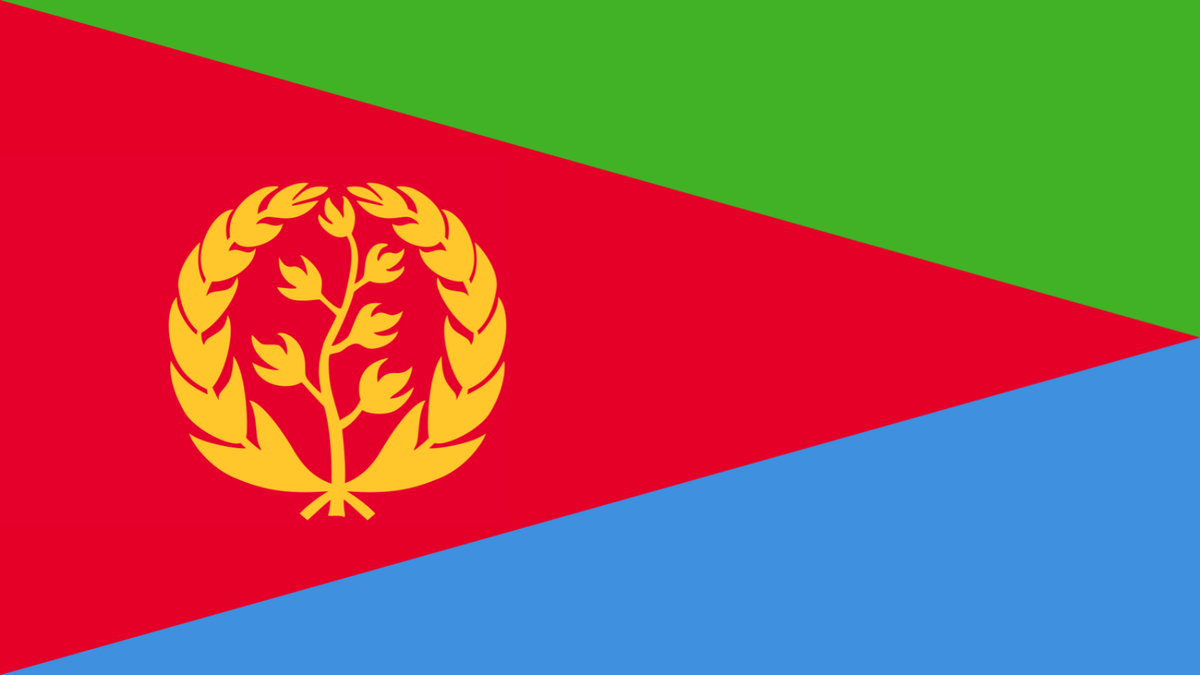
- Capital: Asmara, sitting at about 7,628 feet of elevation [1]
- Population: roughly 3.6 million [2]
- Area: about 117,600 square kilometers (45,400 square miles) [1]
- Official working languages: Tigrinya, Arabic, and English [1]
- Currency: Nakfa (ERN)
- Independence year: 1993, after a 30-year war with Ethiopia [3]
Here's something I had to look up twice. Eritrea, as a country, is younger than I am. It got its independence in 1993, the same year I started middle school. But the coastline it sits on, the Red Sea edge, has been a trade artery for around three thousand years. So you've got this nation that's barely thirty years old wrapped around a piece of earth that watched Egyptian, Aksumite, Ottoman, and Italian ships come and go. That gap is basically the whole story.
A Capital That Looks Like 1930s Milan
Asmara is one of the strangest skylines in Africa, and almost nobody outside the continent talks about it. When the Italians colonized Eritrea in the late 1800s and held it until 1941, they used Asmara as a kind of architectural laboratory. They built Art Deco cinemas, Futurist gas stations, modernist apartment blocks, all at altitude, all between roughly 1935 and 1941. UNESCO listed the whole city center as a World Heritage Site in 2017, calling it "a modernist city of Africa" [4].
The Fiat Tagliero building is the one people post pictures of. It's a 1938 service station shaped like an airplane, with two 15-meter cantilevered wings that hold themselves up with no supporting columns. The engineer who designed it had to sign a contract promising it wouldn't collapse, because the local authorities didn't believe the math. It's still standing. Cars still pull up to it.
Nine Ethnic Groups in a Country Smaller Than Pennsylvania
Eritrea recognizes nine ethnic groups, each with its own language, music, and traditions [3]. The Tigrinya are the largest, mostly Christian, living in the highlands around Asmara. The Tigre live in the western lowlands and along the coast, mostly Muslim. Then you've got the Saho, Afar, Bilen, Hedareb, Kunama, Nara, and Rashaida. The Rashaida are the youngest group there, having arrived from the Arabian Peninsula in the 1800s, and they still speak Arabic and live a nomadic life along the northern coast.
What's wild is that the country balances all this with no official "national" language. Tigrinya and Arabic are used as working languages, and English is the medium of instruction in secondary schools and university. Back home in Montana I grew up around exactly two languages on signs, English and a little Spanish. The idea of a country this size, smaller than Pennsylvania, juggling nine living traditions in everyday life is something I think about a lot.
The Dahlak Archipelago
Off Eritrea's coast there are over 350 islands, collectively called the Dahlak Archipelago. Most are uninhabited. The ones that are inhabited host a small population of fishermen and pearl divers. The waters here have some of the most untouched coral reefs left in the Red Sea, partly because the country's tourism infrastructure is so limited that the reefs have been left alone for decades.
The archipelago has been a known pearl-fishing ground since at least the first century AD. There's mention of it in the Periplus of the Erythraean Sea, an ancient Greek manual for merchants sailing the region. Same waters. Same pearls. Different millennium.
A Country That Runs on Its Own Calendar
Eritrea uses the Ge'ez calendar for religious and many cultural purposes, the same one used in Ethiopia. It runs roughly seven to eight years behind the Gregorian calendar most of the world uses. So when it was 2024 in New York, it was 2016 or 2017 in Asmara, depending on the month. New Year falls on September 11 in the Gregorian calendar, marking the end of the rainy season.
The day is also split differently. Sunrise is "hour one", so what we'd call 7 a.m. is 1 o'clock locally. It throws off pretty much every traveler who tries to book a meeting without checking twice.
Coffee Ceremony as a Three-Hour Event
Coffee in Eritrea isn't a drink, it's a ritual. The beans get roasted in front of you on a small pan, then ground by hand, then brewed three times from the same grounds in a clay pot called a jebena. Each round has its own name. Awel is the first and strongest, Kalei the second, Bereka the third and lightest, and tradition says the third pour carries a blessing. The whole thing can take two to three hours, often with frankincense burning in the room.
Frequently Asked Questions
Is Eritrea a safe country to visit?
Eritrea is generally considered safe in terms of street crime, with very low rates compared to most of the region. However, the country requires travel permits for most areas outside Asmara, and the border with Ethiopia has periodic tensions. Most travelers visit on organized tours with pre-arranged permits.
What language do they speak in Eritrea?
The most widely spoken language is Tigrinya, followed by Tigre and Arabic. There are nine recognized ethnic languages in total. Tigrinya, Arabic, and English serve as working languages, with English used in secondary and higher education. Italian is still spoken by some older residents in Asmara.
Why is Asmara a UNESCO site?
UNESCO inscribed Asmara in 2017 as "a modernist city of Africa". It contains one of the highest concentrations of well-preserved early modernist and Art Deco architecture in the world, built mostly during the Italian colonial period between 1893 and 1941, much of it still in everyday use.
Is Eritrea part of Ethiopia?
Not anymore. Eritrea was federated with Ethiopia in 1952 and annexed in 1962. It fought a 30-year independence war that ended in 1991 and became fully independent in 1993 after a UN-supervised referendum. Border disputes between the two countries continued for decades afterward.