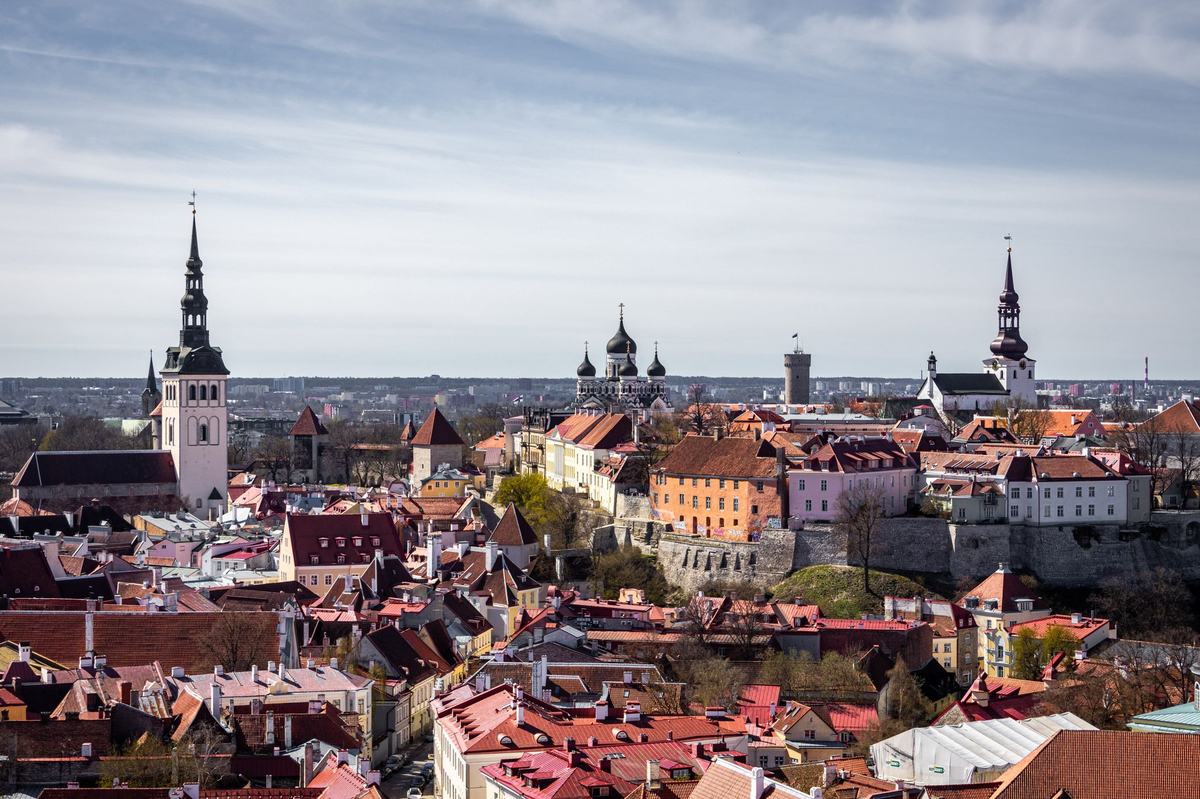
- Capital: Tallinn, with a medieval Old Town that's a UNESCO World Heritage Site [1]
- Population: roughly 1.37 million [2]
- Area: about 45,339 square kilometers (17,505 square miles), a bit larger than Switzerland [1]
- Official language: Estonian, a Finno-Ugric language related to Finnish, not Russian
- Currency: Euro (EUR), adopted in 2011
- Restored independence in 1991 after about 50 years of Soviet occupation [3]
Most people couldn't find Estonia on a map. That's probably exactly how the Estonians have survived, honestly. Wedged between the Baltic Sea and Russia, smaller than West Virginia, with a population about the size of San Diego, this country has spent the last thirty years quietly turning itself into one of the most digitally advanced societies on the planet. You can vote online here. You can start a company in about fifteen minutes from your phone. You can be a citizen of Estonia without ever having set foot in it. And then you can drive an hour outside the capital and find yourself in a forest so dense and so old that the bears outnumber the people who pass through.
A Country That Files Its Taxes in Three Minutes
Estonia is the only country in the world where you can become an "e-resident" without ever moving there [4]. The government issues a digital identity card to non-citizens that lets them open a bank account, sign contracts, and run an EU-based company entirely online. As of recent years, over 100,000 people from more than 170 countries have signed up. The program has launched something like 25,000 companies that exist almost entirely as cloud-based entities with an Estonian address.
For actual residents, 99 percent of government services are online. Driver's licenses, prescriptions, property records, all of it. The average Estonian files their income taxes in about three minutes. Voting happens online in national elections, and has since 2005, which makes Estonia the first country in the world to do it nationwide. The whole system runs on a decentralized data exchange called X-Road, which other countries are now licensing to build their own versions. Turns out a small country with not much to lose was the perfect lab for what a digital state actually looks like.
Half the Country Is Forest
Here's the thing about Estonia that surprised me the most. It's one of the most heavily forested countries in Europe, with about 51 percent of its land area covered in trees [5]. Pine, spruce, and birch mostly, in a long stretch of green that runs from the Gulf of Finland down to the Latvian border. There are five national parks and over a hundred nature reserves. Brown bears, lynx, wolves, and elk all live here in numbers that would be unthinkable in most of Western Europe.
A lot of the country is also bog. Estonia has some of the largest intact bog systems in Europe, raised peatlands that have been forming since the last ice age. Locals walk them on boardwalks in summer and on bog shoes in winter. It's the kind of landscape that looks empty to a first-time visitor and then quietly reveals itself the longer you stay. Back home in Montana we have a lot of empty country too, but ours is dry and open. Estonia's empty country is wet and shaded and smells like moss for most of the year.
They Sang Their Way Out of an Occupation
Between 1987 and 1991, Estonia got its independence back from the Soviet Union largely without firing a shot. The movement is now called the Singing Revolution, and it's not just a metaphor. Hundreds of thousands of Estonians, sometimes a quarter of the entire population, gathered at outdoor song festivals in Tallinn and sang banned national songs in defiance of Moscow [6]. The biggest single gathering, at the Tallinn Song Festival Grounds in September 1988, drew an estimated 300,000 people. That's roughly one in four Estonians, all in one field, singing.
The choral tradition here is genuinely ancient. The official Song Celebration, held every five years, started in 1869 and is now on UNESCO's list of intangible cultural heritage. Choirs of up to 30,000 singers perform together. There's no easy American equivalent to it. The closest I can think of is a stadium full of people who all somehow know the same hundred songs by heart.
The Birthplace of Skype and a Lot More
Skype was built in Tallinn in 2003 by an Estonian engineering team, before it was sold to eBay and later Microsoft [7]. That single project poured money and know-how back into the local tech scene in a way that's still paying off. Estonia now has more startups per capita than almost any country in Europe, and it's produced more billion-dollar tech companies per capita than anywhere else on the continent, including Wise, Bolt, and Playtech. Not bad for a country with fewer people than the city of Stockholm.
Part of why this worked is education. Estonian kids start learning programming concepts in elementary school. The country pushed digital literacy as a national project in the mid-1990s under a program called Tiger Leap, when most of the world was still figuring out what email was.
Tallinn's Old Town Is a Time Machine
The medieval Old Town of Tallinn is one of the best-preserved in northern Europe, with city walls, towers, and cobblestone streets that mostly date to the 13th through 16th centuries [1]. UNESCO listed it in 1997. The town hall in the central square is the oldest in the Baltic region, built in 1404 and still in use. There's a working pharmacy on the square, Raeapteek, that's been in continuous operation since at least 1422, which makes it one of the oldest pharmacies in Europe.
Walking through it doesn't feel staged the way some restored European centers do. People live there. Kids ride bikes through the gates. A grandmother carries groceries past a 15th-century guild house. The medieval bones are just part of the working city.
A Language That Isn't Related to Anything Nearby
Estonian belongs to the Finno-Ugric family, which means its closest relative is Finnish, not Russian or Latvian or Lithuanian. It has 14 grammatical cases, no future tense, and no gendered pronouns. The word for he and she is the same. Estonian doesn't even use articles, so "the cat" and "a cat" are just "cat". Linguists love it because it preserves features that have disappeared from most of Europe. Tourists are usually just baffled by the road signs.
Frequently Asked Questions
What is Estonia famous for?
Estonia is famous for being one of the most digitally advanced societies in the world, with online voting, e-residency, and a paperless government. It's also known for Tallinn's medieval Old Town, the Singing Revolution that helped end Soviet rule, and being the birthplace of Skype.
Is Estonia part of Russia?
No. Estonia is an independent country and a member of the European Union and NATO. It was occupied by the Soviet Union from 1940 to 1991, with a brief Nazi German occupation in between, and restored full independence in August 1991 after the Singing Revolution.
What language do they speak in Estonia?
The official language is Estonian, a Finno-Ugric language related to Finnish and unrelated to Russian or the Baltic languages. Russian is spoken by about a quarter of the population, especially in the northeast, and English is widely understood among younger Estonians.
Is Estonia in the European Union?
Yes. Estonia joined the European Union in 2004, along with several other Central and Eastern European countries. It adopted the euro as its currency in 2011 and is part of the Schengen Area, making travel between Estonia and most EU countries passport-free.
How big is Estonia?
Estonia covers about 45,339 square kilometers, slightly larger than Switzerland and a little smaller than West Virginia. Its population is roughly 1.37 million, which makes it one of the least densely populated countries in the European Union.