- Capital: Mbabane (administrative) and Lobamba (royal and legislative) [1]
- Population: about 1.2 million [2]
- Area: 17,364 square kilometers, roughly the size of New Jersey [1]
- Official languages: Siswati and English [1]
- Currency: Lilangeni (SZL), pegged 1:1 to the South African rand [3]
- Government: Africa's last absolute monarchy, ruled by King Mswati III since 1986 [4]
I had to look this up twice. There's a country in southern Africa that changed its name in 2018, and most Americans still call it the old one. Swaziland became Eswatini, and the king did it by royal decree on his 50th birthday. The reason is simpler than you'd think. People kept confusing it with Switzerland.
A Name Older Than the Map
Eswatini means "land of the Swazis" in Siswati, and that name predates colonial borders by centuries. The British called it Swaziland during the protectorate years, and the name stuck after independence in 1968. King Mswati III made the switch official on April 19, 2018, exactly fifty years after independence. He'd been using the name informally for years in speeches. The decree just made it the law.
Here's the thing about the name change. It wasn't just nostalgia. The king pointed out that no other country in the region carries an English version of its name. South Africans don't live in "Southafricaland". The Swazi people had a perfectly good word for their own home, and they decided to use it.
Africa's Last Absolute Monarchy
This is the part that surprises people. King Mswati III holds executive, legislative, and judicial authority. He appoints the prime minister, names members of parliament, and can dissolve the government. Political parties were banned in 1973 by his father, King Sobhuza II, and the ban has never been formally lifted. Candidates run as individuals, not under party banners. [4]
The royal family is large by any standard. Mswati III has fifteen wives and over thirty children. His father, Sobhuza II, had 70 wives and 210 children when he died in 1982. Sobhuza ruled for 82 years and 254 days, which is the longest verifiable reign of any monarch in recorded history. Longer than Louis XIV. Longer than Queen Victoria. He took the throne as an infant in 1899 and held it until his death.
The Queen Mother and Dual Rule
Eswatini runs on a dual monarchy system that's genuinely unusual. The king is called the Ngwenyama, which means "the Lion". The queen mother is the Ndlovukati, "the She-Elephant". She's not just ceremonial. She holds spiritual authority, mediates between the king and the people, and serves as regent when there's no adult king on the throne. The system pairs masculine and feminine power as complementary forces, not competing ones.
When a king dies, the next ruler is chosen by the royal council, the Liqoqo, in consultation with the queen mother. The chosen son is rarely the eldest. He's selected based on his mother's status and his own character. It's a system designed to prevent dynastic feuding, and it's worked for a long time.
The Reed Dance and the Incwala
If you've heard of Eswatini at all, you've probably seen photos of the Umhlanga, the annual Reed Dance. Tens of thousands of unmarried young women travel to the royal village of Ludzidzini, gather reeds from the riverbeds, and present them to the queen mother to repair her windbreak. The ceremony lasts eight days and ends with a dance before the king. It's a celebration of chastity, community, and cultural continuity, and it draws crowds from across the country.
The other major ceremony is the Incwala, the kingship ritual, held around the summer solstice in December. It's older, more sacred, and less open to outsiders. Photography is restricted. The full meaning is held closely by the royal family and the regiments who participate. What the public sees is the bull sacrifice, the songs, and the king's appearance in ceremonial dress. What happens inside the sacred enclosure stays there.
A Landlocked Country Between Giants
Eswatini is wedged between South Africa and Mozambique, with no coastline of its own. It's one of only sixteen monarchies left in Africa, and the only absolute one. The country sits at a crossroads of cultures, languages, and economies. Most exports go to South Africa, the currency is pegged to the rand, and the border between the two countries is one of the busiest in the region.
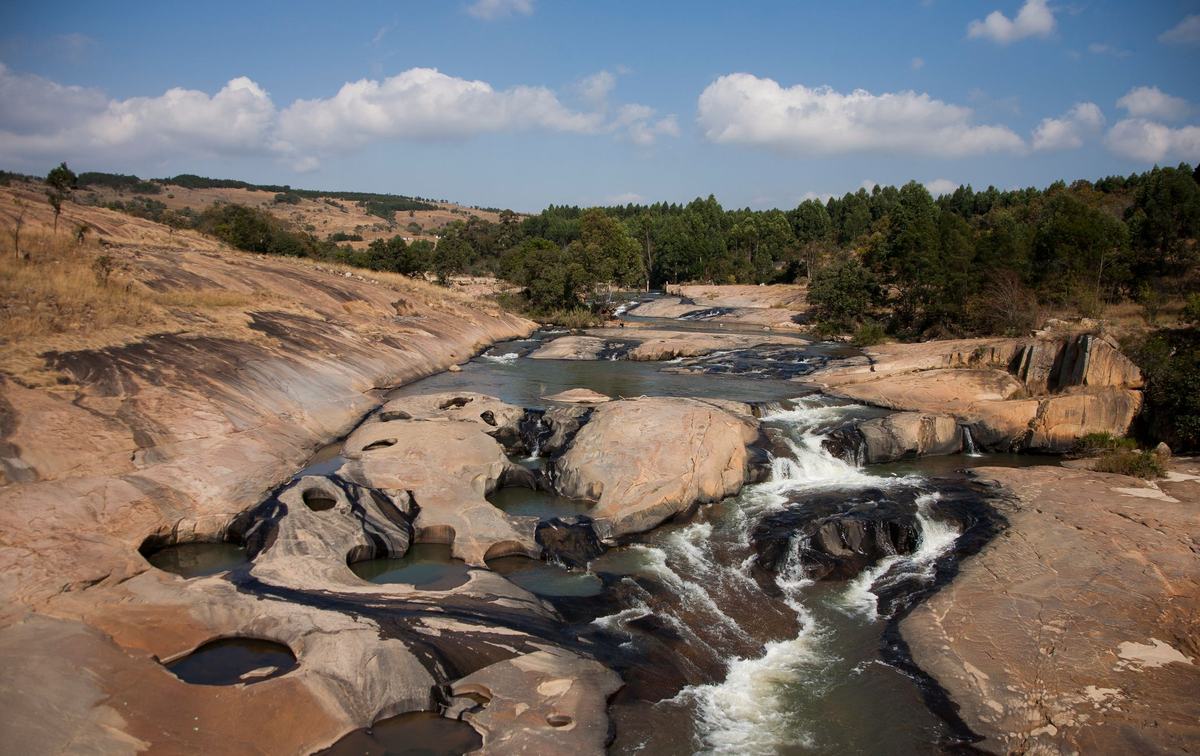
The land itself runs from high mountains in the west to lowveld bush in the east. You can drive across the whole country in about two hours. The Highveld is cool and forested, full of pine plantations that supply paper mills. The Middleveld is rolling farmland. The Lowveld is hot, dry, and home to most of the country's wildlife reserves. Hlane Royal National Park has lions, elephants, and rhinos roaming land that used to be the king's hunting ground.
Small Country, Heavy Burdens
Eswatini has one of the highest HIV prevalence rates in the world. About 26 percent of adults between 15 and 49 are living with HIV, according to UNAIDS, though the country has made real progress on treatment access. [5] Life expectancy dropped to under 40 in the worst years of the epidemic. It's now back up to around 60. The recovery is slow, but it's real.
The economy depends heavily on South Africa, sugar exports, and a small but growing tourism industry. Subsistence farming employs most rural households. Income inequality is high. The royal family controls significant business holdings through a trust called Tibiyo TakaNgwane, which was set up under King Sobhuza II. Critics say it concentrates wealth. Defenders say it preserves resources for the Swazi nation. The argument hasn't been settled.
Frequently Asked Questions
Why did Swaziland change its name to Eswatini?
King Mswati III renamed the country on April 19, 2018, on his 50th birthday and the 50th anniversary of independence. The new name is the Siswati word for the country and predates the colonial name "Swaziland". The king also wanted to end confusion with Switzerland in international forums.
Where is Eswatini located?
Eswatini is a small landlocked country in southern Africa, bordered by South Africa on three sides and Mozambique to the east. It covers 17,364 square kilometers, about the size of New Jersey. The country has no coastline and depends on its neighbors for sea access.
Is Eswatini safe to visit?
Eswatini is one of the safer destinations in southern Africa for tourists, with low rates of violent crime against visitors. Standard travel precautions apply in urban areas. The country's small size, English-language services, and well-maintained game reserves make it a popular stop on regional itineraries.
What language do they speak in Eswatini?
The two official languages are Siswati and English. Siswati is a Bantu language closely related to Zulu, spoken by nearly the entire population. English is the language of business, government, and education. Most Swazis are fluent in both from a young age.