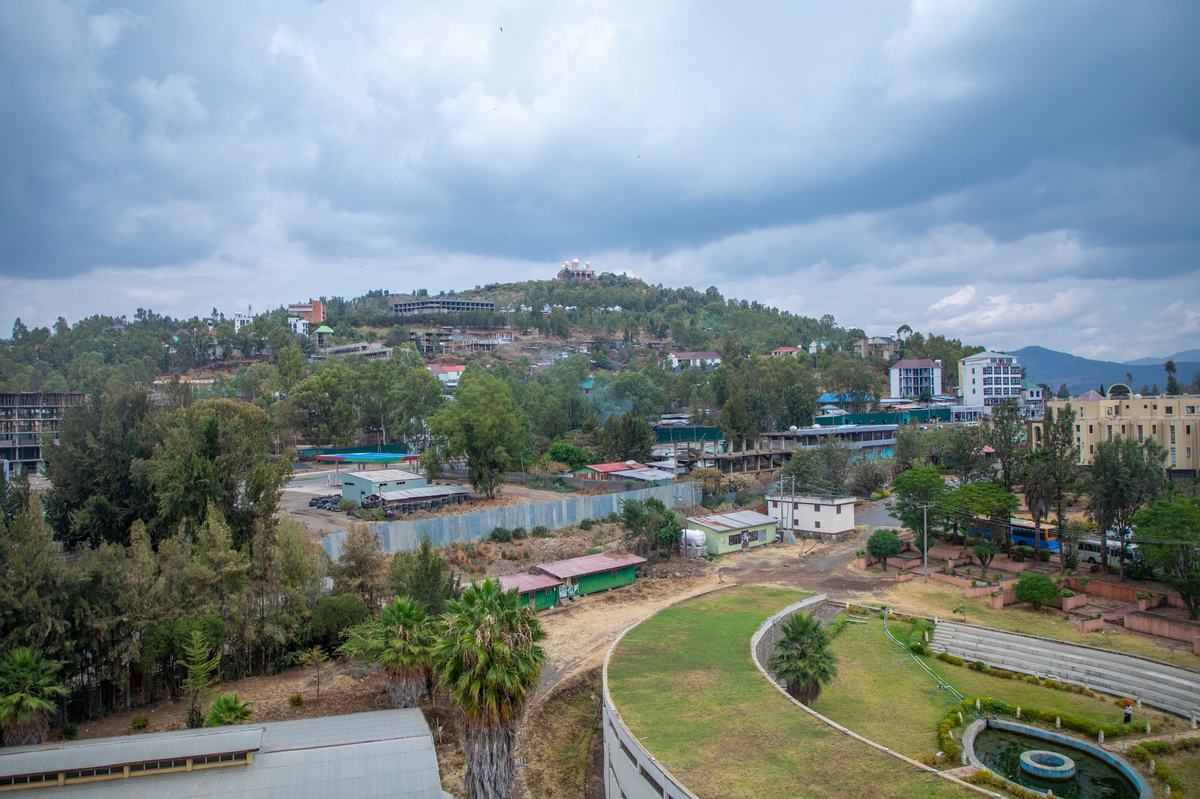
- Capital: Addis Ababa, sitting at roughly 7,700 feet above sea level [1]
- Population: about 126 million people, making it the second most populous country in Africa [2]
- Area: 1.1 million square kilometers (about twice the size of Texas) [1]
- Official working language: Amharic, with over 80 other languages spoken across the country [1]
- Currency: Ethiopian birr (ETB)
- One claim to fame: the only African nation that successfully resisted European colonization [3]
I grew up thinking I had a decent handle on world history. Then I started reading about Ethiopia and realized I'd been missing a giant piece of the puzzle. Here's a country that runs seven years behind the calendar you're using right now, tells time by a totally different clock, fought off an Italian invasion in 1896 with mostly farmers, and probably gave the world coffee. And that's just the warm-up.
Most people couldn't tell you where Ethiopia sits on a map. Horn of Africa, landlocked since 1993, sharing borders with Eritrea, Sudan, South Sudan, Kenya, Somalia, and Djibouti. It's the kind of country that doesn't really announce itself - it just keeps being remarkable while everyone's looking somewhere else.
A Calendar That Runs Seven Years Behind
Ethiopia uses its own calendar. Not as a quirk, not as a tourism gimmick. As the actual calendar people live by. It has 13 months. Twelve of them are 30 days each, and then there's a tiny little month at the end called Pagumē that's either 5 or 6 days long, depending on whether it's a leap year.
The Ethiopian calendar is based on the Coptic calendar and counts years from a different starting point for the birth of Christ than the Gregorian calendar most of the world uses. The result is that Ethiopia is currently about seven to eight years "behind" the date you'd see on your phone. I had to look this up twice. When it was 2025 outside Ethiopia, it was 2017 or 2018 there, depending on the month.
Their day starts at a different time too. Ethiopian clocks consider sunrise to be the start of the day, so what you'd call 7 AM is "1 o'clock" in Ethiopian time. The logic is genuinely beautiful when you think about it. Why would the day start in the middle of the night? Ethiopia sits near the equator, and the sun comes up around 6 AM every day of the year. So they just count from there.
The Birthplace of Coffee
Every time you grab a cup of coffee, you're participating in something that started in Ethiopia. The legend goes that a goatherd named Kaldi noticed his goats getting unusually energetic after eating the red berries off a particular shrub in the Kaffa region. He tried them himself, then brought some to a local monastery. The monks were skeptical at first - one supposedly threw the beans into a fire, which produced an aroma so good they raked them back out, ground them up, and brewed the first cup of coffee.
The science backs the geography even if the legend's apocryphal. Coffea arabica, the species that accounts for most of the world's specialty coffee, is native to the highland forests of southwestern Ethiopia. The Kaffa region is widely cited as the very word's etymological root. From there, coffee made its way to Yemen, then the Ottoman Empire, then Europe, then your kitchen this morning.
In Ethiopia, the coffee ceremony is still a daily ritual in many households. Green beans get roasted on a small pan over coals, ground by hand, brewed in a clay pot called a jebena, and served in tiny cups across three rounds. Each round has a name. The whole thing can take over an hour. The pace tells you something about what coffee was supposed to be before it became a paper cup on a commute.
The Battle That Changed African History
Here's the thing about Ethiopia and colonization. In the late 1800s, European powers were carving up Africa like a Thanksgiving turkey. Italy had its eye on Ethiopia. In 1896, the Italians marched in expecting a routine conquest.
Emperor Menelik II had other ideas. At the Battle of Adwa on March 1, 1896, an Ethiopian force of around 100,000 soldiers, including women who carried supplies and tended the wounded, defeated a modern European army. The Italians lost roughly 7,000 men killed and thousands more captured or wounded. It was the most decisive African victory over a colonial power in the entire colonial era.
Adwa rewrote the rules. Ethiopia kept its sovereignty when nearly every other African country lost theirs. For Black communities around the world, including the early Pan-African movement and the American civil rights tradition, Adwa became a symbol that European supremacy wasn't inevitable. Italy did briefly occupy Ethiopia under Mussolini from 1936 to 1941, but that was a five-year occupation, not colonization in the formal sense. Ethiopia is the only African country that never spent a sustained period as a European colony.
Rock-Hewn Churches and Ancient Christianity
In the town of Lalibela, in the northern Ethiopian highlands, there are 11 medieval churches carved straight down into the bedrock. Not built. Carved. Each one is a single piece of stone, hollowed out from the top down, with the surrounding rock excavated away to leave a freestanding building sitting inside a pit. The Church of Saint George is shaped like a cross from above and reaches three stories deep into the earth.
The churches date to the late 12th and early 13th centuries, commissioned by King Lalibela as a "New Jerusalem" after Muslim conquests made pilgrimage to the original Jerusalem dangerous. UNESCO designated them a World Heritage Site in 1978. They're still active places of worship - this isn't a museum, it's a living religious center where Orthodox Christian priests still hold services every day.
Ethiopia is one of the oldest Christian nations on Earth. The Kingdom of Aksum adopted Christianity as its state religion in the 4th century, decades before Rome did. The Ethiopian Orthodox Tewahedo Church has its own canon of scripture, its own liturgical language called Ge'ez, and its own traditions that have continued unbroken for around 1,700 years.
Lucy and the Cradle of Humanity
In 1974, a research team digging in the Afar region of Ethiopia found a partial skeleton of an early human ancestor. They named her Lucy, after the Beatles song that was playing in camp the night they celebrated the discovery. She lived around 3.2 million years ago, walked on two legs, and was part of a species called Australopithecus afarensis.
Lucy is, in a real sense, family. Ethiopia has produced more critical fossils for understanding human evolution than almost anywhere else on the planet. The Lower Awash Valley and the Omo region keep yielding remains that push back our understanding of when our ancestors started walking upright, using tools, and looking recognizably human.
Back home in Montana, when I was a kid, I had a poster of human evolution on my bedroom wall. I didn't realize until much later that most of those ancestors on the poster came from Ethiopian dirt.
A Country of 80+ Languages
Ethiopia has somewhere between 80 and 90 living languages, depending on how you count dialects. Amharic is the federal working language and what you'd hear in government and national media. But Oromo is actually spoken by more people as a first language, and Tigrinya, Somali, Afar, and dozens of others each have millions of speakers.
The script used for Amharic, Tigrinya, and Ge'ez is called Fidel. It's a syllabary with 33 base consonants, each modified into 7 different forms to indicate the vowel that follows. So you're looking at roughly 231 distinct characters in active use. It's one of the oldest writing systems still in use today, and it's unique to the Horn of Africa.
Frequently Asked Questions
What language do they speak in Ethiopia?
Amharic is the federal working language of Ethiopia, used in government, media, and schooling. However, Oromo has the largest number of native speakers, and over 80 other languages are spoken across the country, including Tigrinya, Somali, and Afar. Most educated Ethiopians also speak some English.
Is Ethiopia safe to visit?
Most of Ethiopia is welcoming to tourists, particularly the historical northern circuit including Lalibela, Gondar, and Axum. However, some border regions and the Tigray area have experienced conflict in recent years, so checking your government's current travel advisories before booking a trip is essential.
Why is Ethiopia 7 years behind?
Ethiopia uses the Ethiopian calendar, based on the ancient Coptic calendar, which calculates the date of Jesus Christ's birth differently than the Gregorian calendar used by most of the world. This creates a gap of roughly seven to eight years, so 2025 in your calendar is 2017 or 2018 in Ethiopia's.
What is Ethiopia famous for?
Ethiopia is famous for being the birthplace of coffee, the only African country that successfully resisted European colonization, and home to ancient rock-hewn churches at Lalibela. It's also where the fossil "Lucy" was found, one of the most important early human ancestor discoveries ever made.
Is Ethiopia a poor country?
Ethiopia is classified as a low-income country by the World Bank, with one of Africa's fastest-growing economies but still significant poverty and food insecurity. The country has made major investments in infrastructure, agriculture, and education, though droughts and political conflict continue to affect millions of people.