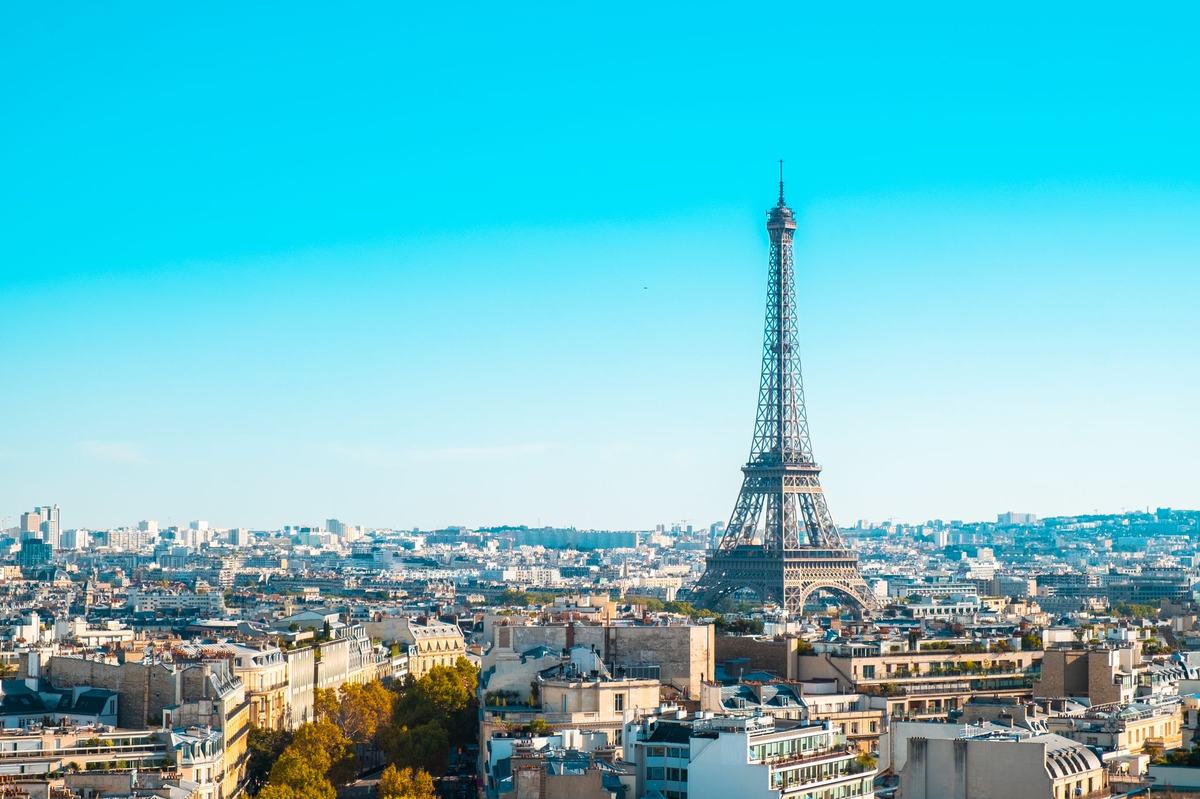
- Capital: Paris [1]
- Population: about 68.4 million [1]
- Area: 643,801 square kilometers (248,573 square miles), including overseas territories [1]
- Official language: French [1]
- Currency: Euro (EUR) [1]
- The world's most visited country, drawing roughly 100 million international tourists in 2023 [2]
I grew up thinking of France the way most American kids do, which is to say, almost entirely through the Eiffel Tower, croissants, and a vague sense that everyone there is somehow better dressed than I am. Then I started reading about it for this series and realized France is much weirder than the postcard version. It runs most of its electricity off nuclear reactors. It has more time zones than any other country on Earth. It legally protects the baguette. None of that fits on a fridge magnet.
Here's the thing about France. It's the largest country in the European Union by area, with five different climate zones inside its borders, and territory scattered from the Caribbean to the South Pacific to a slice of South America. The metropolitan part, the hexagon-shaped bit attached to Europe, is what most people picture. But France has so much overseas land that the sun never sets on it. That's not poetry. It's a literal statement about its twelve time zones.
The Most Visited Country on Earth
For more than three decades running, France has been the world's number one tourist destination. Roughly 100 million international visitors arrived in 2023, more than the population of the country itself [2]. To put that in scale, the United States, which is more than fourteen times larger by area, comes in second. France gets more tourists than Spain, Italy, and Greece combined in some years.
Paris obviously does a lot of the heavy lifting. The Louvre alone draws around 9 million visitors a year, making it the most visited museum in the world. But the numbers go up because France is dense with things people travel for. The Côte d'Azur. Provence. Normandy beaches. The châteaux of the Loire Valley. Mont Saint-Michel. The Alps and the Pyrenees, where the same country offers world-class skiing and Mediterranean beaches within a single afternoon's drive. Back home in Montana, you can drive eight hours and still be in Montana. In France you can drive eight hours and pass through six distinct cuisines.
Nuclear Power, Bread, and Other National Habits
Here's something that'll ruin the next geography quiz you take. About 70 percent of France's electricity comes from nuclear reactors [3]. That's the highest share of any country in the world. Fifty-six reactors spread across eighteen sites generate the bulk of the country's power, which means the average French household runs its lights, refrigerator, and electric kettle on fission. France exports so much surplus nuclear electricity that it's typically the largest net exporter of power in the world.
It started in the 1970s, after the oil shocks, when France looked around and decided it didn't want to be at the mercy of imported fuel. The government committed to a massive build-out of reactors, and forty years later, the country has cheaper electricity and lower per-capita carbon emissions than most of its European neighbors. Germany went the opposite direction. France kept building.
The other thing France does at scale is bread. The country produces and consumes around 10 billion baguettes a year. That works out to roughly 320 baguettes consumed per second across the country. The traditional baguette is so culturally important that UNESCO added "the artisanal know-how and culture of baguette bread" to its Intangible Cultural Heritage list in 2022 [4]. There's a 1993 French law called the décret pain that defines exactly what a traditional baguette is: flour, water, salt, yeast, kneaded and baked on the premises. No additives. No freezing the dough. The state literally has an opinion on your sandwich.
The Country with Twelve Time Zones
Most people, if asked which country has the most time zones, would guess Russia. Russia has eleven. France has twelve [5]. This sounds like a trick, and in a way it is. France keeps that count because it includes its overseas departments and territories, the places people forget exist when they think about France.
French Guiana is in South America, sharing a border with Brazil. Réunion and Mayotte are in the Indian Ocean. Martinique, Guadeloupe, and Saint Martin are in the Caribbean. French Polynesia is most of a Pacific Ocean's worth of small islands. New Caledonia is closer to Australia than to Paris. All of these places use the euro, vote in French elections, and are full legal parts of France. The European Union's border extends into the Amazon rainforest because of French Guiana, which is also where the European Space Agency launches its rockets. The reason Ariane rockets lift off from a jungle near the equator is that it's still technically France.
More Cheese Than Days in the Year
President Charles de Gaulle once asked how anyone could govern a country with 246 different cheeses. He was lowballing. The current count, depending on how you slice it, is somewhere between 1,200 and 1,600 distinct French cheeses [6]. Roquefort, Camembert, Brie, Comté, Reblochon, Beaufort, Munster, Cantal, Crottin de Chavignol. About fifty of them have AOP status, which is a European protected-origin label that essentially says: it can only be called this if it was made here, with this milk, in this exact way.
I find this part charming and slightly daunting. There's a French saying that you could eat a different cheese every day of the year and still not finish the country's catalog. Cheese is so embedded in daily eating that it traditionally gets its own course at dinner, served before dessert, with bread and wine. And nobody talks about this, but France produces about 1.9 million tons of cheese a year, second only to the United States in absolute volume, though the US gets there with much less variety.
A Country That Invented Modern Cinema, Then the Metric System
The Lumière brothers showed the first publicly screened motion picture in Paris in December 1895. France basically invented commercial cinema, which is why the most prestigious film festival on Earth happens every May in Cannes. The country still subsidizes its film industry heavily, which is part of why French cinema remains a real cultural force rather than a footnote.
Before that, France gave the world the metric system. After the 1789 revolution, the new government decided the patchwork of regional weights and measures had to go, and a commission of scientists produced a unified decimal system based on the size of the Earth. The meter was originally defined as one ten-millionth of the distance from the equator to the North Pole, measured along the meridian running through Paris. The kilogram was a cube of water at a specific temperature. The system spread, and now every country on Earth except the United States, Liberia, and Myanmar uses it. France also runs the International Bureau of Weights and Measures, in a small town just outside Paris, which still officially defines the second, the meter, and the kilogram.
The Republic That Keeps Reinventing Itself
France is on its Fifth Republic, which means the current constitutional structure dates only to 1958. The country went through a monarchy, a revolution, an empire under Napoleon, a restored monarchy, another revolution, another empire under Napoleon's nephew, three previous republics, a Nazi occupation, and a brief crisis in Algeria before settling into what it has now. Charles de Gaulle wrote the current constitution to give the president real power, which is why the French presidency is one of the strongest in any democracy.
Despite all that political churn, France has been continuously inhabited for tens of thousands of years. The Lascaux cave paintings in the Dordogne are around 17,000 years old, some of the most sophisticated prehistoric art ever found. The country sits on a deep, deep layer of human history. You can stand in a vineyard in Burgundy that's been producing wine, more or less continuously, since the Romans planted it two thousand years ago. That kind of continuity is hard to imagine from a country like the United States, where two hundred years feels like a long time.
Frequently Asked Questions
What is the capital of France?
The capital of France is Paris, located in the north-central part of the country along the Seine River. It's the political, economic, and cultural center, home to about 2.1 million people in the city proper and around 11 million in the wider metropolitan area.
Why is France the most visited country in the world?
France draws roughly 100 million international tourists a year, more than any other country. Visitors come for Paris, the Mediterranean coast, alpine skiing, wine regions, châteaux, and a high concentration of cultural sites within easy travel distance of one another.
What percentage of France's electricity comes from nuclear power?
About 70 percent of France's electricity is generated by nuclear reactors, the highest share of any country in the world. Fifty-six reactors at eighteen sites supply the bulk of national demand and make France a major net exporter of electricity in Europe.
How many cheeses does France produce?
France produces somewhere between 1,200 and 1,600 distinct cheeses, depending on the count. About fifty hold AOP protected-origin status. Cheese is so central to French eating that it traditionally gets its own course at dinner, served between the main dish and dessert.
How many time zones does France have?
France spans twelve time zones, more than any other country. The count includes overseas departments and territories such as French Guiana, Réunion, Martinique, French Polynesia, and New Caledonia, all of which are full constitutional parts of France.
Sources
- France Country Profile - CIA World Factbook
- International Tourism Highlights - UN Tourism (UNWTO)
- Nuclear Power in France - World Nuclear Association
- Artisanal know-how and culture of baguette bread - UNESCO
- Overseas France - French Government Portal
- French Cheese and AOP designation - CNIEL (French Dairy Board)