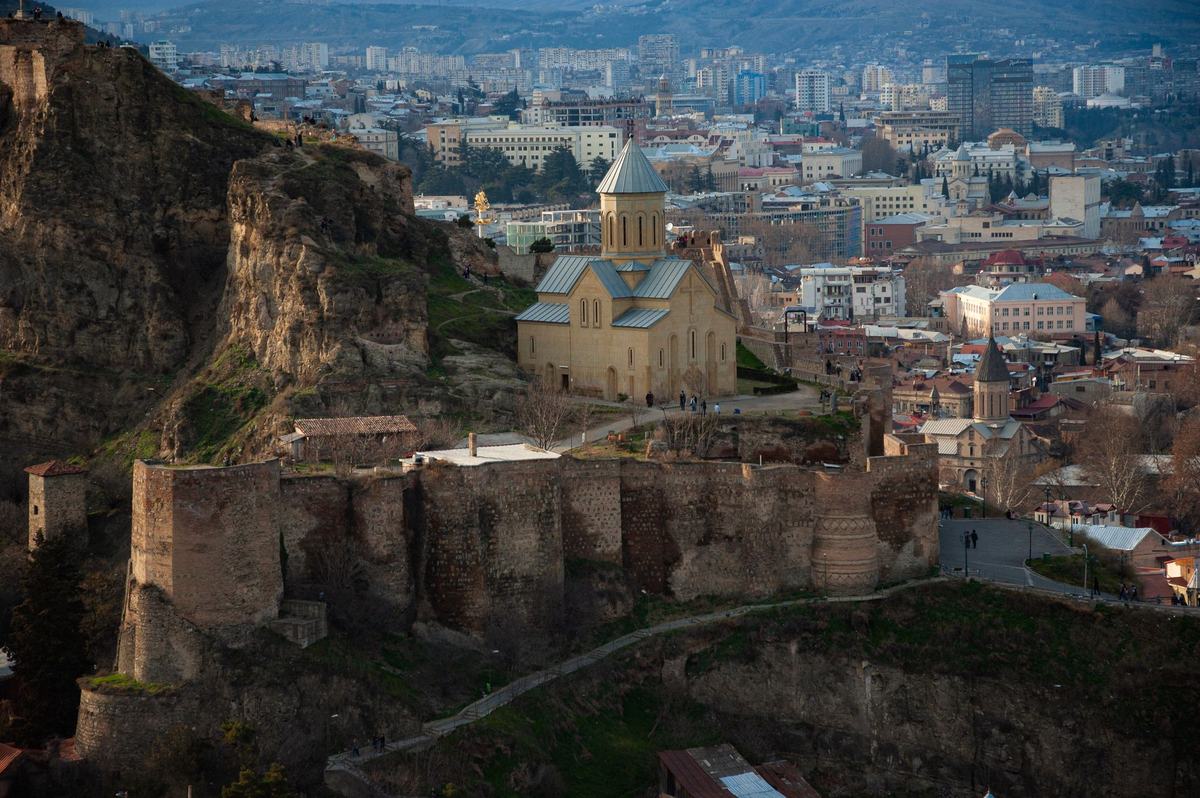
- Capital: Tbilisi [1]
- Population: about 3.7 million [2]
- Area: 69,700 square kilometers [1]
- Official language: Georgian [1]
- Currency: Lari (GEL)
- Distinguishing claim: home to the earliest known winemaking, dated to roughly 6,000 BCE, predating every other wine tradition on record [3]
I grew up thinking wine came from France and Italy and maybe California, and that was the end of the story. Turns out the oldest wine residue ever found, scraped out of clay jars in a Neolithic village south of Tbilisi, is about 8,000 years old. Georgians were fermenting grapes before the Pyramids existed. Before writing. Before most of the things we think of as civilization. And they have not stopped since.
Georgia sits where the Caucasus Mountains hit the Black Sea, wedged between Russia, Turkey, Armenia, and Azerbaijan. It is small, a little smaller than South Carolina, with a population about the size of Connecticut. But it has its own alphabet, its own language family, its own polyphonic singing tradition that UNESCO put on its first heritage list, and a cuisine that anyone who has eaten it will defend in conversation for an unreasonable length of time. Here's the thing. Almost nobody in America knows any of this.
A Wine Tradition Older Than Writing
The wine claim is not a marketing stunt. In 2017, archaeologists working at two sites near Tbilisi published chemical evidence of grape wine residue in clay jars dating to about 6000 BCE, which is the earliest such evidence found anywhere on Earth [3]. The technique these early Georgians used, fermenting grapes in large clay vessels called qvevri buried underground, is still in use today. UNESCO recognized the qvevri method as Intangible Cultural Heritage in 2013 [4].
A traditional Georgian table, the supra, is built around wine the way an American Thanksgiving is built around turkey. A toastmaster, the tamada, makes long elaborate toasts that everyone is expected to listen to and respond to with their glass. There are toasts for ancestors, for children, for peace, for the dead, for women, for the host. It is not unusual to sit at a supra for five or six hours and drink wine through every minute of it.
An Alphabet Like Nothing Else
Georgian is one of only fourteen scripts in active use in the world today, and it does not look like anything else. The letters are loops and curls that resemble musical notation more than an alphabet. UNESCO added the three historic forms of Georgian script to its Intangible Cultural Heritage list in 2016 [5]. The current form, Mkhedruli, dates back roughly a thousand years.
The language itself is not related to Russian, Turkish, Persian, or any of the neighbors. It belongs to a small family called Kartvelian that has no proven relatives outside the Caucasus. Georgians have been speaking some version of this for at least three thousand years, which is part of why national identity here runs so deep. The language is the country, and the country is the language.
Mountains, Towers, and the Highest Villages in Europe
Most of Georgia is mountains. The Greater Caucasus runs along the northern border with Russia, and the peaks here are some of the highest in Europe, with Mount Shkhara at 5,193 meters [6]. In the upper valleys of Svaneti, a region cut off by snow for half the year, medieval stone defensive towers still rise out of the villages. These towers were built between the 9th and 13th centuries to protect families from raiders and avalanches, and many are still standing and still lived in. UNESCO designated the upper Svaneti landscape a World Heritage Site in 1996.
Ushguli, a cluster of four villages in Svaneti, sits at about 2,200 meters and is among the highest continuously inhabited settlements in Europe. The road in is bad enough that for most of the year you cannot get there easily, which is why the towers, the language, and the local Svan culture have survived intact. Back home in Montana, the small towns I grew up around felt remote. Ushguli is on another scale entirely.
Cuisine That Hits Above Its Weight
Khachapuri is the dish people remember. A boat-shaped bread filled with cheese and finished with a runny egg and a knob of butter, it is the kind of food you eat once and then think about for a week. Khinkali, soup-filled dumplings pinched at the top into a thick knot, are the other obvious entry point. You hold them by the knot, bite through the side, slurp the broth, then eat the rest. The knot itself is the only part you leave on the plate.
What surprised me was how much vegetable cooking there is. Pkhali is finely chopped greens like spinach or beetroot leaves bound with walnut paste and pomegranate seeds. Lobio is a slow-cooked bean stew that you scoop up with cornbread called mchadi. Walnuts show up everywhere, in sauces, in stuffed eggplant rolls, in salads. It is a cuisine that grew up where the mountains and the Black Sea and the influence of Persian and Ottoman cooking all overlap, and the result tastes like nowhere else.
A Country at a Crossroads
Georgia became an independent kingdom in the 11th century, was absorbed by the Russian Empire in 1801, became a Soviet republic in 1921, and declared independence again in 1991 [1]. Joseph Stalin was born here, in the town of Gori, which now has a museum about him that locals have complicated feelings about. The country fought a brief war with Russia in 2008, and roughly twenty percent of its territory, the breakaway regions of Abkhazia and South Ossetia, remains outside of Tbilisi's control.
Tbilisi, the capital, is built around natural sulfur hot springs that have been drawing visitors since the 5th century. The old town is a tangle of wooden balconies, brick churches, and bathhouses topped with little domes. Modern glass buildings rise behind them. The city in 2026 feels like a place caught mid-pivot, looking west and east at the same time, which is something Georgia has been doing for most of its history.
Frequently Asked Questions
What is Georgia the country known for?
Georgia is known as the birthplace of wine, with winemaking traditions dating back about 8,000 years. It is also known for its own alphabet, the Caucasus mountains, polyphonic singing, and a distinctive cuisine featuring khachapuri and khinkali.
Where is the country of Georgia located?
The country of Georgia sits at the eastern edge of the Black Sea, between Russia to the north and Turkey, Armenia, and Azerbaijan to the south. It is in the South Caucasus region, at the seam of Europe and Asia.
Is Georgia in Europe or Asia?
Georgia is geographically transcontinental, with most of its territory in the South Caucasus near the boundary between Europe and Asia. Politically and culturally, Georgia identifies with Europe and has applied for European Union membership.
What language do Georgians speak?
Georgians speak Georgian, a language with no proven relatives outside the small Kartvelian family of the Caucasus. It uses its own unique alphabet, Mkhedruli, which is unrelated to Latin, Cyrillic, or Greek scripts.